Scientists Discover a New Protein–RNA Interaction That Could Open the Door to Treating Fibrosis
Researchers at Florida State University have uncovered a previously unknown way in which a human protein interacts with RNA, a finding that could have major implications for treating fibrosis, a condition marked by excessive tissue scarring. Fibrosis plays a role in many serious diseases affecting organs such as the lungs, liver, heart, and skin, and there are currently no drugs that can reliably stop or reverse its progression.
The discovery centers on a protein called LARP6 (La-related protein 6). This protein is involved in controlling how the body produces type I collagen, one of the most abundant structural proteins in humans and a key contributor to fibrotic disease when produced in excess. By revealing how LARP6 binds to RNA at a molecular level, the study offers scientists a clearer target for future anti-fibrotic therapies.
The research was carried out by a team from FSU’s Institute of Molecular Biophysics and the Department of Chemistry and Biochemistry, with close collaboration from fibrosis experts in the university’s College of Medicine. Their findings were published in the peer-reviewed journal Nucleic Acids Research in 2025.
Understanding Why Collagen Control Matters
To understand the importance of this discovery, it helps to look at collagen itself. Type I collagen is a critical building block for tissues such as skin, tendons, bones, and connective tissue. Under normal conditions, the body carefully regulates how much collagen it produces. However, in fibrotic diseases, this balance breaks down.
When collagen production becomes uncontrolled, it leads to thickened, stiff scar tissue that gradually replaces healthy tissue. This scarring can impair organ function and, over time, become life-threatening. Fibrosis is a major factor in conditions like pulmonary fibrosis, liver cirrhosis, and certain heart diseases.
LARP6 has long been known to influence collagen production, but exactly how it recognizes and binds RNA had remained unclear until now.
A Closer Look at LARP6 and RNA Binding
LARP6 belongs to a large family of proteins known as La-related proteins (LARPs). These proteins are found in plants and animals and are responsible for binding RNA molecules, which carry genetic instructions and help regulate how proteins are made.
Among the five main human LARPs, LARP6 is unique because of its direct role in collagen biosynthesis. Despite its importance, it has received far less attention than other members of the family. This new study changes that by providing the first detailed picture of how LARP6 interacts with RNA at the molecular level.
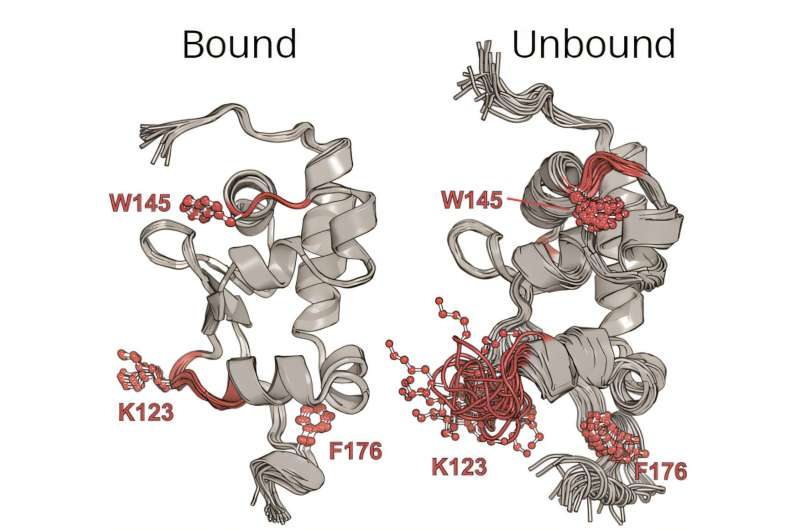
The researchers discovered that LARP6 uses a previously unrecognized RNA-binding region. Rather than relying on the classical RNA-binding methods seen in similar proteins, LARP6 employs a noncanonical binding mechanism. This new binding site allows the protein to recognize its RNA target with remarkable precision, much like two puzzle pieces locking together.
When LARP6 binds to RNA, the interaction forms a tight, water-repelling core. This structural change makes the protein more rigid and stable, a key insight that explains why LARP6 is unstable on its own but becomes functional once it attaches to RNA.
How the Discovery Was Made
Studying LARP6 turned out to be technically challenging. The protein is inherently unstable unless it is bound to RNA, which makes it difficult to observe using many standard structural biology techniques.
The research team initially explored methods such as X-ray crystallography, but these approaches were not well suited to capturing the protein in its natural, functional state. They ultimately turned to nuclear magnetic resonance (NMR) spectroscopy, a technique that allows scientists to study molecules in solution under conditions that closely resemble those inside the human body.
NMR spectroscopy proved to be the ideal tool. It allowed the researchers to observe not only the structure of the LARP6–RNA complex but also its dynamic behavior, including how different regions of the protein move and stabilize upon binding RNA. This approach provided critical insights into how the interaction directly influences collagen production.
Why This Matters for Fibrosis Treatment
One of the most important aspects of this discovery is its potential medical relevance. The researchers found that the way LARP6 binds RNA is directly tied to the biosynthesis of type I collagen. This means that interfering with this interaction could, in theory, reduce excessive collagen production.
At present, treatments for fibrosis largely focus on managing symptoms or slowing disease progression, rather than addressing the root cause. Targeting the LARP6–RNA complex represents a completely new therapeutic strategy. Because the interaction is specific and structurally well-defined, it may be possible to design drugs that disrupt it without affecting other essential cellular processes.
This makes LARP6 an especially attractive target, as few proteins are so directly linked to collagen overproduction at the RNA level.
Broader Implications for RNA-Binding Proteins
Beyond fibrosis, this research contributes to a growing body of knowledge about RNA-binding proteins (RBPs). RBPs play crucial roles in gene regulation, protein synthesis, and cellular signaling, and they are increasingly recognized as key players in many diseases.
The discovery of a noncanonical RNA-binding mechanism in LARP6 suggests that many proteins may interact with RNA in ways that are still not fully understood. This opens the door to re-examining other RBPs that may have been overlooked or misunderstood due to assumptions about how RNA binding typically works.
What Comes Next
While the findings are promising, this research represents an early but critical step. Developing a drug that safely and effectively targets the LARP6–RNA interaction will require extensive follow-up studies, including cellular experiments, animal models, and eventually clinical trials.
Still, the work provides something that has long been missing in fibrosis research: a clear molecular target tied directly to collagen overproduction. For a disease area with limited treatment options, that alone is a significant breakthrough.
Research Reference
Noncanonical RNA binding of human La-related protein 6 – Nucleic Acids Research (2025)
https://academic.oup.com/nar/article/53/14/gkaf682