Scientists at the American Museum of Natural History Describe More Than 70 New Species in 2025
Scientists from the American Museum of Natural History (AMNH) have had a remarkably productive year. In 2025, researchers affiliated with the museum formally described more than 70 previously unknown species, spanning an extraordinary range of life forms—from feathered dinosaurs and mammals to fish, insects, marine invertebrates, and even a newly recognized mineral.
These discoveries were not limited to a single expedition or ecosystem. Instead, they reflect decades of accumulated scientific work, combining modern field research, reanalysis of historical specimens, and advances in imaging, genetics, and fossil interpretation. Together, they offer a vivid reminder that Earth’s biodiversity—past and present—is still far from fully documented.
A Wide Spectrum of Life Forms
The newly described species represent nearly every major branch of life studied by zoologists and paleontologists. Among them are dinosaurs, mammals, fishes, reptiles, arachnids, insects, marine animals, and one mineral species. Some of these organisms lived millions of years ago and are known only through fossils, while others still inhabit rivers, forests, caves, and mountains today.
What makes this achievement particularly notable is that many of these species were not discovered during brand-new expeditions. Several were identified by revisiting museum specimens collected decades ago, some as early as the 1930s. Advances in technology and fresh scientific perspectives allowed researchers to recognize unique traits that had previously gone unnoticed.
New Marine and Fossil Discoveries
One standout marine discovery is Endolobactis simoesii, a new genus and species of sea anemone found along the Atlantic coast of Mexico. This anemone is notable for its frond-like projections on its lobes, a feature not seen in closely related species. Its discovery raises the number of known sea anemone species in this region to 24, improving scientists’ understanding of marine biodiversity in the western Atlantic.
Another fossil highlight is Anticosticrinus natiscotecensis, a new genus and species of crinoid, an ancient group of marine animals related to starfish and sea urchins. Discovered on Anticosti Island in Quebec, this fossil species shows a distinctive arrangement of skeletal plates, offering new insights into early crinoid evolution.
Insects Preserved in Time
Insects accounted for a large share of the new species. Among the most unusual are two species of fruit flies whose males have evolved hard, jaw-like mouthparts—a rare feature among flies. These structures are thought to help males grasp females during courtship. Remarkably, both species are known from single specimens collected in the Philippines in the 1930s, underscoring the value of long-preserved collections.
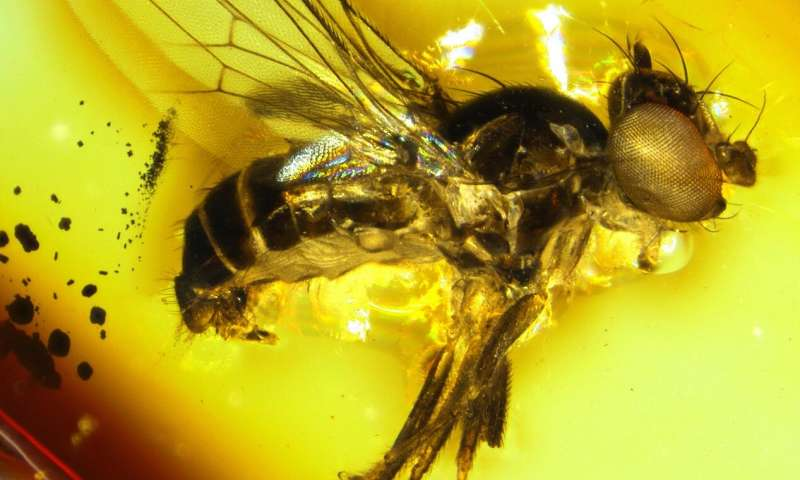
Researchers also described four species of “sap” flies trapped in 17-million-year-old amber from the Dominican Republic. These fossils captured the flies while tree resin was still soft. Their presence reveals unexpected biogeographic connections between the Caribbean and North America, rather than Central or South America, which is more commonly seen in the fossil record.
In total, dozens of newly described insects—many of them bees—were added to scientific literature this year, significantly expanding knowledge of insect diversity both past and present.
Arachnids With Medical and Ecological Importance
Four newly described arachnid species stood out for their ecological and medical relevance. One is Hemiscorpius jiroftensis, a scorpion from Iran whose venom is being studied for potential pharmaceutical applications. Others include a giant vinegaroon (whip scorpion) from Mexico, a short-tailed whip scorpion from the Venezuelan Amazon, and a cave-dwelling hooded tick-spider adapted to life in total darkness.
These discoveries highlight how little is still known about arachnid diversity, especially in caves and remote habitats.
Mammals From the High Andes
Among the mammal discoveries is Marmosa chachapoya, a small mouse opossum with an unusually long nose and tail. It was found in Río Abiseo National Park in the Peruvian Andes, an area once inhabited by the pre-Columbian Chachapoya culture, which inspired the species’ name.
This opossum is particularly notable because few species in its group are known from such high elevations, suggesting unique adaptations to cooler, mountainous environments.
Newly Recognized Fish Species
Fish discoveries were equally diverse. Scientists described Paretroplus risengi, a cichlid from northwestern Madagascar distinguished by its unique breeding coloration. Although discovered more than 20 years ago, it was only formally recognized this year.
Two new species of suckermouth catfish, Chiloglanis kinsuka and Chiloglanis wagenia, were identified from rapids along the Congo River. Despite being separated by nearly 1,600 kilometers, the two are closely related and highly adapted to fast-flowing water.
Another fish, Supradiscus varidiscus, was collected in Vietnam’s highlands 25 years ago and sat unstudied until recently. It is the first species of its genus recorded in Vietnam.
Researchers also described Labeo niariensis, a large-eyed carp relative from the Republic of the Congo that had long been misidentified.
Feathered Dinosaurs and Fossil Diets
Two spectacular dinosaur discoveries came from Early Cretaceous fossils in China, dating back about 125 million years. Scientists identified Sinosauropteryx lingyuanensis, once thought to be a primitive bird, and Huadanosaurus sinensis, a newly named genus and species.
What makes Huadanosaurus especially remarkable is that it was found with two mammal skeletons preserved inside its abdomen, providing rare direct evidence of its last meal and offering valuable clues about dinosaur diets and predator–prey relationships.
A New Mineral Joins the List
In an unusual addition to a list dominated by living and fossil organisms, scientists also described a new mineral species, Lucasite-(La). Discovered within volcanic rock in Russia, the mineral was officially approved by the International Mineralogical Association in 2025, with its type specimen now housed at the museum.
Why These Discoveries Matter
Beyond the individual species, this body of work highlights the enduring importance of natural history museums. Specimens collected generations ago continue to yield discoveries when revisited with modern tools. At the same time, new fieldwork shows that many regions of the world remain underexplored.
Together, these findings reinforce a simple but powerful message: Earth’s biodiversity—past and present—is far richer than we currently understand, and careful scientific study continues to reveal surprises year after year.
Research References:
https://academic.oup.com/nsr/article/early/2024/xx/xxxxx
https://www.mapress.com/zt/article/view/zootaxa.xxxx.x.x
https://bioone.org/journals/journal-of-paleontology/volume-xx/issue-x/xxxx
https://onlinelibrary.wiley.com/doi/xx.xxxx/jfb.xxxxx
https://www.schweizerbart.de/papers/ejm/detail/xx/xxxxx