A Tiny Genetic Pause May Have Helped Complex Life Evolve
Scientists have uncovered compelling new evidence that a brief pause during gene activity—something so small it happens at the molecular level—may have played a major role in the evolution of complex life forms, including humans. This discovery adds an important layer to our understanding of how gene regulation became more sophisticated as life evolved from simple single-celled organisms into complex multicellular animals.
The research focuses on a process known as promoter-proximal pausing, a short halt that occurs right after a gene begins to be transcribed. While this pause lasts only minutes, it may have had enormous evolutionary consequences.
What Is Promoter-Proximal Pausing?
To understand the significance of this finding, it helps to first understand how genes are turned on. When a gene is activated, an enzyme called RNA polymerase II starts copying DNA into RNA, a process known as transcription. For a long time, scientists assumed that once transcription began, the enzyme simply continued smoothly along the gene.
However, promoter-proximal pausing shows that this isn’t always the case.
Shortly after RNA polymerase II starts its job—usually after copying 20 to 60 nucleotides—it often stops and waits. This pause can last anywhere from one to ten minutes, which is a surprisingly long time in molecular biology. During this pause, the cell can decide whether to continue, slow down, or fine-tune how strongly the gene is expressed.
This pause acts like a regulatory checkpoint, giving cells greater control over when and how genes are activated.
Humans Have It, Yeast Mostly Doesn’t
One of the most interesting aspects of promoter-proximal pausing is how unevenly it appears across life forms.
Humans have it. So do animals like fruit flies (Drosophila). But common laboratory yeast largely do not.
Early studies of gene transcription focused heavily on yeast, which led many scientists to believe that this pausing step was either rare or unimportant. That view began to change when researchers found clear evidence of promoter-proximal pausing in animal cells, including humans.
This raised an intriguing evolutionary question: When did this pause evolve, and why?
Tracking the Evolution of the Pause Across Life
To answer that question, researchers examined organisms spanning the entire tree of life, from bacteria and single-celled eukaryotes to plants and animals. They used a powerful technique called PRO-seq (Precision Run-On sequencing), which allows scientists to map exactly where RNA polymerase II is located on genes at a given moment.
What they found was striking.
Simple organisms already show a weak and short-lived version of pausing. In these species, RNA polymerase may slow down near the start of genes, but the pause is brief and poorly defined.
In contrast, animals display a longer, more precisely positioned pause. Over evolutionary time, this pause became stronger, more stable, and more tightly regulated—suggesting that it was refined as life became more complex.
The Role of the NELF Complex
A major reason for this evolutionary refinement appears to be the emergence of a protein complex called Negative Elongation Factor, or NELF.
NELF is made up of four subunits, and these subunits did not all appear at once during evolution. Two core subunits existed in many early eukaryotes. The remaining two emerged later, particularly in lineages leading to multicellular animals.
As these additional subunits appeared, the pause became longer and more controllable. This allowed cells to regulate transcription with far greater precision.
In simple terms, NELF helps RNA polymerase stay paused until the cell gives the green light to proceed.
Why This Extra Control Matters
Fine control over gene expression is essential for multicellular life. Different cell types—such as neurons, muscle cells, and immune cells—need to activate the same genes at different times and levels.
Promoter-proximal pausing provides that control.
Researchers liken this system to adding knobs on a stereo, allowing cells to fine-tune the “volume” of gene activity rather than just switching genes on or off. This level of precision would have been especially important as early animals evolved specialized tissues and complex developmental programs.
What Happens When NELF Is Removed?
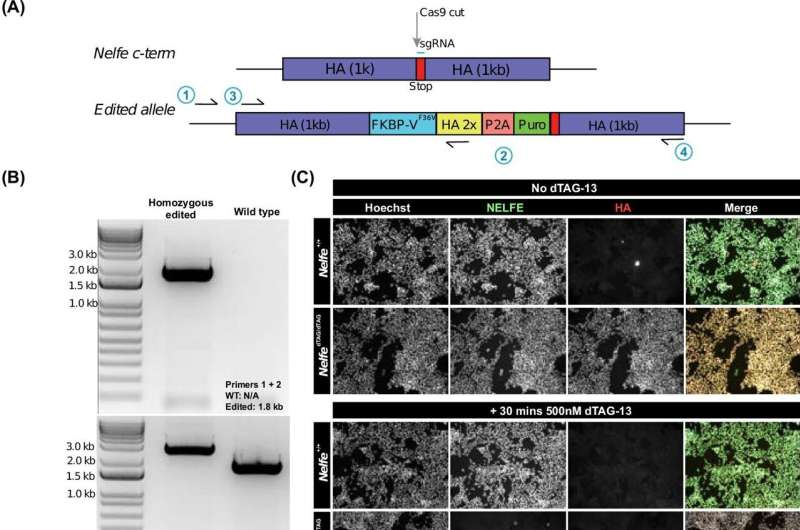
To test how important NELF really is, scientists experimentally depleted two NELF subunits in mouse cells, working with collaborators at the Memorial Sloan Kettering Cancer Center.
Without these regulatory proteins, RNA polymerase II raced ahead too quickly along genes. The consequences were clear:
- Many genes failed to activate properly
- Cells showed a weakened response to heat stress, a condition that normally triggers a strong transcriptional response
- Key heat shock genes, normally controlled by the transcription factor HSF, were not upregulated to the same extent
This demonstrated that promoter-proximal pausing is not just a theoretical concept—it plays a critical role in real-world cellular responses.
A Key Step Toward Multicellular Life
The findings support the idea that promoter-proximal pausing became an important evolutionary innovation during the rise of multicellular animals.
As organisms grew more complex, they needed better ways to coordinate gene expression across different cell types and developmental stages. The evolution of NELF proteins and stabilized pausing provided exactly that.
This added layer of control may have helped prevent transcriptional chaos while allowing new regulatory strategies to emerge.
Implications for Human Health and Disease
Promoter-proximal pausing doesn’t just matter for evolution—it also matters for health.
Disruptions in transcription regulation are a hallmark of many diseases, including cancer. When the pausing mechanism fails or becomes misregulated, genes may turn on too strongly, too weakly, or at the wrong time.
Understanding how this pause works—and how it evolved—gives researchers a deeper framework for interpreting disease-related gene expression changes. Instead of seeing only which genes are altered, scientists can begin to understand why those changes occur.
Additional Contributors and Collaboration
The study was led by researchers at Cornell University, with contributions from faculty across multiple departments and institutions. Scientists from Weill Cornell Medicine, Cornell Engineering, and the College of Agriculture and Life Sciences all played key roles, alongside numerous doctoral students, postdoctoral researchers, and staff scientists.
This collaborative effort highlights how modern biological research increasingly depends on interdisciplinary expertise.
Why This Discovery Matters
At first glance, a short pause in gene transcription may seem insignificant. But this research shows that small molecular changes can have massive evolutionary consequences.
By adding a brief stop at the start of gene activity, cells gained a powerful new way to control when, where, and how genes are expressed. Over millions of years, that control may have helped pave the way for complex animals—and eventually humans.
Sometimes, evolution doesn’t move forward by speeding things up, but by learning when to pause.
Research paper:
https://www.nature.com/articles/s41594-025-01718-y