UC Riverside Scientists Build a DIY Fly-Powered System That Turns Food Waste Into Animal Feed and Fertilizer
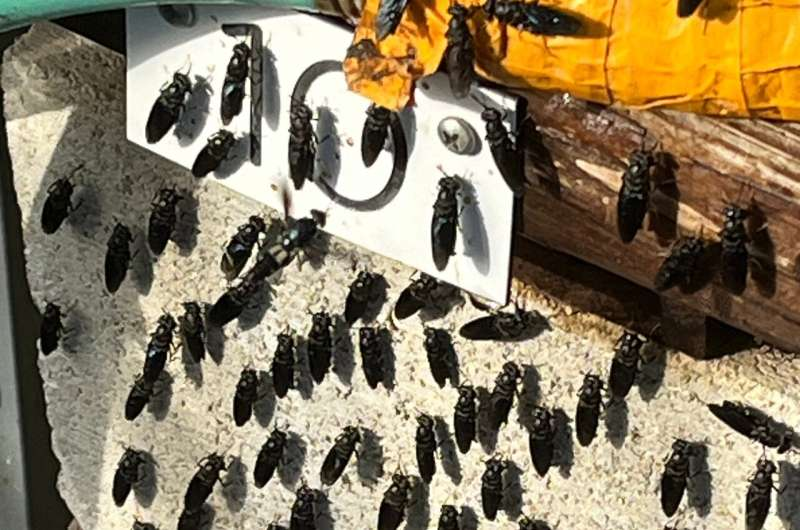
Scientists at the University of California, Riverside have developed a small-scale, do-it-yourself food waste recycling system that uses black soldier flies to convert discarded food into high-protein animal feed and nutrient-rich fertilizer. The project offers a practical and affordable alternative to large industrial waste-processing facilities, making it especially useful for farms, greenhouses, and even large households looking to manage food waste more sustainably.
Food waste is a massive global problem, contributing to landfill overload, greenhouse gas emissions, and lost resources. While large cities and companies already use insects like black soldier flies to process organic waste, those systems typically require heavy infrastructure, specialized staff, and high upfront investment. The UC Riverside team set out to show that the same biological process can work effectively at a much smaller scale.
A Simple System With Big Potential
The system developed by the researchers functions as a bioreactor designed specifically for black soldier fly larvae. Built using off-the-shelf materials, it is simple enough to be maintained by a single person without specialized training. Despite its modest size and low cost, the system is capable of continuously processing food waste and generating valuable outputs.
According to the research team, the setup can be installed right where food waste is produced, such as on a farm, in a greenhouse, or near a food service operation. In their own tests, the scientists ran the system using food waste collected from a university dining hall, demonstrating how easily it can integrate into existing waste streams.
The research behind the system was published in the journal Waste Management, where the authors подробно described the design, operation, and performance of the bioreactor over time.
How Black Soldier Flies Do the Heavy Lifting
Black soldier flies are particularly well suited for this kind of work. Their larvae are highly efficient at breaking down food scraps and agricultural waste, converting it into biomass at impressive rates. Unlike house flies, black soldier flies do not spread disease, are not pests in human environments, and generally avoid indoor spaces.
Inside the bioreactor, larvae feed on food waste and grow rapidly. As they mature, they naturally enter a prepupal stage where they seek out dry, elevated areas. The system takes advantage of this behavior by allowing the prepupae to self-harvest, crawling toward a collection point where they drop into a container without human intervention. This reduces labor and makes the system easier to manage on a daily basis.
With basic oversight, the researchers found the system to be remarkably stable. On average, it produced about one pound of larvae per square yard every day, a significant amount given the system’s size and simplicity.
High-Protein Feed and Valuable Fertilizer
One of the main outputs of the system is black soldier fly larvae, which are rich in protein and fats. These larvae are increasingly used as feed for poultry and fish, offering a more sustainable alternative to traditional feed ingredients like soy and fishmeal.
However, larvae are not the only useful product. The system also generates large quantities of frass, the term used for insect manure. In fact, frass is produced in even greater amounts than the larvae themselves. This byproduct is far from waste. It acts as a soil amendment that improves soil fertility and structure.
Beyond basic nutrients, frass contains fragments of insect exoskeletons left behind during molting. These fragments appear to play a role in stimulating natural plant defense mechanisms and enhancing soil microbial health. Researchers observed that plants grown in soil amended with frass often showed improved resistance to disease, suggesting that frass may function almost like a natural immune booster for plants.
Managing the System: What It Takes to Keep It Running
While the system is designed to be low-maintenance, it does require some basic monitoring. Climate control is one of the most important factors. The larvae thrive in warm conditions but must be kept below 100 degrees Fahrenheit. For this reason, the researchers recommend placing the bioreactor in a shaded area or inside a greenhouse.
Operators also need to occasionally add water and wood chips to maintain proper moisture levels and airflow. One of the key lessons from the study was the importance of monitoring pH levels. If the system becomes too wet, anaerobic bacteria can take over, causing the pH to drop and harming the larvae.
Fortunately, the researchers found that these problems are easy to correct. Small adjustments, such as reducing water input or adding more wood chips, can quickly restore balance and keep the system functioning smoothly.
Environmental and Economic Benefits
This insect-powered approach does more than manage waste. It actively creates resources. By mimicking natural ecosystems where insects consume organic matter and return nutrients to the soil, the system reconnects farming and food production with ecological cycles that modern agriculture often disrupts.
For farms, the benefits are both environmental and economic. Food waste is reduced on-site, lowering disposal costs. At the same time, farmers gain access to locally produced animal feed and fertilizer, reducing reliance on external inputs. The system demonstrates how waste streams can be transformed into productive assets rather than liabilities.
Why Black Soldier Flies Are Gaining Attention Worldwide
Beyond this specific project, black soldier flies are attracting growing interest globally. Researchers and companies are exploring their use in waste management, animal nutrition, and even circular economy models. Compared to traditional composting, black soldier fly systems can reduce odors, speed up waste processing, and potentially lower greenhouse gas emissions.
Their larvae grow quickly, require minimal water, and can thrive on a wide range of organic waste. These traits make them especially appealing in regions facing rising food waste and increasing pressure to develop sustainable agricultural practices.
A Practical Step Toward Local Sustainability
What makes the UC Riverside system stand out is its focus on accessibility. Instead of aiming for large-scale industrial adoption, the researchers deliberately designed something that individuals and small operations could realistically build and maintain. It shows that meaningful environmental solutions do not always require massive investments or complex technology.
By turning unwanted food scraps into useful products, the DIY black soldier fly bioreactor offers a clear example of how local, low-cost innovations can play a role in addressing global challenges like food waste and sustainable agriculture.
Research paper:
https://doi.org/10.1016/j.wasman.2025.115073