Diversifying US Midwest Farming Can Boost Stability, Profits, and Environmental Resilience
Diversification is often talked about as a way to reduce risk, but new research shows just how powerful it can be for farming in the US Midwest. A recent study published in PNAS Nexus finds that moving away from corn-heavy monocultures and toward more diverse cropping systems — especially those that include cover crops and livestock integration — can significantly improve farm stability, economic performance, and environmental outcomes across the region.
The research focuses on one of the most intensively farmed landscapes in the world: the US Midwest. Corn and soybean monocultures dominate millions of hectares, delivering high yields but also contributing to soil degradation, greenhouse gas emissions, water pollution, and vulnerability to climate extremes. This new study takes a detailed, data-driven look at what happens when those systems are diversified at scale.
A Large-Scale, Long-Term Look at Midwest Agriculture
The study was led by Mathieu Delandmeter, Bruno Basso, and colleagues, who used a validated crop simulation model to evaluate 18 different farm management scenarios. These scenarios were applied across approximately 46 million hectares of Midwestern farmland over a period of three decades, using high spatial resolution to capture regional differences in soil, climate, and management practices.
Instead of focusing on a single outcome like yield, the researchers evaluated multiple performance indicators at the same time. These included productivity, profitability, yield stability, resilience to climate extremes, soil carbon storage, nitrogen leaching, and greenhouse gas emissions. This multi-metric approach allowed the team to examine trade-offs and synergies that are often missed in simpler studies.
The systems analyzed ranged from traditional corn monoculture to more diversified rotations such as corn–soybean–wheat, both with and without cover crops, as well as integrated pasture–cattle systems.
Crop Diversity Improves Stability Even When Yields Drop
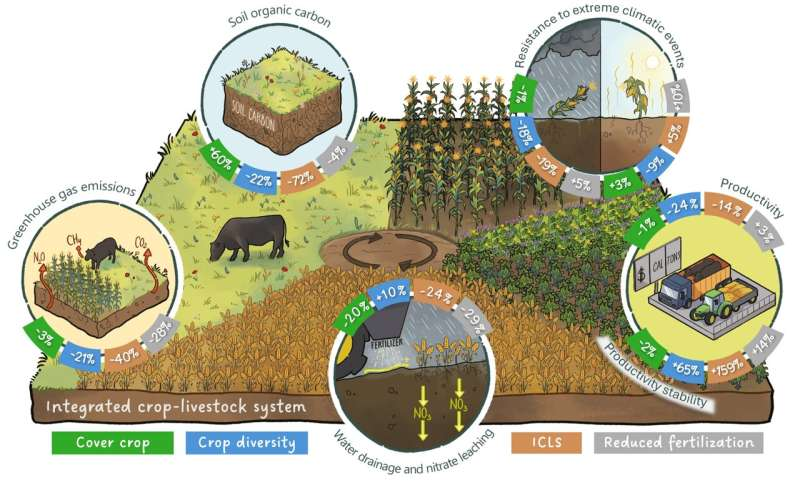
One of the clearest findings from the study is that diversifying crop rotations dramatically improves productivity stability. When farms shifted from corn monoculture to a corn–soybean–wheat rotation with cover crops, productivity stability increased by up to 65%. While total yields in diversified systems were sometimes lower than in monocultures, the year-to-year variability was much smaller.
This matters because stability is often more important to farmers than peak yields. Stable production reduces financial risk, improves planning, and makes farms more resilient to unpredictable weather patterns, which are becoming more common with climate change.
The study highlights that lower yields do not automatically mean worse outcomes. In many cases, diversified systems delivered more reliable economic returns over time, even when average production was reduced.
Cutting Fertilizer Use Brings Climate and Economic Benefits
Nitrogen fertilizer use is a major driver of agricultural greenhouse gas emissions, particularly nitrous oxide. The researchers found that reducing nitrogen fertilizer application by 25% had a surprisingly positive effect across multiple dimensions.
Greenhouse gas emissions dropped by 28%, and many systems shifted from being net carbon sources to net zero or even carbon sinks. At the same time, economic returns increased by around 3%, largely due to lower input costs. This shows that reducing fertilizer use does not necessarily hurt profitability and can actually improve it when managed carefully.
Lower nitrogen use also reduced nitrogen leaching, a key contributor to water pollution and hypoxic “dead zones” downstream, including in the Gulf of Mexico.
Cover Crops Play a Major Role in Soil Health
Cover crops emerged as a critical component of successful diversification strategies. Across the scenarios analyzed, cover crops increased soil organic carbon sequestration by an average of 55%. Higher soil carbon levels improve soil structure, water retention, and nutrient cycling, all of which support long-term productivity.
Healthier soils are also better able to withstand droughts and heavy rainfall, making them a key tool for climate adaptation. The study reinforces growing evidence that cover crops deliver long-term benefits that extend far beyond erosion control.
Livestock Integration Shows the Strongest Gains in Stability
Among all the systems evaluated, integrated pasture–cattle systems delivered some of the most striking results. Compared to corn monoculture, these systems showed 159% greater productivity stability and about 5% higher resistance to extreme droughts.
By integrating livestock, farms were able to recycle nutrients more efficiently, reduce reliance on synthetic inputs, and diversify income streams. Grazed pastures also contributed to improved soil health and carbon storage, while spreading risk across both crop and livestock markets.
The findings suggest that reintroducing livestock into cropping regions could play a major role in improving resilience, especially as climate variability increases.
Understanding the Trade-Offs
The authors are clear that diversification is not a silver bullet. More diverse systems often produced lower total yields, and some management approaches required more complexity and planning. However, the study shows that these trade-offs are often balanced by greater economic stability, lower environmental impacts, and improved resilience.
By analyzing multiple outcomes at once, the researchers were able to identify management combinations that perform well across economic and environmental metrics, rather than optimizing for a single goal.
Why This Research Matters for the Future of Farming
What sets this study apart is its scale and resolution. Modeling 46 million hectares over 30 years allows the findings to be relevant not just for individual farms, but for regional and national agricultural planning. The high-resolution approach also makes it possible to identify where specific practices are most effective, helping guide smarter, location-specific decisions.
The research supports the idea that agroecology and regenerative agriculture are not just niche concepts, but viable strategies for large-scale farming systems. It also highlights the importance of policies, markets, and infrastructure that support crop diversity and livestock integration.
Additional Context: Why Diversification Is Gaining Attention
Across the Midwest and beyond, farmers are facing increasing pressure from climate change, input price volatility, and environmental regulations. Diversification offers a way to spread risk and build resilience without sacrificing long-term profitability.
Practices like extended crop rotations, cover crops, and crop–livestock integration have been shown in other studies to improve biodiversity, reduce pest pressure, and enhance ecosystem services such as pollination and water filtration. However, adoption remains uneven due to economic barriers, limited markets for alternative crops, and lack of processing infrastructure.
Research like this provides strong quantitative evidence that diversification can pay off, helping justify investments and policy support that make these systems easier to adopt.
A Clear Message from the Data
The takeaway from this study is straightforward: diversifying Midwest farming systems improves stability, strengthens resilience, and delivers meaningful environmental benefits, even when some yields decline. By focusing on long-term performance rather than short-term maximization, diversified systems can support both farmers and ecosystems in a changing climate.
As weather extremes become more common and pressure mounts to reduce agriculture’s environmental footprint, this research offers a clear roadmap for how the Midwest can adapt — not by producing more of the same, but by producing smarter and more diverse systems.
Research paper:
https://academic.oup.com/pnasnexus/article/4/12/pgaf377/8392949