Scientists Discover Why Red Blood Cells Form Stripe Patterns and How This Could Improve Blood Disorder Diagnosis
Stripe patterns are everywhere in nature. We see them in the coats of zebras, in the whorls of our fingerprints, and even in the coordinated movement of birds and fish. For decades, scientists have wondered why such patterns emerge so consistently across very different systems. Now, new research suggests that part of the answer may be found in an unexpected place: human red blood cells.
A team of physicists from the University of Bristol in the UK and Saarland University in Germany has uncovered the true mechanism behind the mysterious stripe patterns that appear when red blood cells are spun in a centrifuge. Their findings, published in Proceedings of the National Academy of Sciences (PNAS) in 2025, not only challenge long-held assumptions in blood science but also open the door to new diagnostic possibilities for blood disorders.
What Are These Stripe Patterns in Blood?
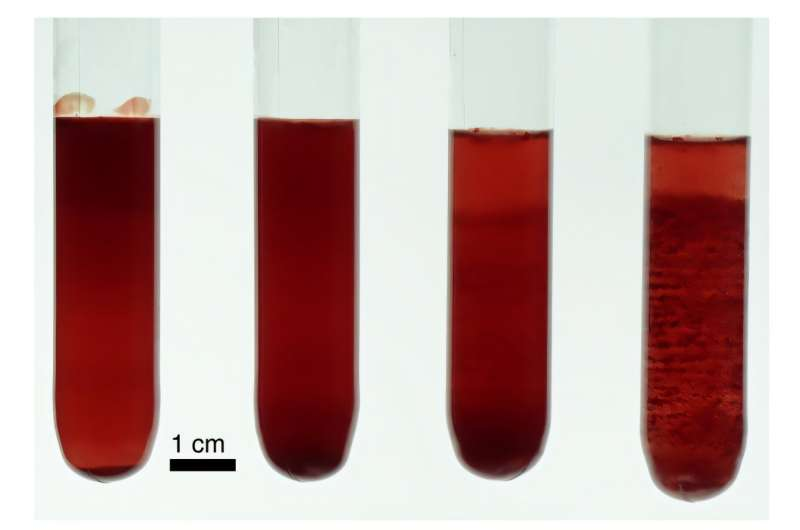
When red blood cells are placed into a tube containing a liquid whose density gradually increases from top to bottom and then spun in a centrifuge, something striking happens. Instead of settling into a smooth gradient, the cells arrange themselves into distinct horizontal bands or stripes. These appear as red layers rich in cells, separated by lighter or nearly white layers with fewer cells.
This phenomenon has been observed for many years in laboratory settings, but the explanation for why it happens has remained incomplete. Traditionally, scientists believed the stripes were mainly the result of differences in cell age.
Red blood cells live for about three months in the human body. As they age, they gradually lose water while retaining hemoglobin, which makes older cells denser than younger ones. Under centrifugation, denser cells sink lower, while lighter, younger cells remain closer to the top. This explanation made intuitive sense, but it did not fully account for the regular, repeating stripe pattern that researchers observed.
The Key Discovery: Cell Aggregation, Not Just Aging
The new study turns that assumption on its head. The researchers found that while age-related density differences do play a role, they are not the main driver of stripe formation. Instead, the dominant factor is cell aggregation, meaning the tendency of red blood cells to stick to one another.
In the experiments, red blood cells were mixed into a carefully prepared solution containing water, salts, and nanoparticles. This mixture creates a smooth density gradient when centrifuged. Each cell moves through the gradient until it reaches a position where its own average density matches that of the surrounding liquid, much like how a weather balloon stabilizes at a certain altitude in the atmosphere.
However, when huge numbers of cells are present—around one billion cells in a single tube—their interactions with neighboring cells become crucial. The study showed that the stripe pattern only emerges when many cells are confined together and allowed to interact.
When the researchers reduced the number of cells or disrupted their ability to adhere to one another, the stripes disappeared. Instead of forming bands, the cells distributed themselves evenly throughout the tube. This demonstrated that aggregation between cells, combined with gravity and buoyancy, is what creates the striped structure.
Why Gravity and Numbers Matter
Another important insight from the research is that stripe formation is a collective phenomenon. Individual red blood cells do not create stripes on their own. The pattern arises only when a very large population of cells behaves together under gravity in a confined space.
In this crowded environment, short-range attractive forces between cells compete with the tendency of each cell to float or sink based on its density. The balance between these forces leads to the emergence of regularly spaced stripes with a characteristic width.
This explains why stripe patterns are so robust and repeatable under the right conditions, and why they vanish when those conditions change.
Implications for Blood Disorder Diagnosis
One of the most exciting aspects of this discovery is its potential impact on medical diagnostics. Many blood disorders alter the shape, stiffness, or adhesive properties of red blood cells. These changes can affect how cells flow, cluster, and respond to forces like gravity.
For example, in sickle cell anemia, red blood cells become abnormally shaped and less flexible. Researchers have observed that blood samples from people with this condition produce different stripe patterns during centrifugation, but until now, there was no clear explanation for why.
By understanding that stripe formation is driven by aggregation and collective behavior, scientists can begin to interpret these altered patterns more meaningfully. In the future, this could lead to simple centrifuge-based tests that help identify or monitor blood disorders by analyzing how red blood cells cluster and arrange themselves.
A Window Into Pattern Formation in Nature
Beyond medicine, the study also offers insights into a much broader question: how patterns form in nature. To explore this, the researchers developed a mathematical model using Dynamic Density Functional Theory, a framework that predicts how particles move and organize over time based on their interactions and the surrounding environment.
Remarkably, equations similar to the ones used to describe red blood cell stripes also appear in models of zebra stripes, bird flocking, and fingerprint formation. In all these systems, complex patterns emerge from simple local rules—how each individual interacts with its immediate neighbors.
This suggests that the same fundamental physical principles may govern pattern formation across vastly different scales, from microscopic blood cells to entire animal populations.
Extra Insight: Why Red Blood Cell Aggregation Matters
Red blood cell aggregation is not just a laboratory curiosity. In the human body, aggregation affects blood viscosity, circulation, and oxygen delivery. Under normal conditions, red blood cells form temporary stacks known as rouleaux, especially at low flow rates.
Changes in aggregation behavior are associated with inflammation, infections, and cardiovascular diseases. Understanding how and why red blood cells stick together under different conditions is therefore crucial for both basic physiology and clinical medicine.
This new research adds an important piece to that puzzle by showing how aggregation can drive large-scale structural patterns, even in a simple experimental setup.
Why This Study Matters
In short, this work challenges a long-standing explanation and replaces it with a more complete and elegant one. Stripe patterns in centrifuged blood are not simply the result of aging cells separating by density. They are the outcome of collective cell behavior, driven by aggregation, gravity, and buoyancy.
By revealing this mechanism, the study bridges gaps between physics, biology, and medicine, while also shedding light on universal laws of pattern formation. What starts as an observation in a test tube ultimately helps us better understand both blood disorders and the natural world.
Research paper: https://www.pnas.org/doi/10.1073/pnas.2515704122