Rare Hall Effect Discovery Opens New Design Pathways for Advanced Spintronic Materials
Scientists at Ames National Laboratory in the United States, working closely with Indranil Das’s research group at the Saha Institute of Nuclear Physics in India, have uncovered an unusual electronic behavior that could significantly influence the future of spintronic materials. Their work focuses on a class of materials known as Heusler compounds, specifically one called Mn₂PdIn, and reveals a rare and highly valuable phenomenon: a strong anomalous Hall effect appearing in a material where it is least expected.
This discovery offers new insights into how researchers might design energy-efficient materials for next-generation computing and memory technologies, including devices inspired by how the human brain processes information.
Understanding Spintronics and Why It Matters
Traditional electronic devices rely entirely on the charge of electrons to operate. Spintronics, short for spin electronics, takes things a step further by also using an electron’s spin, a quantum property that carries magnetic information. By controlling both charge and spin, spintronic devices promise faster performance, lower power consumption, and new ways of storing data.
One of the most important effects in spintronics is the anomalous Hall effect (AHE). In simple terms, AHE allows scientists to electrically detect and manipulate spin-related signals inside a material. This makes it extremely useful for reading information in spin-based memory and logic devices.
Until now, strong anomalous Hall effects have typically been observed in clean, single-crystal materials that possess large magnetic moments. These materials are often difficult and expensive to produce at scale, which limits their practical use.
That is what makes the new findings around Mn₂PdIn especially intriguing.
What Makes Mn₂PdIn So Special
The compound at the center of this research, Mn₂PdIn, belongs to the family of Heusler alloys. These materials are well known in condensed matter physics because their magnetic and electronic properties can be finely tuned by adjusting their composition. Often, Heusler compounds display behaviors that none of their individual elements show on their own.
In this case, Mn₂PdIn surprised researchers by exhibiting a strong anomalous Hall effect despite having a very low net magnetic moment. Even more remarkably, the effect was observed in a polycrystalline sample, rather than a single crystal.
This combination is rare. Polycrystalline materials are made up of many small crystals rather than one perfectly ordered structure. They are much easier to manufacture, making them far more attractive for real-world applications. At the same time, a low magnetic moment means that less energy is required to manipulate electron spins, which directly translates into lower-power devices.
The Role of Fermi Surface Nesting
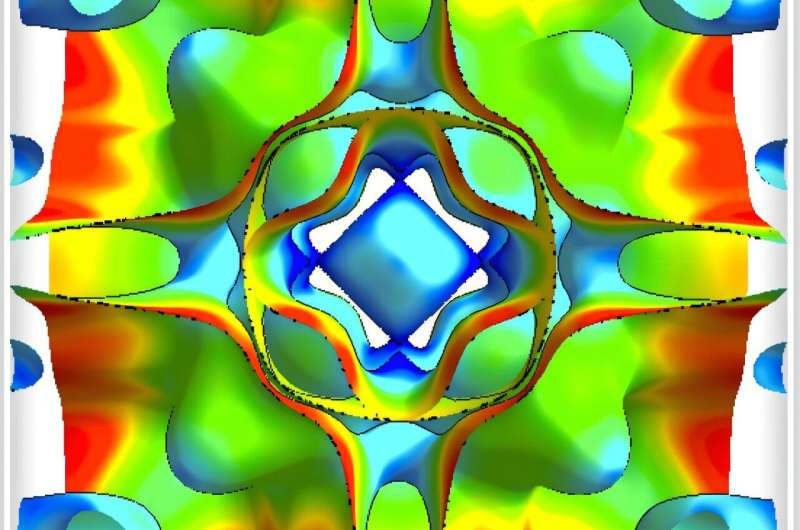
To understand why Mn₂PdIn behaves this way, the researchers looked closely at its electronic structure, particularly something known as Fermi surface nesting.
The Fermi surface describes how electrons are distributed in momentum space inside a solid. When certain sections of this surface align or “nest” with each other, electrons can reorganize themselves in unusual ways. This reorganization can give rise to unexpected physical effects.
In Mn₂PdIn, the team found that carefully tuned Fermi surface nesting was responsible for triggering the anomalous Hall effect. This nesting amplifies subtle electronic interactions, producing a strong Hall signal even though the material’s overall magnetism is weak.
Finding this kind of nesting in a transition-metal-based Heusler compound is uncommon, which is why the discovery is considered especially important.
Magnetic Frustration and Low-Moment Behavior
Another key feature of Mn₂PdIn is that it is magnetically frustrated. Magnetic frustration occurs when competing interactions prevent magnetic moments from aligning in a simple, orderly way. Instead of forming a straightforward ferromagnetic structure, the spins partially cancel each other out.
As a result, Mn₂PdIn ends up with a very small net magnetic moment, even though magnetic interactions are still present at the microscopic level. This internal complexity turns out to be an advantage, allowing strong spin-dependent transport effects like AHE without the energy costs associated with large magnetization.
Why Polycrystalline Materials Are a Big Deal
One of the standout aspects of this work is the demonstration of a strong anomalous Hall effect in a polycrystalline material. In laboratory research, single crystals are often preferred because their uniform structure makes experiments easier to interpret. However, single crystals are difficult to grow and impractical for large-scale manufacturing.
Polycrystalline materials, by contrast, are far easier to produce, shape, and integrate into devices. Showing that complex spintronic effects can survive in such materials removes a major barrier between fundamental research and industrial application.
This finding suggests that future spintronic components could be manufactured more economically, without sacrificing performance.
Implications for Future Spintronic Devices
The broader significance of this research lies in what it reveals about materials design. Instead of relying solely on high magnetization to achieve strong spintronic signals, scientists can now look toward electronic structure engineering, magnetic frustration, and Fermi surface effects.
Low-moment materials like Mn₂PdIn are particularly attractive for energy-efficient memory technologies, where reducing power consumption is critical. They are also relevant for emerging fields such as neuromorphic computing, which aims to mimic the efficiency and adaptability of the human brain.
By identifying the mechanisms behind the anomalous Hall effect in this system, the researchers have provided a roadmap for discovering or designing similar materials in the future.
Heusler Compounds and the Bigger Picture
Heusler alloys have long been a playground for discovering unusual physics. Over the years, they have been linked to phenomena such as half-metallicity, topological electronic states, and exotic magnetic orders. Their flexibility makes them ideal candidates for exploring new spintronic concepts.
The Mn₂PdIn study adds another layer to this picture, showing that even magnetically frustrated, low-moment Heusler compounds can host robust spin-dependent transport effects.
A Collaborative Scientific Effort
This work highlights the value of international collaboration. Expertise in magnetism, electronic structure calculations, and transport measurements all came together to build a complete understanding of the material. Contributions from early-career researchers also played an important role, underlining how complex discoveries often rely on diverse perspectives and skills.
Looking Ahead
The discovery of a rare anomalous Hall effect in Mn₂PdIn does more than highlight one interesting material. It reshapes how scientists think about the ingredients needed for practical spintronic systems. By focusing on electronic topology, Fermi surface design, and magnetic frustration, researchers may be able to unlock a whole new generation of low-power, high-performance devices.
As spintronics continues to move from the lab toward real-world technology, findings like this one provide both inspiration and concrete direction.
Research Paper:
https://doi.org/10.1002/adfm.202513056