Ultracold Atoms Observed Climbing a Quantum Staircase for the First Time
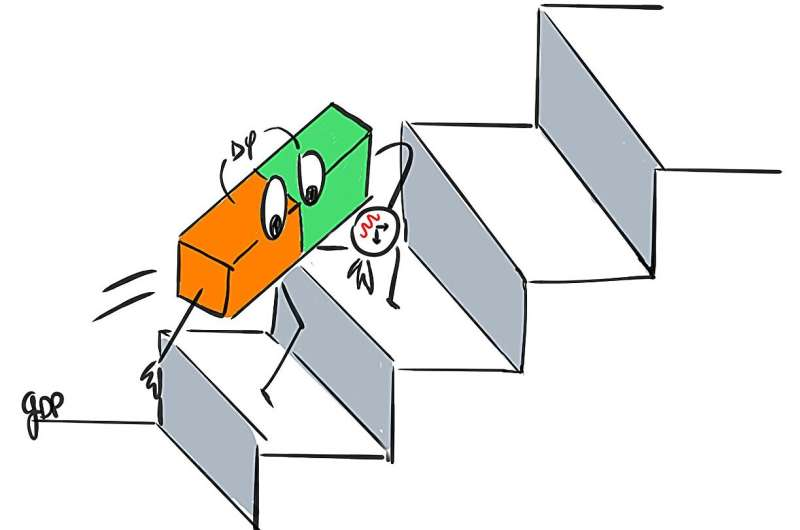
Scientists have achieved a major milestone in quantum physics by observing a famous quantum phenomenon, known as Shapiro steps, in a system made entirely of ultracold atoms. This effect, long known from superconducting electronics, has now been recreated using neutral atoms cooled to nearly absolute zero. The result not only confirms deep theoretical predictions but also opens new possibilities for atomtronics, quantum simulation, and precision quantum technologies.
At the heart of this discovery is an atomic Josephson junction, a structure inspired by superconducting Josephson junctions that are widely used in quantum sensors and quantum computers. In the new experiment, instead of electrons flowing through a solid-state device, researchers worked with clouds of atoms cooled to extremely low temperatures and separated by a barrier made of laser light.
What Are Shapiro Steps and Why They Matter
Shapiro steps are a striking quantum effect first observed in superconducting Josephson junctions. In those systems, when an alternating current is applied, the voltage across the junction does not increase smoothly. Instead, it rises in discrete, evenly spaced steps, forming a staircase-like pattern. Each step corresponds to a precise synchronization between the oscillating drive and the quantum phase of the system.
These steps are not just a curiosity. In superconducting electronics, they are essential for quantum metrology, including highly accurate voltage standards, and they play a role in the operation of superconducting qubits used in quantum computers.
Until now, Shapiro steps had only been observed in solid-state systems involving charged particles. Seeing the same effect emerge in neutral atoms confirms that this phenomenon is truly universal and rooted in fundamental quantum mechanics rather than material-specific properties.
Building an Atomic Josephson Junction
The experiment was carried out by an international team led by researchers at the European Laboratory for Non-Linear Spectroscopy (LENS) in Sesto Fiorentino, Italy. The project involved close collaboration with scientists from the National Institute of Optics (CNR-INO), the University of Florence, the University of Catania, the Technology Innovation Institute (TII) in Abu Dhabi, and the National Autonomous University of Mexico (UNAM).
To create the atomic Josephson junction, the team prepared a strongly interacting Fermi gas of ultracold atoms, cooled to temperatures just a fraction above absolute zero. The atoms were confined in a trap and divided into two regions by a very thin barrier formed using laser light. Despite this barrier, quantum tunneling allowed the atoms to move collectively from one side to the other without energy loss.
An alternating current was then effectively applied to the system. In atomic terms, this meant periodically driving the junction so that atoms flowed back and forth between the two sides.
Observing the Quantum Staircase
As the oscillating drive was applied, researchers closely monitored the difference in chemical potential between the two sides of the junction. This quantity plays the same role for atoms as voltage does for electrons in a conventional circuit.
Instead of changing smoothly, the chemical potential difference increased in distinct steps, forming a clear quantum staircase. Each step was evenly spaced, and its height was determined directly by the frequency of the applied oscillation. This behavior matched the defining signature of Shapiro steps and represented the first time they had been observed in an ultracold atomic system.
What made this result especially powerful was the level of control and precision available in the atomic platform. Unlike solid-state devices, where microscopic processes are often hidden, ultracold atoms allow researchers to probe and manipulate quantum behavior in remarkable detail.
Understanding the Microscopic Mechanism
Beyond simply observing the steps, the team was able to uncover the physical synchronization mechanism responsible for their emergence. The precise control over atomic interactions and motion allowed the researchers to link the macroscopic staircase pattern to microscopic quantum dynamics within the gas.
This insight is crucial for understanding how collective quantum behavior arises from individual particle interactions. It also provides a clearer picture of how quantum coherence and synchronization work in many-body systems driven far from equilibrium.
A Parallel Study Strengthens the Discovery
In the same issue of the journal Science, a complementary study from RPTU University of Kaiserslautern-Landau in Germany was published in a back-to-back format. That independent experiment used a different ultracold atomic setup but arrived at closely related results, further reinforcing the robustness of the phenomenon.
The simultaneous publication of two independent demonstrations highlights how timely and significant this breakthrough is for the quantum physics community.
Why Ultracold Atoms Are Special
Ultracold atoms have become one of the most powerful platforms for studying quantum physics. By cooling atoms to near absolute zero, researchers create states of matter where quantum effects dominate behavior on macroscopic scales.
In these systems, scientists can precisely control:
- Interaction strength between atoms
- Geometry and shape of trapping potentials
- External driving forces
- Measurement of microscopic and macroscopic properties
This makes ultracold atoms ideal for exploring phenomena that are difficult or impossible to study directly in solid-state systems.
The Rise of Atomtronics
This discovery is also a major step forward for atomtronics, a growing field that aims to build circuit-like structures using neutral atoms instead of electrons. In atomtronic systems, lasers replace wires, and atomic flows replace electrical currents.
Atomic Josephson junctions are considered key building blocks for atomtronic devices, just as their superconducting counterparts are essential in electronics. Demonstrating Shapiro steps in such a system confirms that atomtronic circuits can faithfully reproduce complex quantum behaviors found in traditional electronic components.
Potential future applications include:
- Quantum simulators for strongly correlated materials
- Ultra-sensitive rotation and acceleration sensors
- New platforms for studying nonequilibrium quantum dynamics
Connecting to Broader Quantum Technology
Josephson junctions in solid-state platforms are already fundamental to quantum sensors and quantum computers and were highlighted by the 2025 Nobel Prize in Physics for their role in exploring macroscopic quantum phenomena.
By recreating these effects with ultracold atoms, researchers gain a new way to investigate the same physics with unprecedented clarity. This cross-disciplinary bridge between atomic physics and condensed matter physics strengthens our overall understanding of quantum technology.
Looking Ahead
The observation of Shapiro steps in ultracold atoms demonstrates that these systems are not only ideal for testing fundamental quantum theories but also promising candidates for future quantum devices. As experimental techniques continue to improve, researchers expect to explore even more complex atomtronic circuits and to probe deeper into the microscopic origins of collective quantum behavior.
This work shows how simple, well-controlled atomic systems can reveal the same rich physics that underpins some of the most advanced technologies of our time.
Research Paper Reference:
https://doi.org/10.1126/science.ads8885
https://arxiv.org/abs/2409.03448