Earth’s Growing Heat Imbalance Is Being Driven More by Clouds Than Air Pollution, New Study Finds
Earth is currently absorbing more energy from the Sun than it is releasing back into space, a phenomenon known as Earth’s energy imbalance. This imbalance is a key reason global temperatures continue to rise. While air pollution has long been suspected as a major contributor to this trend, a new scientific study suggests that changes in clouds and sunlight reflection, not aerosols from pollution, are playing the dominant role.
The research was led by scientists at the University of Miami Rosenstiel School of Marine, Atmospheric, and Earth Science and published in the journal Science Advances. By examining nearly two decades of satellite observations alongside advanced atmospheric reanalysis data, the study takes a deep dive into what is actually driving the planet’s growing heat imbalance.
What Earth’s Energy Imbalance Really Means
Earth’s energy imbalance refers to the difference between how much solar energy the planet absorbs and how much heat it radiates back into space. When more energy comes in than goes out, that excess heat is stored in the climate system, especially in the oceans. Over time, this leads to global warming, rising sea levels, and changes in weather patterns.
Between 2003 and 2023, researchers found that Earth’s energy imbalance increased by about half a watt per square meter per decade. That might sound small, but across the entire surface of the planet, it represents an enormous amount of additional heat being trapped.
Importantly, the study shows that this increase is driven mainly by changes in reflected sunlight, rather than changes in how much heat escapes Earth’s atmosphere.
Why Aerosols Were Suspected in the First Place
Aerosols are tiny particles suspended in the air. They come from many sources, including industrial pollution, vehicle emissions, wildfires, desert dust, and volcanic eruptions. Aerosols can influence climate in two major ways: they can directly scatter sunlight back into space, and they can indirectly affect how clouds form and how reflective those clouds become.
For years, many scientists believed that declining air pollution, particularly in the Northern Hemisphere, might explain much of the recent increase in Earth’s energy imbalance. Cleaner air means fewer aerosols, which can result in clouds that reflect less sunlight, allowing more solar energy to reach Earth’s surface.
This idea made intuitive sense, but the new study shows that the global picture is far more complex.
A Hemispheric Balancing Act
One of the most interesting findings of the research is how aerosol trends differ between the Northern and Southern Hemispheres.
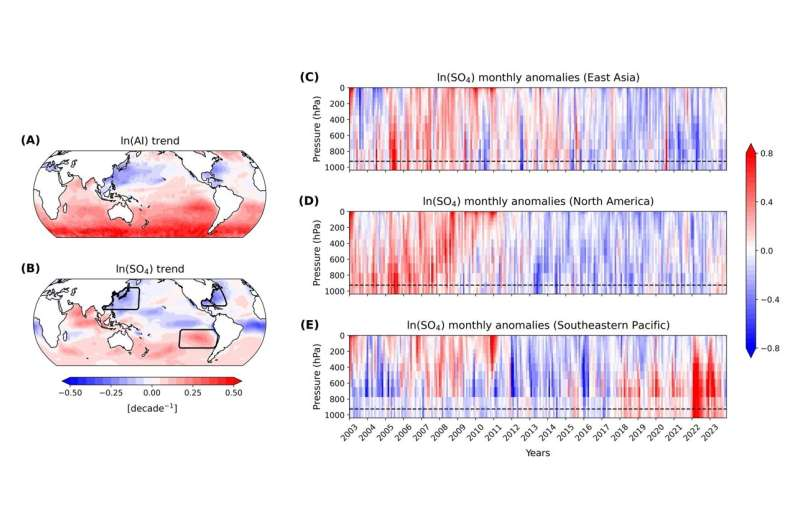
In the Northern Hemisphere, stricter environmental regulations and cleaner technologies have reduced pollution in heavily industrialized regions. This has led to fewer aerosol particles that normally help clouds reflect sunlight. As a result, more solar energy reaches the surface, contributing to regional warming.
In contrast, the Southern Hemisphere has experienced significant increases in aerosols due to natural events. Massive wildfires during the 2019–2020 Australian fire season injected large amounts of particles into the atmosphere. Additionally, the 2022 Hunga Tonga–Hunga Haʻapai volcanic eruption released substantial aerosols high into the atmosphere.
These natural aerosols made clouds brighter and more reflective, sending more sunlight back into space. When scientists accounted for both hemispheres together, they found that the opposing effects largely cancel each other out. The net result is that aerosols have had little overall impact on the recent global increase in Earth’s energy imbalance.
How the Study Reached Its Conclusions
To ensure their findings were robust, the researchers used two independent methods to track aerosol changes over time.
The first method relied on satellite measurements that observe how aerosols affect the passage of sunlight through the atmosphere. The second used modern atmospheric reanalysis data, which combine real-world observations with physics-based models to estimate sulfate aerosol concentrations produced by pollution, volcanoes, and wildfires.
Despite using very different approaches, both methods revealed the same pattern: declining aerosols in the Northern Hemisphere and increasing aerosols in the Southern Hemisphere. This agreement strengthened the conclusion that aerosols are not the main driver of the growing energy imbalance.
Clouds Take Center Stage
If aerosols are not the primary cause, what is? The study points clearly toward cloud-related changes.
Clouds play a crucial role in regulating Earth’s climate. They reflect incoming sunlight back into space and also trap heat within the atmosphere. Small changes in cloud coverage, thickness, altitude, or brightness can have large effects on how much energy Earth absorbs.
According to the researchers, the recent increase in Earth’s energy imbalance is mainly due to less sunlight being reflected back into space, which means the planet is absorbing more solar energy. These changes appear to be linked to surface warming and natural climate variability, rather than to changes in aerosol pollution.
Implications for Climate Science and Policy
This study has important implications for how scientists interpret recent warming trends and how climate models are developed.
Some climate models have placed heavy emphasis on pollution reductions in the Northern Hemisphere when explaining recent increases in Earth’s energy imbalance. However, by not fully accounting for rising natural aerosols in the Southern Hemisphere, those models may overestimate the role of air pollution.
The new findings suggest that researchers should focus more closely on cloud behavior and natural climate processes to better understand why Earth continues to gain heat.
From a policy perspective, the study also helps clarify public discussions around climate change. While cleaner air has many undeniable benefits for human health and ecosystems, it does not appear to be the primary reason the planet’s energy imbalance is accelerating.
Why This Research Matters
Earth’s energy imbalance is one of the most fundamental indicators of climate change. It tells scientists not just that the planet is warming, but how fast heat is accumulating in the climate system.
By showing that aerosol changes largely cancel out at the global scale, this study narrows the search for the true drivers of recent warming. It underscores the importance of understanding cloud dynamics, which remain one of the biggest uncertainties in climate science.
As researchers continue to refine satellite observations and climate models, insights like these are critical for improving predictions and guiding informed decision-making.
Looking Ahead
The study’s authors emphasize that while aerosols can still cause significant regional climate effects, they do not explain the global trend in Earth’s growing heat imbalance over the past two decades. Instead, scientists must take a closer look at how clouds respond to a warming world and how natural variability influences Earth’s radiation budget.
Understanding these processes will be essential for accurately projecting future climate change and for communicating the science clearly to the public.
Research paper: https://www.science.org/doi/10.1126/sciadv.adv9429