Investigating the Martian Megaripple Hazyview Reveals How Wind Still Shapes Mars Today
While much of NASA’s Perseverance rover mission is dedicated to studying ancient rocks that record Mars’ long-lost rivers and lakes, not everything the rover encounters belongs to the distant past. Some features on the Martian surface are still shaped by processes happening today. One of the most fascinating examples of this is a massive wind-formed structure known as the Martian megaripple “Hazyview.”
Megaripples may look like oversized sand ripples at first glance, but they represent something much more complex. These features can rise up to 2 meters (around 6.5 feet) high, making them far larger than typical ripples and distinct from sand dunes. They are formed primarily by wind-driven, or aeolian, processes, which continue to sculpt Mars despite its extremely thin atmosphere.
What Makes Martian Megaripples So Interesting
On Earth, wind shapes deserts, dunes, and ripples constantly. Mars, however, presents a unique puzzle. Its atmosphere is only about 2% as dense as Earth’s, yet wind remains one of the most powerful agents of change on the planet’s surface. Over time, wind erodes exposed bedrock into sand-sized grains and transports this material across the landscape, slowly but persistently reshaping the terrain.
Megaripples are especially intriguing because they appear to sit at the boundary between active and inactive landforms. While they are created by wind, many of them seem to have stopped moving long ago. Scientists believe this is due to the formation of a salty, dusty crust on their surfaces. This crust forms when water vapor in the atmosphere interacts with fine dust, binding grains together and making the ripple much harder for the wind to disturb.
Because of this, most Martian megaripples are thought to be largely inactive, acting as time capsules that preserve evidence of past wind directions, wind strength, and atmospheric conditions.
Perseverance’s Journey to the Honeyguide Region
Before reaching Hazyview, Perseverance had already studied another megaripple field called Kerrlaguna. That investigation focused on dusty, crusted ripples and laid the groundwork for understanding how these features behave under current Martian conditions.
Building on those results, the rover recently entered a much larger and more dramatic megaripple field known as Honeyguide. This area hosts some of the largest megaripples Perseverance has encountered so far during its traverse. Compared to Kerrlaguna, the ripples at Honeyguide rise higher, stretch farther across the landscape, and show sharply defined crests.
One of the most striking features of the Honeyguide megaripples is their uniform orientation. The crests are aligned in a consistent direction, which strongly suggests that winds in this region have blown predominantly north to south for an extended period of time. This consistency provides valuable clues about long-term wind patterns on Mars.
A Closer Look at the Megaripple Hazyview
Within the Honeyguide region, Perseverance focused its attention on a specific megaripple named Hazyview. This feature became the subject of the most detailed megaripple investigation conducted by the rover to date.
More than 50 individual observations were carried out across multiple scientific instruments. These included SuperCam, Mastcam-Z, MEDA (the Mars Environmental Dynamics Analyzer), PIXL, and WATSON. Each instrument played a specific role in examining Hazyview from different perspectives.
The rover studied grain movement to determine whether any parts of the megaripple are still active today. It searched for early morning frost, which could indicate ongoing interactions between atmospheric water and surface materials. Scientists also analyzed changes in mineralogy from the crest of the ripple down into the troughs, looking for subtle chemical differences that could reveal how the ripple formed and evolved.
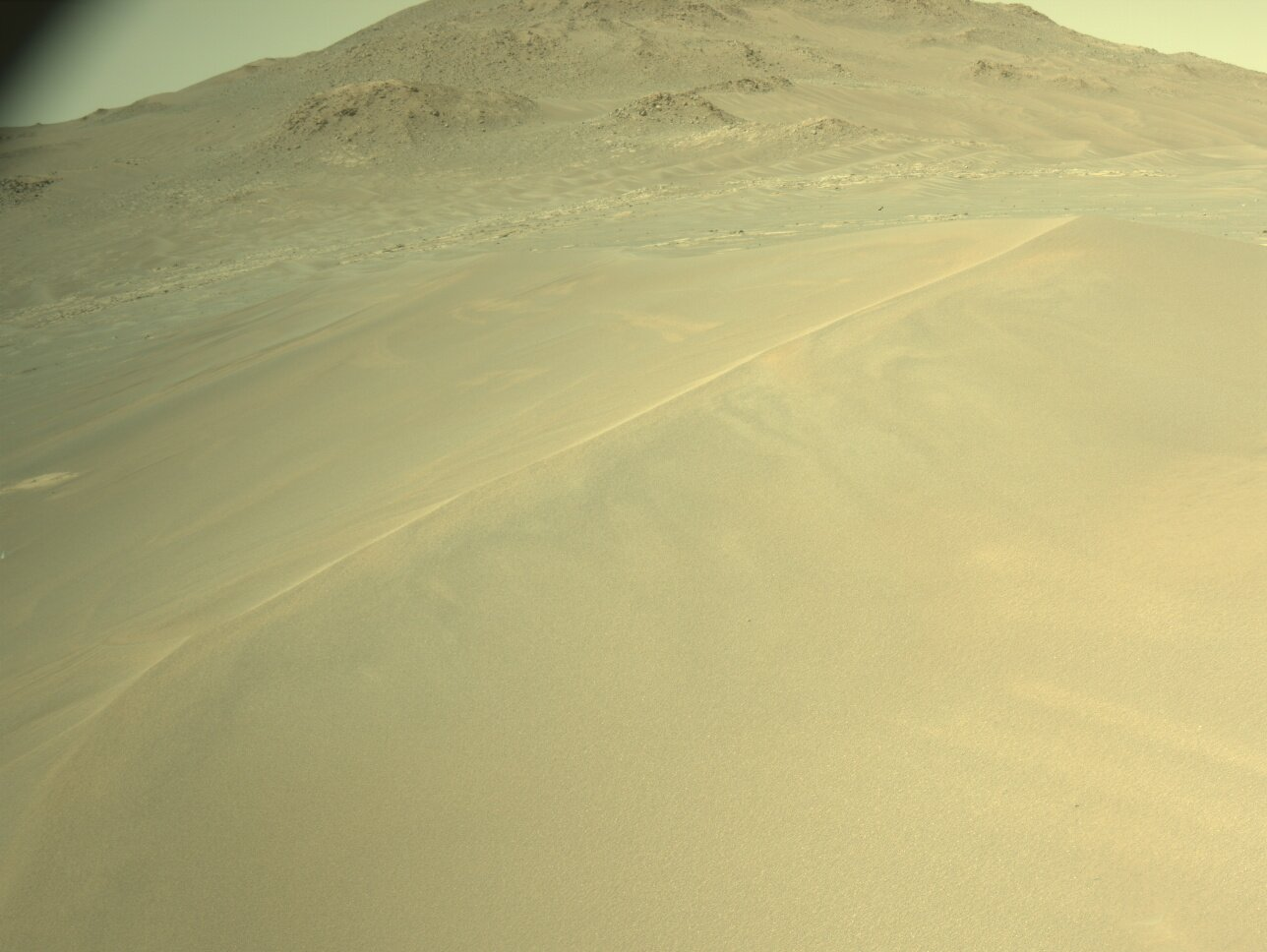
An image of Hazyview captured on December 5, 2025 (Sol 1704) by Perseverance’s Left Navigation Camera (Navcam) shows the ripple clearly. The camera, mounted high on the rover’s mast, not only helps with driving but also provides wide views of the surrounding terrain, making it ideal for documenting large surface features like megaripples.
Why Studying Inactive Ripples Still Matters
Even though many Martian megaripples appear inactive today, they are far from scientifically irrelevant. These features preserve a record of past wind regimes and atmospheric interactions that may span thousands or even millions of years. By decoding these records, scientists can better understand how Mars transitioned from a more dynamic climate to the cold, dry world we see today.
There is also evidence that some megaripples may not be completely dormant. Under certain conditions, such as periods of unusually high wind speeds, parts of these structures could erode or even become partially reactivated. Observing whether Hazyview shows any signs of such activity helps scientists test models of modern Martian surface dynamics.
Implications for Future Human Missions
Understanding Martian megaripples isn’t just about geology. The chemistry and cohesion of Martian soils will play a crucial role in future exploration, especially when humans eventually set foot on the planet. Soil properties affect rover and astronaut mobility, dust behavior, and even resource extraction, such as harvesting materials for construction or oxygen production.
By studying features like Hazyview in detail, scientists gain insights that directly support mission planning and risk assessment for future crews.
Megaripples in the Bigger Picture of Mars Science
Megaripples sit at an important intersection of Mars science. They link atmospheric processes, surface geology, and climate history into a single, observable feature. Unlike ancient lakebeds or river channels, which tell stories from billions of years ago, megaripples help scientists understand how Mars is still changing right now, grain by grain.
As Perseverance continues its journey along the rim of Jezero Crater, the data collected at Hazyview will serve as a valuable reference point. Future observations of wind-blown features elsewhere on Mars can be compared back to this detailed study, improving our overall understanding of the planet’s active surface processes.
In many ways, Hazyview shows that Mars is not a static world frozen in time. Even with its thin atmosphere and harsh conditions, the planet remains shaped by wind, subtle chemistry, and slow but persistent change.
Research reference:
Lapotre, M. G. A., et al. (2016). Large wind ripples on Mars: A record of atmospheric evolution. Nature Geoscience. https://doi.org/10.1038/ngeo2609