JWST Reveals a Stunning Dance Between Two Interacting Dwarf Galaxies
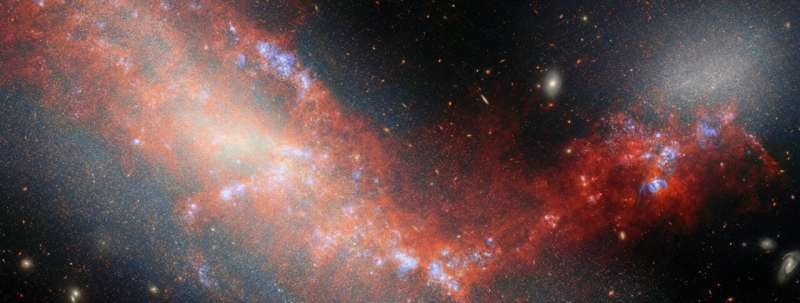
NASA’s James Webb Space Telescope (JWST) has once again delivered a remarkable glimpse into the universe, this time capturing an intricate interaction between two nearby dwarf galaxies, NGC 4490 and NGC 4485. The image, released on December 2, 2025, showcases these galaxies locked in a slow but dramatic gravitational encounter, offering astronomers a rare and detailed look at how small galaxies influence each other and evolve over time.
Located about 24 million light-years away in the constellation Canes Venatici, also known as The Hunting Dogs, this galaxy pair is especially important because it is the closest known interacting dwarf–dwarf galaxy system where scientists can both observe the interaction itself and resolve individual stars within the galaxies. That combination makes this system a natural laboratory for understanding galactic evolution.
A Close Encounter Between Two Small Galaxies
NGC 4490 and NGC 4485 are not massive spiral galaxies like the Milky Way. Instead, they belong to a class known as dwarf galaxies, which are smaller, less massive, and typically rich in gas but relatively poor in heavy elements. These characteristics make them especially valuable to astronomers, as they resemble the kinds of galaxies that were common in the early universe.
The two galaxies are gravitationally bound and are in the midst of an interaction that has been unfolding over hundreds of millions of years. JWST’s powerful infrared vision reveals a bridge of gas, dust, and stars stretching between them, a clear sign that material is being pulled from one galaxy to the other. This bridge is not just debris—it is actively forming new stars.
In the image, glowing regions mark areas of intense star formation, while wisps of dust and gas trace the complex gravitational forces at work. Thanks to Webb’s resolution, astronomers can distinguish individual stellar clusters, some of which are surprisingly young.
Why Dwarf Galaxies Matter So Much
Dwarf galaxies may be small, but they play a big role in cosmic history. In the early universe, galaxies were generally less massive, more gas-rich, and chemically simpler than galaxies we see today. Studying nearby dwarf galaxies allows astronomers to explore these early conditions without having to look billions of light-years away.
When dwarf galaxies interact or merge, they provide clues about how galaxies grow, trigger star formation, redistribute gas, and build up heavier elements over time. Observing such interactions up close helps scientists test models of galaxy evolution that are otherwise based on distant and faint objects.
NGC 4490 and NGC 4485 are particularly useful because they show clear signs of repeated star formation events, likely caused by their gravitational encounters.
Star Formation Triggered by Galactic Interaction
One of the most valuable insights from the JWST observations is the ability to date different stellar populations across the system. By analyzing the brightness and color of stars, astronomers have identified at least two major bursts of star formation.
The first burst occurred roughly 200 million years ago, likely when the two galaxies experienced a close pass that compressed gas and triggered widespread star formation. A second, more recent burst took place about 30 million years ago, coinciding with the formation of the gas bridge that now connects the galaxies.
These bursts are not evenly distributed. Instead, they are concentrated in regions where gas has been compressed or pulled into dense structures. This confirms long-standing theories that gravitational interactions are a powerful driver of star formation, even in relatively small galaxies.
The Role of JWST’s Advanced Instruments
This discovery was made possible by JWST’s advanced infrared instruments, particularly NIRCam (Near-Infrared Camera) and MIRI (Mid-Infrared Instrument). Infrared light is essential for peering through dust clouds that obscure star-forming regions in visible light.
With these instruments, Webb can simultaneously capture:
- Young, massive stars still embedded in dusty regions
- Older stellar populations that trace the galaxies’ past
- Warm dust and gas that fuel future star formation
The resulting image is not just visually striking—it is scientifically dense, packed with information about temperature, composition, and stellar age.
Part of the FEAST JWST Program
The observations of NGC 4490 and NGC 4485 were conducted as part of the FEAST (Feedback in Emerging Extragalactic Star Clusters) program. This international research effort focuses on understanding how star clusters form and evolve, and how young stars influence their surrounding environments.
By studying feedback processes such as stellar winds, radiation, and supernova explosions, the FEAST program aims to answer broader questions about how galaxies regulate star formation over time. The interacting dwarf galaxies provide an ideal target because their simpler structure makes these processes easier to isolate and study.
A Nearby Window Into the Early Universe
Although these galaxies are relatively close in cosmic terms, the processes unfolding within them mirror what likely happened billions of years ago, when galaxy interactions were far more common. In the early universe, small galaxies frequently merged and collided, gradually building up larger systems.
By observing NGC 4490 and NGC 4485, astronomers gain insight into:
- How gas flows between galaxies during interactions
- How star formation is triggered and sustained
- How chemical elements spread through galactic systems
These insights help refine simulations of galaxy formation and improve our understanding of how galaxies like the Milky Way came to be.
What Makes This System Unique
While the Milky Way has its own dwarf companions, such as the Large and Small Magellanic Clouds, NGC 4490 and NGC 4485 stand out because they are interacting with each other, not with a massive host galaxy. This makes them a rare example of a pure dwarf–dwarf interaction that can be studied in exceptional detail.
Their proximity allows JWST to resolve stars down to relatively low masses, something that is impossible in most interacting systems farther away. This level of detail transforms what would otherwise be a distant smudge into a richly detailed astrophysical case study.
Looking Ahead
As JWST continues its mission, systems like NGC 4490 and NGC 4485 will remain central to our understanding of galaxy evolution. Future observations may reveal how long the interaction will last, whether the galaxies will eventually merge, and how their stellar populations continue to change.
For now, this “dance of galaxies” stands as a reminder that even the smallest galaxies can play out some of the universe’s most fascinating stories—slowly, quietly, and on a truly cosmic stage.
Research paper reference:
https://ui.adsabs.harvard.edu/abs/2025ApJ…991..212B