Radio Black Hole Trio Lights Up a Rare Galaxy Merger for the First Time
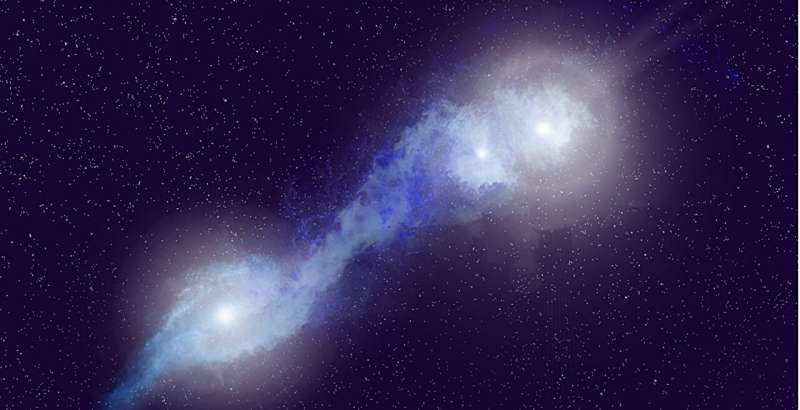
Astronomers have confirmed something they have long suspected might exist but had never clearly seen before: a triple galaxy system where all three galaxies host actively feeding, radio-bright supermassive black holes. This newly confirmed system, known as J1218/J1219+1035, sits about 1.2 billion light-years away from Earth and represents the first known “triple radio AGN” ever identified.
The discovery marks a major milestone in understanding how galaxies and their central black holes grow together, especially during cosmic collisions. While galaxy mergers are common across the universe, catching three supermassive black holes actively feeding and glowing in radio waves at the same time is extraordinarily rare.
A rare cosmic system caught mid-merger
J1218/J1219+1035 consists of three interacting galaxies locked in an ongoing merger. Each galaxy hosts a supermassive black hole at its center, and all three of those black holes are currently accreting material. As gas and dust spiral inward, the black holes emit strong radio signals, making them visible to sensitive radio telescopes.
The galaxies are not merely close neighbors passing by each other. They form a dynamically bound group, with tidal distortions and elongated structures that clearly show they are gravitationally interacting. Two of the galactic nuclei are separated by roughly 22,000 light-years, while the third lies about 97,000 light-years away from the central pair. In astronomical terms, this places them firmly in the middle of a complex and active merger.
This system is only the third confirmed triple AGN system in the nearby universe, but it is the first where all three black holes are radio-bright, setting it apart from anything previously observed.
How astronomers found the triple black hole system
The path to confirming J1218/J1219+1035 as a triple radio AGN was anything but straightforward. The system first stood out in mid-infrared observations from NASA’s Wide-field Infrared Survey Explorer (WISE). Those data hinted that at least two of the galaxies might host obscured active galactic nuclei, hidden behind thick dust clouds.
Follow-up optical spectroscopy strengthened the case for one clear AGN and suggested a “composite” signal in another galaxy. However, the nature of the third galaxy remained uncertain. Its emissions could have been explained by intense star formation or shock-heated gas, both of which can mimic the signs of black hole activity at optical wavelengths.
The breakthrough came with high-resolution radio observations using the U.S. National Science Foundation’s Very Large Array (VLA). Observing the system at 3, 10, and 15 GHz, astronomers detected compact radio cores precisely aligned with the centers of all three galaxies. This alignment is a strong indicator that the radio emission originates from active black holes rather than from star-forming regions.
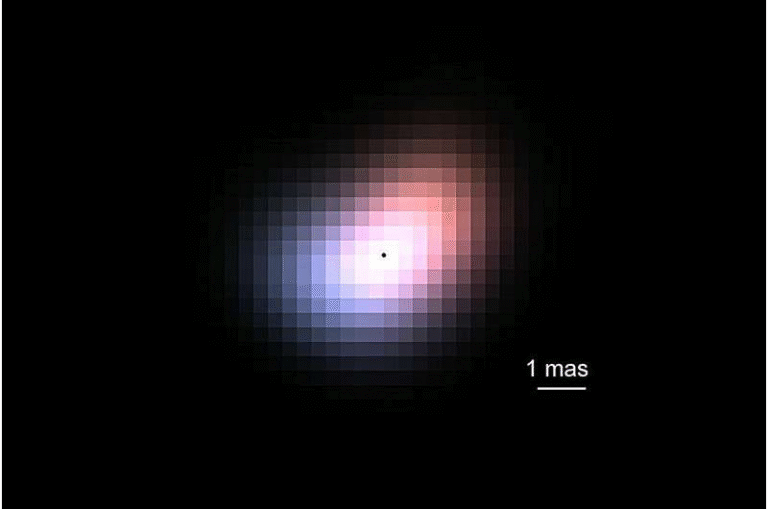
To further test this conclusion, the team used the Very Long Baseline Array (VLBA) at 4.9 GHz. Although the VLBA did not detect ultra-compact milliarcsecond-scale cores, it set brightness-temperature limits that exceed what star formation alone can produce. This effectively ruled out non-AGN explanations and confirmed the black hole origin of the radio emission.
Radio signatures that sealed the confirmation
The radio spectra of the three galactic cores provided additional confirmation. Two of the sources show steep radio spectra, a classic hallmark of non-thermal synchrotron emission produced by relativistic particles spiraling in magnetic fields near black holes. The third source exhibits an even steeper spectrum, which may point to unresolved jet activity or compact outflows.
Together, these signatures leave little doubt that all three galaxies host active, radio-emitting supermassive black holes. This makes J1218/J1219+1035 not just a triple AGN, but a uniquely radio-loud and energetically active system.
Why triple AGN systems matter
Triple AGN systems are a crucial but rarely observed prediction of hierarchical galaxy evolution. According to this framework, large galaxies grow over time by repeatedly merging with smaller ones. Each merging galaxy brings its own central black hole, which can eventually form binary or even triple black hole systems.
Observing such systems in action is incredibly valuable. J1218/J1219+1035 offers astronomers a real-world laboratory for studying how galaxy interactions funnel gas into galactic centers and trigger black hole growth. The fact that all three black holes are active suggests that mergers are highly effective at feeding black holes, at least under the right conditions.
The system also provides insight into how black hole feedback works in crowded environments. Radio jets and outflows launched by active black holes can heat or expel surrounding gas, potentially regulating future star formation and black hole growth.
The role of radio astronomy in revealing hidden black holes
One of the most important lessons from this discovery is the power of radio observations. Optical and X-ray studies can struggle to identify AGN in merging systems because of dust obscuration and overlapping emissions. Radio waves, however, can cut through dust and gas, revealing compact cores and jets that would otherwise remain hidden.
By combining mid-infrared selection with high-resolution radio imaging, astronomers were able to identify a complex system that might have been misclassified or overlooked using traditional methods alone. This approach is likely to uncover more triple AGN systems in future surveys.
What comes next for J1218/J1219+1035
The current observations have firmly established the system as the first confirmed triple radio AGN, but many questions remain. Future near-infrared imaging will help map the galaxies’ tidal features in greater detail, shedding light on how gas and stars are redistributed during the merger.
Planned X-ray observations will probe the high-energy output of each black hole, offering another perspective on their accretion rates and energetic impact. Together, these multi-wavelength studies will build a more complete picture of how multiple supermassive black holes interact, grow, and eventually merge.
With only two other triple AGN systems known locally, expanding the sample is essential. Each new discovery helps refine models of galaxy evolution and provides clues about the future formation of supermassive black hole binaries, which are expected to be powerful sources of gravitational waves.
A glimpse into cosmic growth
The discovery of J1218/J1219+1035 moves triple radio AGN from theoretical expectation into observational reality. It highlights how galaxy mergers can ignite multiple black holes at once and underscores the importance of radio astronomy in uncovering the universe’s most complex systems.
As radio surveys become deeper and more sensitive, astronomers expect that this rare trio may be the first of many, offering new insight into how galaxies — and the black holes at their hearts — evolve over cosmic time.
Research paper: https://doi.org/10.3847/2041-8213/ae2002