Ultra-Hot Lava World TOI-561 b Has a Thick Atmosphere That Defies Long-Held Expectations

Astronomers have uncovered some of the strongest evidence yet that a rocky planet beyond our solar system can hold on to a substantial atmosphere, even under conditions that were long thought to make this impossible. The planet in question, TOI-561 b, is an ultra-hot super-Earth so close to its star that its surface is likely dominated by a global magma ocean. And yet, despite extreme heat and radiation, it appears to be wrapped in a thick, volatile-rich atmosphere.
This surprising discovery comes from a Carnegie-led team of researchers using NASA’s James Webb Space Telescope (JWST), with their findings published in The Astrophysical Journal Letters. The results challenge decades of assumptions about how small, rocky planets evolve when they orbit dangerously close to their host stars.
A Rocky Planet Unlike Anything in Our Solar System
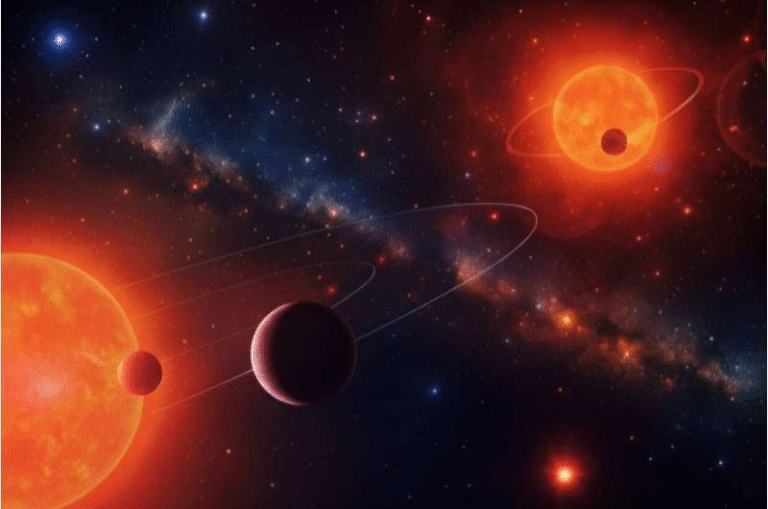
TOI-561 b is classified as a super-Earth, meaning it is rocky like Earth but larger. The planet has roughly twice Earth’s mass, yet it looks nothing like our home world. It orbits its star at an astonishingly close distance—about one-fortieth the distance of Mercury from the Sun. Because of this proximity, a full year on TOI-561 b lasts just 10.56 hours.
The planet is also tidally locked, which means one side permanently faces the star while the other remains in constant darkness. The dayside is blasted by intense stellar radiation, making it one of the hottest rocky planets ever studied in such detail.
Based on earlier models, astronomers believed planets like this should be bare rocks, stripped of any atmosphere shortly after formation. Smaller planets, especially those exposed to extreme heat, were expected to lose their gases quickly to space. TOI-561 b, however, refuses to follow that script.
JWST Sees Something Unexpected
The research team used JWST’s Near-Infrared Spectrograph (NIRSpec) to study the planet’s dayside. Their observations focused on secondary eclipses, moments when the planet passes behind its star. By comparing the total light from the star-planet system before, during, and after these eclipses, scientists were able to isolate the light coming directly from the planet itself.
If TOI-561 b were a bare rock, its dayside temperature should have been close to 4,900°F (2,700°C). Instead, JWST measured a significantly lower temperature of about 3,200°F (1,800°C). While still unimaginably hot, this cooler-than-expected reading strongly suggests the presence of an atmosphere capable of redistributing heat.
Without an atmosphere, heat would stay trapped on the dayside, making it far hotter. The observed temperature points to strong winds and atmospheric circulation, carrying heat to the nightside and reducing the extreme temperature contrast.
What This Atmosphere Might Be Made Of
The emission spectrum captured by JWST shows that TOI-561 b is not consistent with a dark, airless rock or a thin rock-vapor envelope. Instead, the data match models of a thick atmosphere rich in volatile elements.
Possible components include water vapor, carbon dioxide, and oxygen, although the exact mix is still being studied. In some models, the atmosphere is assumed to be almost entirely water vapor, which fits the observations well. These gases absorb certain wavelengths of infrared light, making the planet appear cooler to JWST than it would if its surface were directly exposed.
There is also the possibility of bright silicate clouds high in the atmosphere. These clouds could reflect incoming starlight, adding another cooling effect and further supporting the idea of a substantial atmospheric layer.
Density, Composition, and an Ancient Origin
TOI-561 b’s atmosphere may also help explain its unusually low density. While it is not a “super-puff” planet, it is less dense than expected for a rocky world with an Earth-like composition.
The team initially considered whether this could be explained by an unusual interior structure, such as a smaller iron core and a mantle made of less-dense rock. This idea is supported by the planet’s origin. TOI-561 b orbits a star that is about twice as old as the Sun and notably iron-poor. The star belongs to the Milky Way’s thick disk, a region populated by very old stars formed under different chemical conditions than those near the Sun.
This suggests TOI-561 b may be representative of planets that formed early in the universe, when the available building materials were different from those that shaped our own solar system.
Still, composition alone cannot fully explain the observations. A thick atmosphere remains a key piece of the puzzle.
How Can Such a Planet Keep Its Atmosphere?
One of the biggest questions raised by this discovery is how TOI-561 b has managed to retain its atmosphere at all. The planet is exposed to intense stellar radiation, and some atmospheric gases are almost certainly escaping into space.
Researchers think the answer may lie in a dynamic balance between the planet’s surface and its atmosphere. TOI-561 b likely hosts a global magma ocean, and this molten surface can continuously release gases into the atmosphere through outgassing. At the same time, some of those gases may dissolve back into the magma, creating a kind of equilibrium.
This constant exchange could allow the planet to maintain a thick atmosphere over billions of years, even as some material is lost to space. To explain the observations, TOI-561 b would need to be far more volatile-rich than Earth, leading researchers to describe it as something like a wet lava world.
Why This Discovery Matters
This finding has major implications for planetary science and exoplanet studies. It shows that rocky planets in extreme environments can be more complex than previously thought. Atmospheres may survive—or be continuously replenished—even under intense heat and radiation.
The discovery also broadens the range of planets that scientists might consider when studying planetary evolution, atmospheric loss, and the role of interior processes like magma oceans. While TOI-561 b is far too hot to be habitable, understanding how it works helps refine models that are also applied to cooler, potentially Earth-like worlds.
What Comes Next
The observations discussed here are the first results from JWST’s General Observers Program 3860. The team observed the TOI-561 system continuously for more than 37 hours, during which the planet completed nearly four full orbits.
Scientists are now analyzing the full dataset to map temperatures around the entire planet and better constrain the atmosphere’s composition. These follow-up studies should reveal how heat moves from day to night and which gases dominate the atmosphere.
Rather than closing the case, TOI-561 b has opened up a new set of questions. And that, according to the researchers, is what makes this discovery especially exciting.
Research paper:
https://iopscience.iop.org/article/10.3847/2041-8213/ae0a4c