New AI Tool Can Take a Cattle’s Temperature With Just a Photo
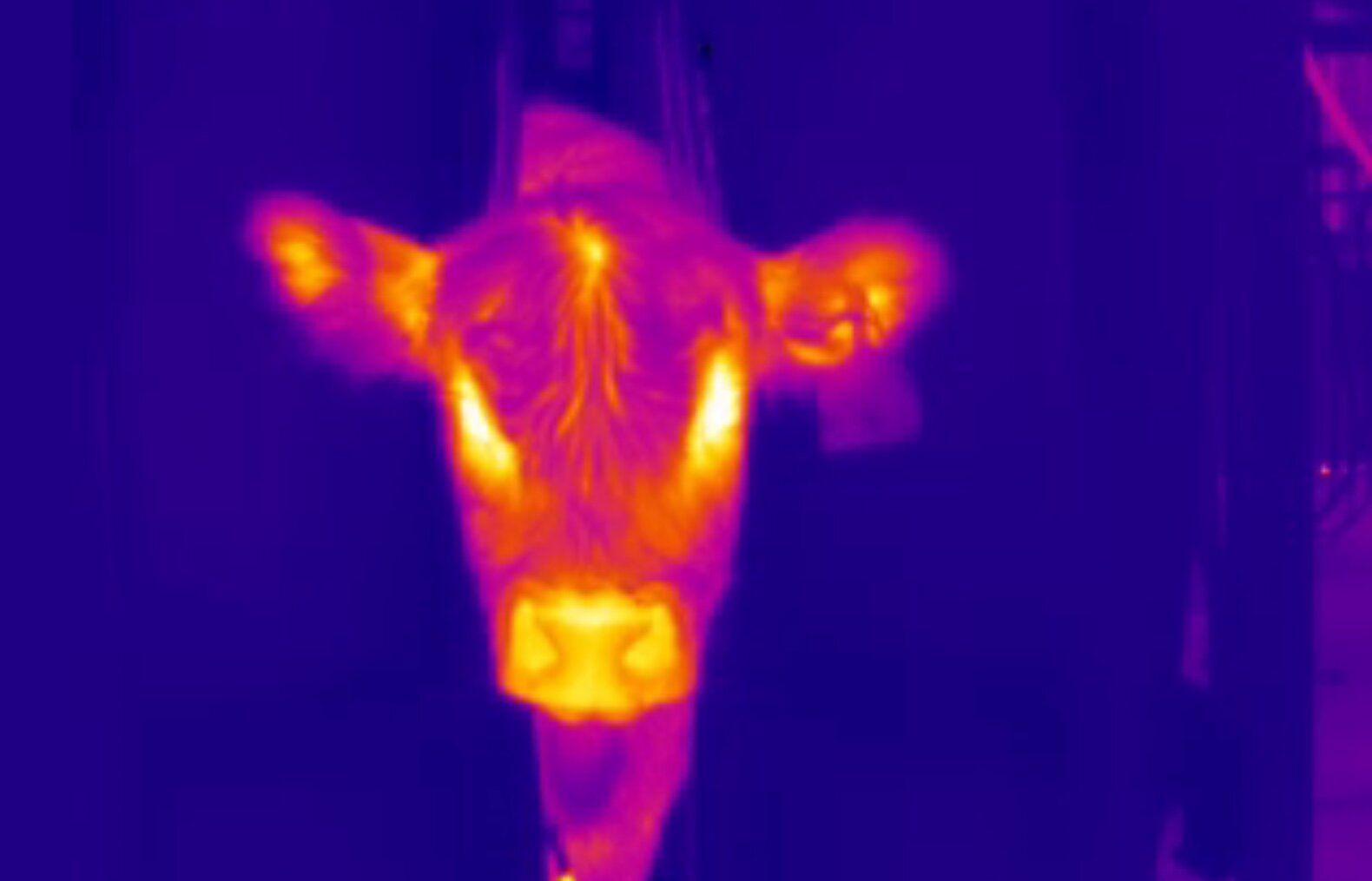
A team of researchers at the University of Arkansas has developed a new artificial intelligence system that can estimate a cow’s body temperature using nothing more than a single thermal image of its face. The tool, called CattleFever, combines computer vision, thermal imaging, and machine learning to offer a non-invasive alternative to traditional temperature checks, which are usually done rectally and can be stressful for animals.
This research comes from the Artificial Intelligence and Computer Vision Lab (AICV Lab) at the University of Arkansas and represents an early but important step toward automated health monitoring systems for livestock. The study describing the tool has been published in the peer-reviewed journal Smart Agricultural Technology.
Why Measuring Cattle Temperature Matters
Body temperature is one of the earliest and most reliable indicators of illness in cattle. A fever often appears before visible symptoms such as lethargy, appetite loss, or abnormal behavior. Today, the most accurate way to measure a cow’s temperature is through a rectal thermometer, a process that is time-consuming, labor-intensive, and can cause stress for both animals and handlers.
In large herds, routine temperature checks are often impractical. As a result, early signs of disease can go unnoticed, increasing the risk of infections spreading through a herd. A contact-free, automated method for temperature estimation could significantly improve animal welfare, reduce labor costs, and help ranchers intervene earlier when health issues arise.
What Is CattleFever?
CattleFever is an AI-based system designed to estimate a cow’s internal body temperature using thermal images of the animal’s face. Instead of touching the animal, the system analyzes heat patterns captured by a thermal camera and uses machine learning models to predict body temperature.
The project was led by Trong Thang Pham, a doctoral student at the University of Arkansas. The AICV Lab is directed by Ngan Le, an associate professor of electrical engineering and computer science whose research focuses on computer vision, medical imaging, and robotics.
The goal of the project is not just academic accuracy, but real-world usability. The researchers envision a future where ranchers could use thermal cameras and AI software to continuously monitor herd health with minimal disruption.
Building a Dataset From Scratch
One of the biggest challenges the researchers faced was the lack of suitable existing datasets. While there are publicly available datasets for animals such as dogs, cats, horses, and sheep, cattle data is surprisingly limited.
An existing cattle dataset called CattleEyeView focuses on overhead RGB images and was created mainly for herd tracking, not facial analysis or temperature estimation. Most other animal datasets also rely on standard RGB images, while CattleFever required paired RGB and thermal data.
To solve this, the researchers created an entirely new dataset.
How the Data Was Collected
The research team collected data from thousands of calves at the Arkansas Agricultural Experiment Station’s Savoy Research Complex. Each calf was placed in a pen, and the team recorded 20 seconds of synchronized RGB video and thermal images.
At the same time, each animal’s body temperature was measured using a rectal thermometer, providing a precise benchmark, or ground truth, for training and evaluating the AI models.
This process ensured that every thermal image could be directly compared with an accurate internal temperature reading.
Mapping the Cattle Face With Precision
To make sense of the images, the researchers needed to identify consistent facial regions across both RGB and thermal images. They designed a 13-point facial landmark system targeting anatomically significant areas, including:
- Both ears
- Eyes
- Poll (top of the head)
- Muzzle
- Nostrils
- Mouth
These landmarks were chosen because certain facial regions are more reliable indicators of internal temperature than others.
The team manually annotated 600 image frames, carefully marking each landmark. These annotated images were then used to train an AI model that automatically labeled the remaining 4,000 frames. The final dataset, named CattleFace-RGBT, allows precise alignment between RGB and thermal facial features.
This landmark-detection system can automatically locate a calf’s face and identify key features across both image types.
Finding the Best Indicators of Fever
With the dataset in place, the researchers ran extensive experiments to determine which facial regions best reflected core body temperature. Through a series of ablation studies, they tested different combinations of landmarks.
The results showed that the eyes and nostrils were the most accurate indicators, producing surface temperature readings that closely matched rectal thermometer measurements. These areas are less affected by external conditions and provide a clearer thermal signal.
Once the relevant regions were identified, the AI focused specifically on temperature data from those spots.
Machine Learning Behind the Predictions
The team tested multiple machine learning approaches to translate facial thermal readings into an estimated body temperature. Among all the models evaluated, random forest regression delivered the most accurate and stable results.
In a random forest regression model, many decision trees are trained on different subsets of the data. The final prediction is calculated by averaging the outputs of all trees. This approach helps reduce noise and overfitting, making it well-suited for complex biological data.
Using this method, the CattleFever system consistently predicted body temperature within one degree of the rectal thermometer reading.
What the System Can and Cannot Do Yet
The study clearly demonstrates that accurate temperature estimation from thermal images is possible, but there are still limitations.
All images used in the research were captured with calves facing directly toward the camera in controlled pen environments. Real-world ranch conditions are far less predictable. Cattle move freely, change posture, and are often viewed from different angles and distances.
The researchers acknowledge that future work will need to address these challenges by training the system on images taken in natural field environments, including side views and moving animals. Teaching the AI to recognize cattle faces from diverse angles is a key next step.
Open Data for the Research Community
In keeping with open-science principles, the University of Arkansas team has publicly released the CattleFace-RGBT dataset. This allows other researchers to build upon the work, test new algorithms, and help move the technology closer to practical deployment.
The researchers emphasize that sharing data and results openly accelerates progress and benefits the broader agricultural and scientific communities.
The Bigger Picture: AI in Livestock Health
CattleFever fits into a growing movement toward precision livestock farming, where sensors, AI, and automation are used to monitor animal health in real time. Similar technologies are already being explored for:
- Detecting lameness from walking patterns
- Monitoring feeding behavior
- Identifying respiratory illness through sound analysis
- Tracking stress using thermal imaging
As thermal cameras become more affordable and AI models more robust, systems like CattleFever could eventually be integrated into barns, feeding stations, or mobile devices, offering continuous health insights without human intervention.
Research Reference
Trong Thang Pham et al., CattleFever: An automated cattle fever estimation system, Smart Agricultural Technology (2025).
https://doi.org/10.1016/j.atech.2025.101434