Inflatable Fabric Robotic Arm Could Change the Way Apples Are Picked
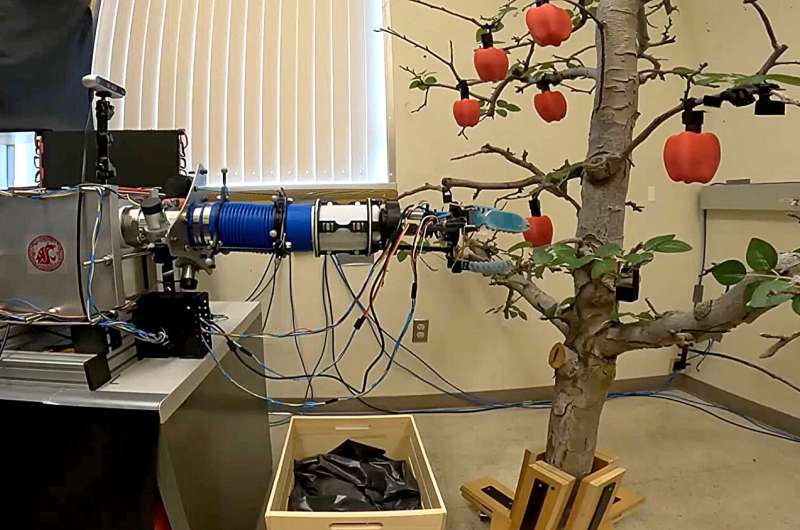
A team of researchers at Washington State University (WSU) has developed a low-cost inflatable fabric robotic arm designed to pick apples and potentially handle several other orchard tasks in the future. Built with simplicity, safety, and affordability in mind, this soft robotic system aims to address one of the biggest challenges facing modern agriculture today: persistent labor shortages.
At first glance, the robotic arm looks nothing like the rigid, metal machines people usually associate with industrial robotics. Instead, it resembles a reinforced version of the familiar inflatable tube figures often seen outside stores. This design choice is intentional and central to the system’s functionality.
A Soft Robot Built for Orchards
The robotic arm is made from a durable fabric material filled with air, making it lightweight, flexible, and inherently safer than traditional rigid robotic arms. The arm itself is about two feet long, and the entire system, including its metal base, weighs less than 50 pounds. Because of its low weight and soft structure, it can operate close to people without posing major safety risks and can interact gently with delicate apple branches and fruit.
Using a basic vision system, the arm can detect an apple, extend toward it, grasp it, and then retract to complete the picking action. From detection to harvest, the process takes roughly 25 seconds per apple. While that is significantly slower than a human picker, who can harvest an apple in about three seconds, the researchers see this as an early-stage prototype with clear room for improvement.
The research team recently published their findings in the journal Smart Agricultural Technology, outlining the design, testing, and early performance of what they call an everting inflatable fabric manipulator.
Designed to Be Affordable and Practical
One of the most striking aspects of this robotic arm is its cost. The materials used to build the arm total approximately $5,500, which is far less than many existing robotic harvesting systems. Traditional orchard robots are often large, mechanically complex, and prohibitively expensive for small and mid-sized farms.
The WSU team intentionally focused on keeping the design uncomplicated. Fewer mechanical parts mean lower maintenance requirements and higher reliability, especially in outdoor agricultural environments where dust, moisture, and uneven terrain can quickly damage complex machinery.
The arm’s inflatable structure also eliminates the need for heavy motors along its length. Instead, controlled air pressure allows the arm to extend and retract smoothly, reducing both energy use and mechanical wear.
Built for Modern Orchard Layouts
The robotic arm has been designed specifically with modern apple orchards in mind. Many contemporary orchards train their trees into linear or V-trellis systems, where branches grow along a flat plane. These layouts are ideal for robotic access, as fruit is easier to see and reach without navigating dense, irregular canopies.
Because the inflatable arm is flexible and compliant, it can maneuver within these structured environments while minimizing the risk of damaging branches or knocking fruit to the ground. This makes it particularly well-suited for high-density orchards that prioritize efficiency and consistency.
Responding to a Growing Labor Crisis
The motivation behind this research is deeply rooted in real-world agricultural challenges. Tree fruit growers around the world are struggling to find enough workers for labor-intensive tasks such as harvesting, pruning, pollination, flower thinning, and spraying.
Washington State, which leads the United States in apple and sweet cherry production, is especially affected. In 2023 alone, apple and sweet cherry production in the state contributed more than $2 billion to the U.S. gross domestic product. Despite this economic importance, farms across the state face ongoing labor shortages driven by an aging workforce and a decline in migrant agricultural labor.
During recent visits to orchards, members of the research team observed fruit rotting on the ground simply because there were not enough workers available to harvest it in time. This kind of loss is costly for farmers and highlights the urgency of developing reliable automation tools.
Collaboration and Field Integration
The project is not being developed in isolation. The WSU researchers are collaborating with the Prosser Research Extension Center to test and refine the system under real orchard conditions. They are also working with Cornell University researcher Manoj Karkee, who specializes in agricultural automation.
One major goal of the collaboration is to integrate the inflatable arm onto an automated mobile platform. This platform would be able to move through orchard rows autonomously, positioning the robotic arm where it is needed. Together, mobility and soft manipulation could form the foundation of a fully automated orchard system.
Strengths and Current Limitations
The robotic arm offers several clear advantages. Its soft, inflatable design makes it safer than rigid robots, both for nearby workers and for the trees themselves. Its low cost improves accessibility for farmers, and its simple construction enhances durability and ease of repair.
However, the system also has limitations. The most obvious is speed. At its current rate, the robot cannot compete with human pickers in terms of individual fruit throughput. Additionally, the vision and detection system used to locate apples is still relatively basic and contributes more to the slowdown than the arm’s physical movement.
The research team is actively working to improve both the mechanical components and the detection software, with the aim of significantly reducing pick times in future versions.
Beyond Apple Picking
While apple harvesting is the initial focus, the researchers are clear that this is only one potential application. Because the arm is gentle and adaptable, it could eventually be used for pruning branches, thinning flowers, and applying sprays. By designing a single robotic platform capable of performing multiple orchard tasks, the team hopes to increase its overall value to farmers.
Rather than replacing human labor entirely, the long-term vision involves farmers deploying multiple inexpensive robots to assist workers and reduce dependence on large seasonal labor forces. This hybrid approach could make orchards more resilient to labor fluctuations while maintaining productivity.
Soft Robotics and the Future of Farming
This inflatable arm is part of a broader trend toward soft robotics in agriculture. Unlike traditional robots built from rigid materials, soft robots use flexible structures that better mimic biological systems. This makes them particularly well-suited for handling fragile objects like fruit.
As sensing technologies, artificial intelligence, and materials science continue to advance, soft robots are expected to play a growing role in farming. Systems like the one developed at WSU offer a glimpse into a future where automation is not just powerful, but also safe, affordable, and adaptable to real agricultural needs.
For now, the inflatable fabric robotic arm remains a prototype, but it represents a practical and thoughtful step toward addressing one of agriculture’s most pressing challenges.
Research paper:
Ryan Dorosh et al., An everting inflatable fabric manipulator designed for apple picking, Smart Agricultural Technology (2026).
https://doi.org/10.1016/j.atech.2025.101635