Study Finds Food Waste Compost Is Less Effective Than Potting Mix Alone for Growing Seedlings
Food waste is a massive issue in the United States. According to the U.S. Food and Drug Administration, an estimated 30–40% of the country’s total food supply ends up as waste every year. Much of this discarded food goes straight to landfills, where it contributes to greenhouse gas emissions and environmental harm. Because of this, scientists and agricultural experts are constantly searching for better ways to reuse food waste in productive and sustainable ways.
One such idea is turning food waste into compost and using it to grow plants. Composting food scraps can reduce landfill waste while creating a nutrient-rich material that might support plant growth. But how effective is food waste compost when compared to traditional commercial potting mixes?
A recent study led by researchers at the University of Arkansas System Division of Agriculture set out to answer that question. Their findings suggest that while food waste compost has clear environmental benefits, it does not perform as well as commercial potting mix when used on its own for seedling production.
Why Researchers Wanted to Test Food Waste Compost
The study was driven by two major concerns: sustainability and agricultural efficiency. On one hand, composting food waste keeps organic material out of landfills and reduces methane emissions. On the other, growers need reliable growing media that support strong seedling development, especially during early growth stages when plants are most vulnerable.
The research team wanted to see whether food waste compost could serve as a replacement for, or supplement to, commercial potting mix. If successful, this could reduce reliance on peat-based products, which have their own environmental drawbacks due to peatland extraction.
The study focused specifically on seedling propagation, an important stage in crop production where uniform emergence, healthy growth, and nutrient uptake are critical.
How the Study Was Designed
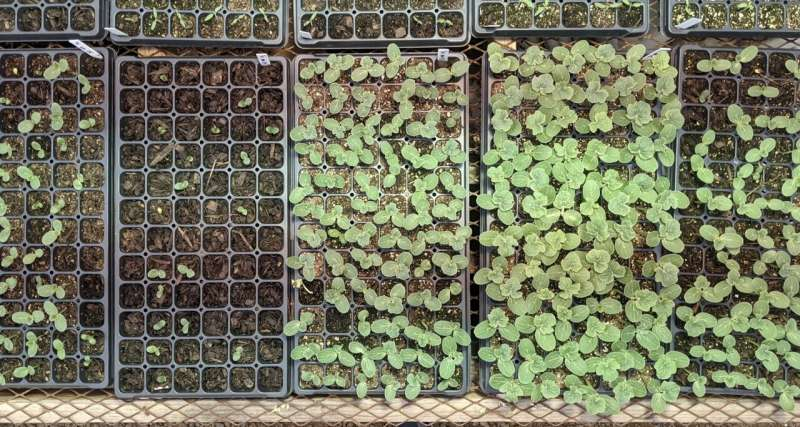
Researchers tested food waste compost as a growing substrate for tomato and watermelon seedlings, two widely grown crops that are sensitive to growing conditions during early development.
Seedlings were grown in several different substrate treatments:
- 100% food waste compost
- 100% commercial peat moss-based potting mix
- Blends of food waste compost and potting mix, mixed in varying ratios
The food waste compost used in the experiment was made from food scraps provided by a commercial partner and wood chips sourced from a tree service company. This blend reflects the type of compost that might realistically be produced at scale.
To evaluate performance, researchers measured several key indicators of plant health, including:
- Seedling emergence rates
- Plant growth and size
- Biomass accumulation, which reflects overall plant vigor
- Nutrient uptake, particularly nitrogen levels
- Leaf greenness, measured using a SPAD meter, a non-destructive tool that estimates chlorophyll content
What the Researchers Found
The results were clear: food waste compost alone did not perform as well as commercial potting mix.
Seedlings grown in 100% food waste compost showed lower emergence rates, weaker growth, and reduced biomass compared to those grown in pure commercial potting mix. In other words, fewer seeds sprouted successfully, and the plants that did emerge were generally less robust.
However, the story changed when food waste compost was blended with potting mix.
The study found that mixtures containing less than 50% food waste compost produced significantly better results than pure compost. These blended substrates supported improved seedling emergence, stronger growth, and better biomass accumulation. While they still did not outperform pure commercial potting mix, they came much closer in terms of overall plant health.
This suggests that food waste compost can be useful, but only when used as part of a carefully balanced growing medium.
Why Pure Compost Struggled
One reason food waste compost may struggle as a standalone substrate is its physical and chemical properties. Compost can vary widely depending on the materials used and how it is processed. Factors such as water retention, aeration, salinity, and nutrient availability all play a role in seedling success.
Commercial potting mixes are specifically engineered to provide consistent structure, proper drainage, and predictable nutrient levels. Food waste compost, by contrast, may be too dense, hold too much moisture, or release nutrients at rates that are not ideal for young plants.
Seedlings are particularly sensitive to these conditions, which helps explain why pure compost underperformed in the trials.
Environmental Benefits Still Matter
Despite the limitations revealed by the study, the researchers emphasized that composting food waste still plays an important role in sustainable agriculture.
Diverting food waste from landfills helps reduce greenhouse gas emissions and creates a usable organic product. Even if food waste compost cannot fully replace commercial potting mix, it can still reduce the total amount of peat-based materials needed, which is a meaningful environmental benefit.
As one researcher involved in the study noted, composting represents a “sweet spot for sustainability”, balancing waste reduction with agricultural use.
Who Was Involved in the Research
The study was led by Matt Bertucci, an assistant professor of sustainable fruit and vegetable production with the University of Arkansas System Division of Agriculture. He is affiliated with the Department of Horticulture, the Arkansas Agricultural Experiment Station, the Cooperative Extension Service, and the Dale Bumpers College of Agricultural, Food and Life Sciences.
The research team included experts from both horticulture and food science:
- Allyson Hamilton, former graduate student
- Kristen Gibson, professor of food safety and microbiology and director of the Arkansas Center for Food Safety
- Mary Savin, professor and head of the Department of Horticulture
- D.E. Kirkpatrick, program associate
- R.C. Woody-Pumford, graduate student
Their interdisciplinary collaboration helped ensure that both plant performance and food safety considerations were addressed.
What This Means for Growers and Gardeners
For commercial growers, the takeaway is practical: food waste compost should not be used alone for seedling production. However, incorporating it at lower percentages into traditional potting mixes may be a viable way to improve sustainability without sacrificing plant quality.
Home gardeners may also find this information useful. While compost is often promoted as a miracle solution, this study reinforces the idea that balance matters. Compost can enrich soil and improve structure, but young plants still benefit from stable, well-designed growing media.
The Bigger Picture of Food Waste Recycling
Food waste composting is just one part of a larger effort to manage organic waste more responsibly. Other approaches include anaerobic digestion, animal feed recovery, and food donation programs. Each method has its own strengths and limitations.
Research like this helps refine how compost is used, ensuring that sustainability efforts are both environmentally responsible and agriculturally effective.
Research Reference
Assessing Food Waste Compost as a Substrate Amendment for Tomato and Watermelon Seedlings
HortTechnology (2025)
DOI: https://doi.org/10.21273/horttech05559-24