Open-Sourcing the Future of Food as a New Cell Bank Makes Cultivated Meat Technology Public
For the past couple of years, the cultivated meat industry has been going through a difficult phase. Once seen as one of the most promising solutions for sustainable protein, many startups in this space have faced shrinking investments, operational slowdowns, or complete shutdowns. However, the scientific and technical progress made by these companies is not disappearing. Instead, a new initiative led by Tufts University and the Good Food Institute is ensuring that valuable cultivated-meat technology remains accessible to researchers and companies worldwide.
At the center of this effort is the creation of an open-access cell bank that will preserve and distribute high-quality animal cell lines originally developed by private startups. This move represents a significant shift toward collaboration and transparency in a field that has largely been driven by proprietary research.
Why the Cultivated Meat Industry Hit a Rough Patch
Cultivated meat, also known as cell-grown or cultured meat, is produced by growing animal cells in controlled environments instead of raising and slaughtering animals. Over the last decade, the industry attracted massive attention and investment, with startups promising more sustainable, ethical, and resilient food systems.
However, over the past two years, funding has cooled significantly. Rising costs, regulatory uncertainty, and broader investor pullbacks in climate and food tech led many companies to downsize, pivot their business models, or shut down entirely. When startups close, years of research and millions of dollars in R&D are often lost, especially when intellectual property ends up locked away or unused.
This is exactly the problem Tufts University’s Center for Cellular Agriculture (TUCCA) set out to solve.
Tufts and the Good Food Institute Step In
TUCCA, which focuses on developing cell-based alternatives to meat, milk, and eggs, partnered with the Good Food Institute (GFI), a nonprofit dedicated to advancing alternative proteins. Their shared goal is to rescue and repurpose valuable intellectual property from defunct cultivated-meat startups and make it available to the broader scientific community.
The most concrete example of this effort involves SCiFi Foods, a San Francisco–based cultivated meat startup that closed in 2023.
What Happened to SCiFi Foods
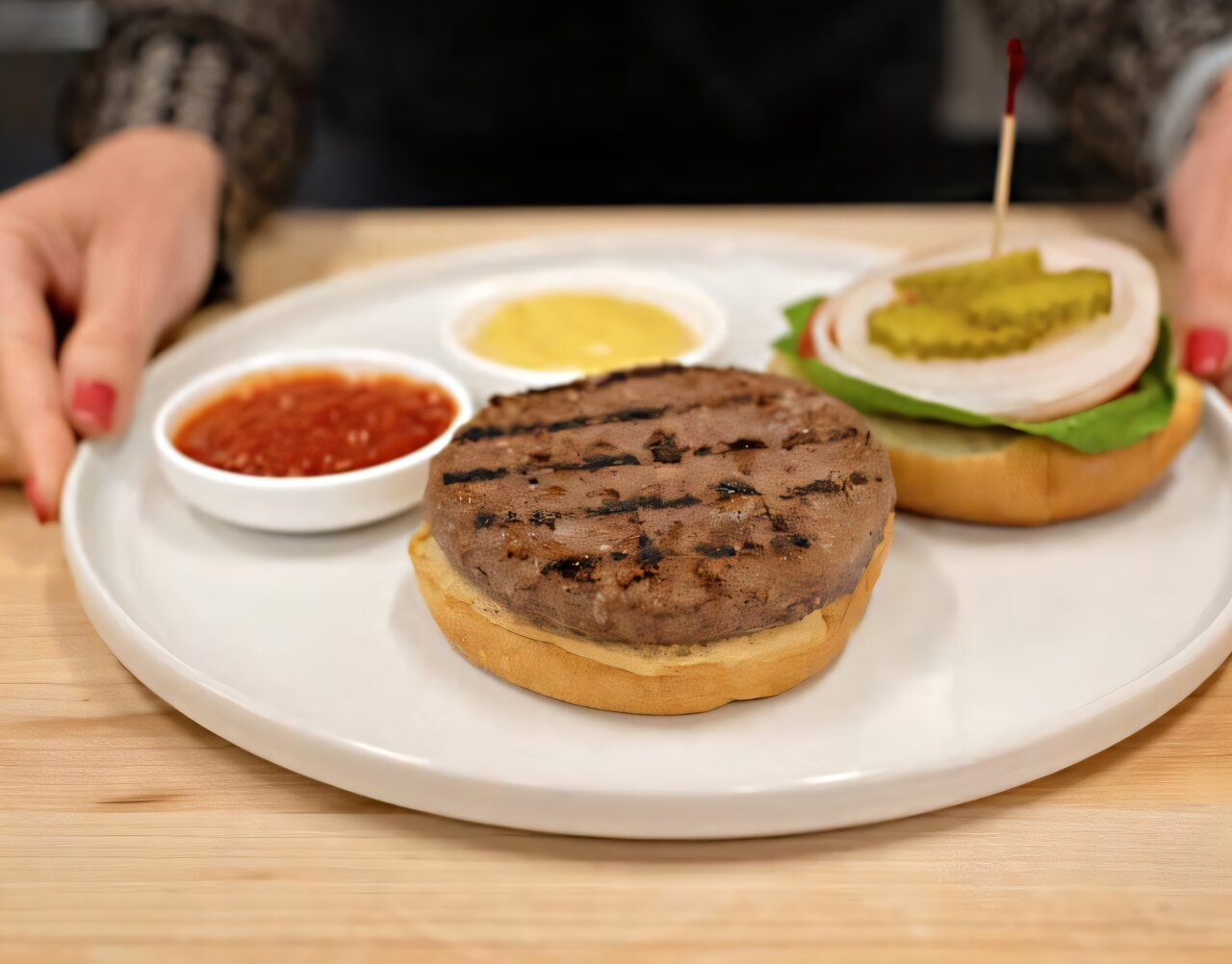
SCiFi Foods had been working on cultivated beef and had made notable progress. The company raised around $40 million across several funding rounds and developed a hybrid burger made from 90% soy protein and 10% cultivated beef cells. Importantly, SCiFi Foods had already submitted its cultivated beef product to the U.S. Food and Drug Administration (FDA) for regulatory review, placing it close to potential market approval.
Despite these advances, the worsening funding environment forced the company to shut down. Its assets, including valuable cell lines, were put up for auction.
Recognizing the importance of this technology, the Good Food Institute placed the winning bid, acquiring SCiFi Foods’ cell lines and associated technical knowledge. These assets were then transferred to Tufts for long-term storage, validation, and public distribution.
What Exactly Was Acquired
The acquisition included eight bovine cell lines and recipes for two serum-free growth media formulations. Serum-free media is especially important because it avoids the use of animal-derived components, making the production process more ethical and scalable.
Among these eight cell lines are the three most commercially developed beef cell lines from SCiFi Foods. These cells were modified using CRISPR gene-editing technology so they can grow indefinitely in culture. This property, known as immortality, is essential for industrial-scale food production.
Additionally, the cells were adapted to grow in single-cell suspension, meaning they float freely in nutrient liquid rather than needing to attach to surfaces. This trait makes them far easier to scale up in large bioreactors.
Two of the cell lines were further engineered to remove antibiotic resistance markers, a critical step that makes them more suitable for food applications and regulatory approval.
Why Single-Cell Suspension Matters So Much
One of the biggest technical challenges in cultivated meat production is scalability. Many animal cells naturally require a surface to attach to, which complicates large-scale manufacturing. Cells grown in single-cell suspension behave more like yeast or bacteria used in fermentation, allowing them to be grown efficiently in large industrial bioreactors.
According to researchers leading the evaluation, these bovine cell lines are among the first livestock-derived cell lines capable of suspension growth that will be broadly available to the public. This alone makes the initiative highly significant for the field.
The Open-Access Cell Bank
The rescued cell lines will become part of an open-access cell bank maintained by the Tufts Cellular Agriculture Commercialization Lab. The lab is currently raising funds to expand its infrastructure and support the banking, validation, and distribution of cell lines.
The goal is to make these cells available with very few restrictions on use, allowing academic researchers, startups, and established companies to experiment, optimize production processes, and develop new products without needing to reinvent foundational biology from scratch.
This model effectively transforms private startup IP into a public good, ensuring that progress continues even when individual companies fail.
A Larger Vision for Future Foods
The cell bank will be housed within TUCCA’s upcoming future foods innovation hub. This facility is designed to offer shared-use prototyping and scale-up research spaces, incubator labs for startups, and access to a network of experts in cellular agriculture.
Beyond the SCiFi Foods assets, the cell bank plans to include additional cell lines developed at Tufts, including bovine, pork, and even mackerel cells. Demand is expected to be high, and Tufts and GFI are preparing a formal waitlist system for interested users.
Why This Approach Could Change the Industry
By openly sharing cell lines and technical knowledge, this initiative lowers entry barriers for new researchers and companies. It encourages collaboration instead of duplication, reduces costs, and speeds up innovation.
This approach also reflects a broader shift in climate and food technology. As funding becomes more selective, shared infrastructure and open science may prove essential for maintaining momentum. The idea of “composting” intellectual property — recycling it into something useful rather than letting it decay — could extend well beyond alternative proteins.
What This Means for Cultivated Meat’s Future
While the cultivated meat industry still faces challenges, efforts like this show that progress does not stop when startups fail. Instead, foundational technologies can be preserved, improved, and shared, helping the entire field move forward.
By keeping critical tools like cell lines accessible, Tufts University and the Good Food Institute are laying the groundwork for a more efficient, resilient, and transparent cultivated meat ecosystem — one that may ultimately deliver on the promise of sustainable animal protein at scale.