Can a Bat Catch Prey on a Mirror Using Echolocation? Scientists Reveal Expert Foraging Skills with the Help of a Robot
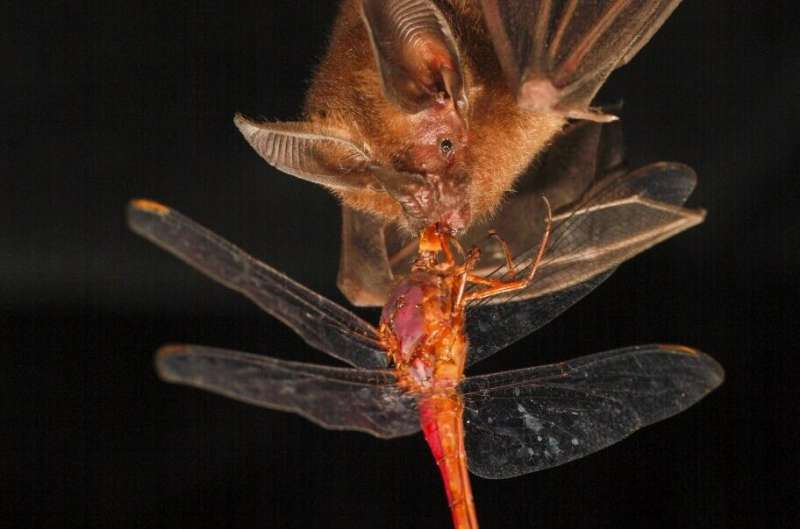
Scientists have long been fascinated by how bats manage to hunt so effectively in complete darkness, especially in dense tropical forests packed with leaves, branches, and background noise. A new study now offers one of the clearest explanations yet for how one tropical bat species pulls off this impressive feat. Researchers have shown that the common big-eared bat (Micronycteris microtis) can detect silent insects resting on leaves by using the leaves themselves almost like acoustic mirrors—and they proved it by building and testing a robot.
The research, published in January 2026 in the Journal of Experimental Biology, brings together biology and robotics to demonstrate a simple but powerful solution to a problem that once seemed incredibly complex: how to find motionless prey in an acoustically cluttered rainforest using sound alone.
Understanding the Challenge of Hunting in a Rainforest
Tropical rainforests are among the most difficult environments for echolocation. Sound waves bounce off countless surfaces, creating a chaotic mix of echoes. For bats that hunt flying insects, movement helps distinguish prey from background clutter. But Micronycteris microtis does something far more challenging—it hunts silent, motionless insects that are perched on leaves.
These insects do not flutter, crawl, or make noise. From an echolocation perspective, they blend almost perfectly into their surroundings. Yet this bat species routinely finds and captures them with remarkable accuracy. The question researchers wanted to answer was how.
The Acoustic Mirror Idea Explained
Earlier work by bat researcher Inga Geipel from the Smithsonian Tropical Research Institute suggested a clever explanation. Instead of trying to analyze every leaf in detail, the bat may approach leaves at an angle and listen carefully to how echoes behave.
A smooth, empty leaf acts much like a mirror. When the bat’s ultrasonic calls hit it, most of the sound reflects away, and very little returns to the bat. However, if an insect is sitting on that leaf, the situation changes. The insect’s three-dimensional body scatters sound in many directions, and some of that sound is reflected back toward the bat. The bat hears this stable echo and knows prey is present.
The beauty of this idea is its efficiency. The bat does not need to calculate the size, position, or orientation of every leaf—something that would require time and energy it cannot afford.
Why a Robot Was Needed to Test the Theory
While behavioral experiments supported this idea, the researchers wanted to know whether this strategy was actually sufficient to work in the real world. To find out, they decided to remove the bat from the equation and test the strategy itself.
The team included engineers Dieter Vanderelst from the University of Cincinnati and Herbert Peremans from the University of Antwerp. Together with Geipel, they built a robotic arm equipped with a sonar head that could emit ultrasonic signals similar to bat echolocation calls.
The robot was placed in an experimental setup with several artificial leaves made of cardboard. One leaf had a fake dragonfly attached, while the others were empty. Crucially, the robot was not allowed to measure leaf orientation or position in advance. It could only emit sound, listen to echoes, and adjust its movements accordingly.
How the Robot Searched for Prey
The robot explored the leaves randomly, sweeping its sonar across them. When it detected an echo, it moved in that direction. If the echo weakened—indicating a smooth, empty leaf—it abandoned that leaf and continued searching elsewhere.
This approach mimicked the hypothesized bat strategy: follow stable echoes and ignore fleeting ones.
The results were striking. Using this simple algorithm, the robot correctly identified the leaf with the artificial dragonfly 98 percent of the time. It mistakenly identified prey on empty leaves only 18 percent of the time, showing that false positives were relatively rare.
What the Echo Data Revealed
As the robot moved, it collected detailed echo data. This revealed a clear pattern:
- Empty leaves produced echoes that peaked briefly and then dropped sharply as the robot’s angle changed.
- Occupied leaves produced echoes that stayed relatively stable across different angles, thanks to the insect’s uneven shape reflecting sound in multiple directions.
The robot was most accurate when approaching leaves from angles that match how Micronycteris microtis typically approaches leaves in the wild. This alignment between robotic performance and natural bat behavior strongly supports the acoustic mirror hypothesis.
Why This Matters for Bat Biology
This study provides the first physically tested explanation for how gleaning bats can detect silent prey without performing complex calculations or mapping their surroundings. It shows that bats may rely on the dynamic interaction between their movement, sound emissions, and the environment, rather than on detailed internal representations of the world.
As Herbert Peremans emphasized, nature does not evolve isolated components—it evolves systems. In this case, the bat’s flight height, call structure, and movement patterns work together with the reflective properties of leaves to make hunting possible.
Broader Implications Beyond Bats
The findings have relevance far beyond bat biology. Understanding how bats extract useful information from noisy echo environments could influence the design of new sonar systems.
Potential applications include:
- Detecting fruit hidden among leaves in orchards
- Identifying pests on crops without disturbing plants
- Improving robotic navigation in cluttered environments
By translating biological efficiency into engineering solutions, researchers hope to improve both agricultural technology and autonomous sensing systems.
Getting to Know the Common Big-Eared Bat
The common big-eared bat (Micronycteris microtis) lives in Central and South American forests. It is known for its large ears, which help it detect faint echoes, and for its ability to glean prey from surfaces rather than catching insects mid-air.
This bat’s hunting style is rare and demanding, making it an ideal species for studying advanced echolocation strategies. The new robotic study adds a crucial piece to the puzzle of how such bats survive and thrive in complex environments.
A Clear Step Forward in Sensory Science
By combining field biology, behavioral research, and robotics, this study shows that a simple, elegant rule—listen for stable echoes—can solve a problem once thought to require extraordinary computational ability.
The work deepens our understanding of animal perception and demonstrates how much can be learned by letting biological ideas step into the physical world through machines.
Research paper:
A robotic model of efficient prey finding in the gleaning bat Micronycteris microtis, Journal of Experimental Biology (2026)
https://doi.org/10.1242/jeb.250818