Elective C-Sections Are Linked to Lower Childhood Cortisol Levels, Raising New Questions About the Role of Labor
For years, scientists have compared babies born vaginally with those delivered by cesarean section, often focusing on differences in early microbial exposure. Vaginal birth exposes newborns to the maternal vaginal microbiome, while cesarean delivery does not, and this has been linked to differences in immune development and health later in life. However, new research suggests that another factor may be just as important as microbes: the experience of labor itself.
A large, Dartmouth-led study published in the Proceedings of the National Academy of Sciences reports that children born by elective cesarean section before labor begins show consistently lower cortisol levels in childhood than those born vaginally or by cesarean after labor has already started. The findings come from a detailed analysis of more than 3,500 children in Brazil and add an important new layer to how researchers think about birth, development, and long-term biology.
What the Study Looked At
The researchers analyzed data from the Pelotas Birth Cohort, a long-running population study in Brazil that has followed thousands of children from birth onward. The final sample included 3,537 children, whose cortisol levels were measured at ages 4 and 6–7 years.
Instead of using blood or saliva samples, the team measured cortisol using hair samples, which provide a record of average cortisol exposure over several months. This method is especially useful in large studies because it reflects long-term systemic cortisol levels, not just short-term stress responses.
The children were grouped by birth mode:
- Vaginal delivery
- Cesarean delivery after labor began (unplanned or emergency C-section)
- Cesarean delivery before labor began (planned or elective C-section)
The Key Finding: Labor Matters
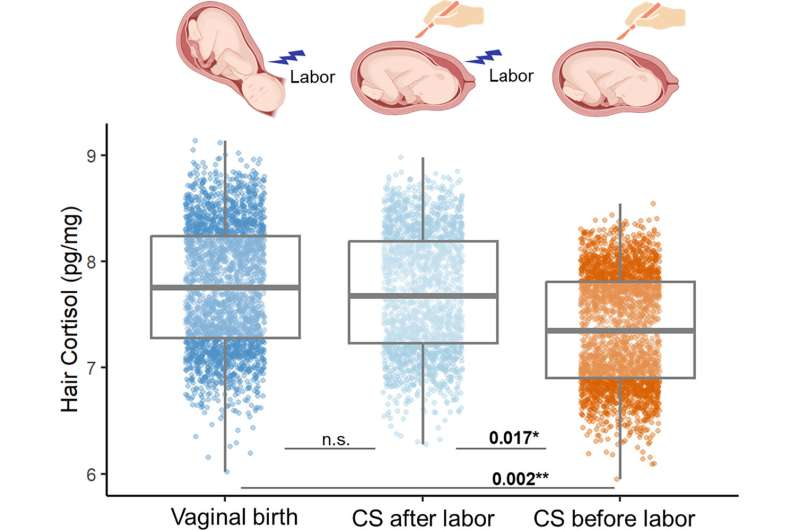
The results were clear. Children born by planned C-section before labor had about 6–7% lower hair cortisol levels than children born vaginally. They also had significantly lower cortisol than children born by C-section after labor had started.
Importantly, there was no meaningful difference in cortisol levels between children born vaginally and those delivered by C-section after labor. This strongly suggests that exposure to labor itself, rather than whether the baby passes through the birth canal, plays a central role in shaping long-term cortisol regulation.
These differences were statistically significant and persisted across middle childhood, showing up at both age points studied.
Why Cortisol Is So Important
Cortisol is often described as the body’s main stress hormone, but its role goes far beyond stress. It is deeply involved in growth, metabolism, immune function, and brain development. Cortisol helps regulate how the body responds to challenges and maintains balance across multiple systems.
Because cortisol affects so many biological processes, long-term differences in baseline levels during childhood could potentially influence health and behavior later in life. While lower cortisol is not automatically harmful, previous studies have linked atypically low cortisol levels to conditions such as early life trauma, altered stress responses, and attention-related disorders.
Labor as a Developmental Signal
Human labor is not a passive or simple event. It is a physiologically intense process involving rhythmic uterine contractions, changes in oxygen levels, and surges of hormones such as cortisol and oxytocin. From an evolutionary perspective, labor may act as a kind of biological signal, preparing the baby’s body for life outside the womb.
When a cesarean is performed before labor begins, these signals are largely bypassed. The study’s findings suggest that skipping labor may subtly alter how the child’s hypothalamic–pituitary–adrenal (HPA) axis—the system that regulates cortisol—is set during early development.
The Role of Gestational Age
Gestational length also mattered. The researchers found that children born after a shorter gestation tended to have lower cortisol levels overall. These effects were most pronounced in children who were both:
- Born earlier
- Delivered by C-section before labor
Interestingly, the difference in cortisol between vaginal births and planned C-sections became much smaller when children were born after 39.5 weeks of gestation. This suggests that waiting longer in pregnancy, even when a planned C-section is necessary, may reduce some of the observed differences.
Why Brazil Was an Ideal Setting
Brazil has one of the highest cesarean section rates in the world, second only to a few countries globally. A large proportion of these surgeries are elective rather than medically required, which made it easier for researchers to study the effects of planned C-sections without as many confounding medical factors.
To further strengthen the findings, the researchers conducted a separate analysis that matched children based on maternal and clinical factors such as age, number of previous births, high blood pressure, and diabetes. Even after accounting for these risks, the cortisol differences remained.
What This Does—and Does Not—Mean
The study does not claim that elective C-sections are harmful or that lower cortisol automatically leads to negative outcomes. Many cesarean deliveries are medically necessary and life-saving. Instead, the research highlights that labor itself may play a previously underappreciated role in long-term biological development.
The findings raise important questions for clinicians and parents, particularly around timing and decision-making for planned cesarean deliveries. They also point to the need for more research on whether and how these cortisol differences influence outcomes such as obesity, immune function, emotional regulation, and behavior later in life.
Future Directions
The research team plans to continue following the children to see whether lower childhood cortisol levels help explain other health patterns previously linked to cesarean delivery. There is also growing interest in exploring whether it might be possible to mimic some of labor’s hormonal or mechanical signals for babies born via planned C-section.
As cesarean delivery rates continue to rise worldwide, studies like this add nuance to the conversation by showing that birth is not just about how a baby is delivered, but what physiological experiences surround that moment.
Understanding Cortisol in Childhood
Cortisol levels naturally change as children grow, and both unusually high and unusually low levels can signal altered stress regulation. Measuring cortisol in hair has become an important tool because it captures long-term trends, rather than moment-to-moment fluctuations. This makes it especially valuable for understanding how early life experiences may shape biology over time.
A Bigger Picture of Birth and Development
This research adds to a growing body of evidence that birth is a complex biological transition, shaped by evolution and influenced by modern medical practices. While cesarean delivery is an essential part of modern healthcare, understanding its long-term biological effects can help refine guidelines and support informed decision-making.
By focusing on labor—not just delivery mode—this study opens the door to a deeper understanding of how early experiences shape children well beyond the first moments of life.
Research paper:
https://www.pnas.org/doi/10.1073/pnas.2519365122