Why Meritocracy Is Hard to Achieve in Modern Organizations
The idea of meritocracy is deeply appealing. At its core, it promises a simple and fair principle: people should be hired, promoted, and rewarded based on their talent, effort, and performance, not on who they know or where they come from. Many organizations proudly describe themselves as meritocracies, believing that clear rules and good intentions are enough to ensure fairness. But research shows that achieving true meritocracy is far more complicated than it sounds.
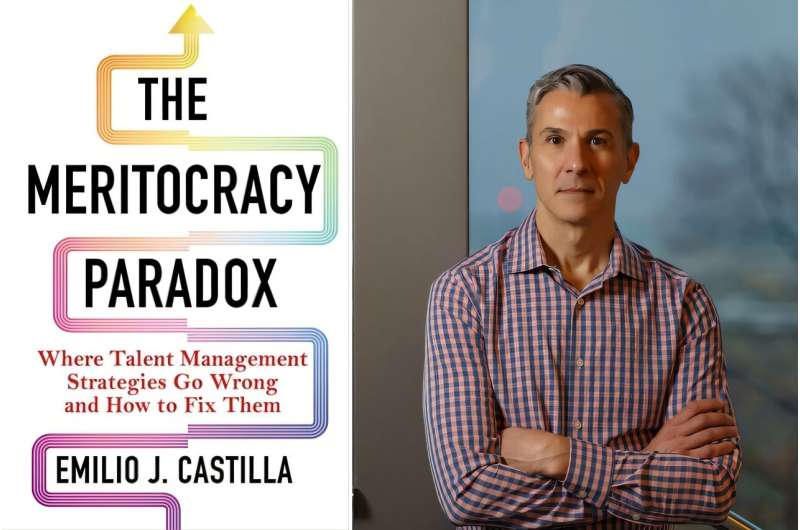
This question is at the heart of a new book by Emilio J. Castilla, the NTU Professor of Management at the MIT Sloan School of Management and co-director of MIT’s Institute for Work and Employment Research (IWER). In The Meritocracy Paradox: Where Talent Management Strategies Go Wrong and How to Fix Them (Columbia University Press, 2025), Castilla brings together decades of research to explain why organizations struggle to live up to their meritocratic ideals—and what leaders can realistically do to improve.
Why Good Intentions Are Not Enough
A large body of organizational research has consistently shown that bias and unfairness can creep into workplace decisions, even when leaders genuinely believe they are being objective. These problems show up across nearly every stage of talent management, including:
- Who gets interviewed for jobs
- Who gets hired
- How employee performance is evaluated
- Who receives promotions
- How bonuses and rewards are distributed
Because these decisions are often made by people under pressure, using incomplete information, it becomes very difficult to ensure that outcomes are based purely on merit. This is one reason why being “truly meritocratic” is such a challenge for organizations of any size.
The Paradox of Meritocracy
One of Castilla’s most influential findings comes from research conducted with Stephen Benard, which uncovered what they called the paradox of meritocracy. Their study showed that emphasizing meritocracy can actually increase bias, rather than reduce it.
In controlled experiments, participants were asked to make compensation decisions for employees who performed equally well. When participants were told that their organization strongly valued meritocracy, they were more likely to award higher bonuses to men than to women, despite identical performance levels. When meritocracy was not emphasized, this gender gap was smaller.
The explanation behind this paradox is both subtle and unsettling. When managers believe they are operating in a fair, merit-based system, they may become less vigilant about their own biases. The assumption that “the system is fair” can reduce self-scrutiny, allowing unconscious preferences to influence decisions without being noticed.
What Does “Merit” Even Mean?
Another major obstacle to meritocracy is that there is no single, universally agreed-upon definition of merit. In research conducted with Aruna Ranganathan (PhD ’14), Castilla found that managers within the same organization often hold very different ideas about what counts as merit.
Some may prioritize technical skills, others teamwork, leadership presence, loyalty, or past experiences. These interpretations are often shaped by a manager’s own career path and personal history. As a result, two employees with similar performance records can receive very different evaluations depending on who is making the decision.
This variability makes meritocracy difficult to implement consistently and can lead to unequal and sometimes inequitable outcomes, even when everyone involved believes they are being fair.
Making Talent Management More Meritocratic
Despite these challenges, Castilla’s research offers practical and encouraging guidance. Making talent management systems fairer does not necessarily require expensive tools or complex reforms. What it does require is commitment from top leadership, along with two key organizational principles: transparency and accountability.
The Role of Transparency
Transparency means being explicit and open about how decisions are made. Organizations should clearly define:
- The criteria used for hiring and promotion
- How performance is evaluated
- How rewards and bonuses are determined
Research shows that clear, specific, and well-communicated criteria can significantly reduce bias. When employees and managers understand exactly what is being evaluated, there is less room for subjective interpretations that may favor some groups over others.
The Importance of Accountability
Accountability involves ensuring that someone is responsible for monitoring talent management processes and outcomes. In many organizations, this role is assigned to a committee or group representing different parts of the company.
Studies show that when managers know their decisions will be reviewed, they tend to think more carefully and deliberately. This awareness alone can reduce the impact of unconscious bias and lead to more consistent, merit-based outcomes.
Can Organizations Ever Be Truly Meritocratic?
Castilla is clear that perfect meritocracy is probably unrealistic. Human judgment, social dynamics, and structural inequalities make it unlikely that any organization can fully eliminate bias. However, this does not mean meritocracy is a lost cause.
Striving for meritocracy still has real benefits. Organizations that successfully hire, reward, and promote the most capable and hardworking employees—regardless of gender, race, or background—are more likely to perform well over time. This is the enduring promise of meritocracy, even if it can never be perfectly achieved.
A Historical Perspective on Meritocracy
Interestingly, the idea of meritocracy is not a modern invention. One of the earliest formal merit-based systems emerged in ancient China, during the Han and Qin dynasties, more than 2,000 years ago. As early as 200 B.C.E., the Chinese empire developed civil service examinations to identify capable and talented officials for government administration.
This historical example highlights an important lesson. As organizations grow larger and more complex, leaders cannot rely on nepotism, social class, corruption, or personal relationships to make effective decisions. Merit-based systems, while imperfect, consistently outperform these alternatives.
Why Meritocracy Is Still Worth Pursuing
Even with its flaws, meritocracy remains one of the best guiding principles for people management. Compared to systems based on favoritism or inherited privilege, meritocracy offers a framework that can be refined, monitored, and improved over time.
Castilla’s work reminds us that fairness is not something organizations achieve once and then forget about. It is an ongoing process that requires constant attention, self-reflection, and structural safeguards. When organizations take transparency and accountability seriously, they move closer to the ideal—even if they never fully reach it.
In that sense, the goal is not to claim meritocracy, but to work toward it with humility and evidence-based practices.
Research paper reference:
https://ideas.wharton.upenn.edu/wp-content/uploads/2018/07/Castilla-Benard-2010.pdf