Anglo-Saxon Center Unearthed Near Skipsea Castle Is Reshaping What We Know About Pre-Norman England
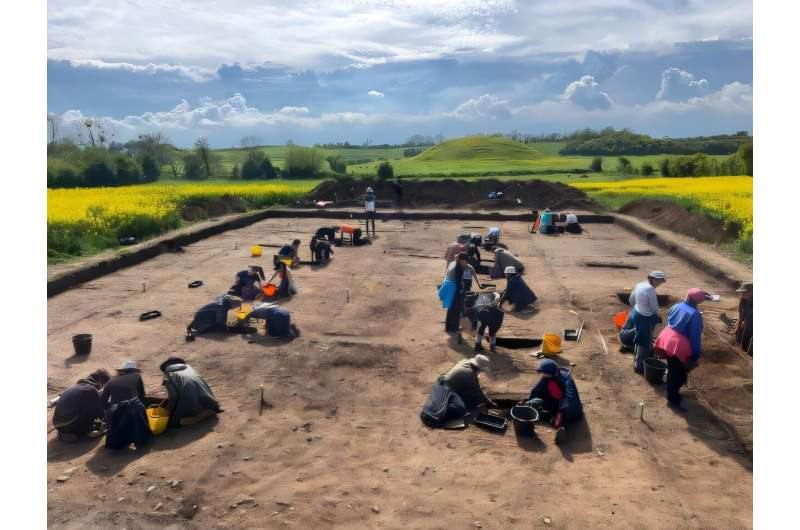
Archaeologists working near Skipsea Castle in East Yorkshire have uncovered a series of rare and highly significant discoveries that are transforming how historians understand life in England in the centuries leading up to the Norman Conquest of 1066. The findings point to the existence of an important Anglo-Saxon elite center, complete with high-status buildings, industrial activity, and evidence of political and social organization on a scale rarely seen for this period.
The excavations are being led by researchers from the University of York and are taking place in a field known as Sparrow Croft, located about 225 meters from the Norman castle. This work is part of a six-year research project that began in 2023, and archaeologists say they are only halfway through what the site may still reveal.
What makes these discoveries so striking is not just the number of structures found, but their quality, rarity, and clear association with wealth and power during the late Anglo-Saxon period.
Evidence of a High-Status Anglo-Saxon Settlement
Among the most important finds is what archaeologists believe to be a rare medieval malthouse, dating from roughly AD 750 to 850. Malthouses were used to prepare malted grain, a key ingredient in brewing beer, which played a central role in Anglo-Saxon society. Beer was not only a staple drink but also essential to feasting, hospitality, and political gatherings.
The structure includes a drying oven and an adjoining clay floor, all of which would once have been enclosed within a timber-framed, wattle-and-daub building. Very few examples of Anglo-Saxon malthouses have been identified in England, and their presence is usually associated with elite or lordly households rather than ordinary settlements.
Nearby, archaeologists uncovered another unusual feature: a square sunken structure lined with timber and mortar. This is believed to be the cellar or base of a wooden tower, a type of building that is exceptionally rare in England for this period. Based on its form and construction, researchers think the tower may have functioned as a watchtower, bell tower, or even a tower-nave church.
Both the malthouse and the timber tower are considered key indicators of a high-status site, suggesting that Skipsea was not a minor rural settlement but a place of considerable importance.
A Large Timber Hall for Feasting and Power
Above the remains of the malthouse, archaeologists also identified a large timber hall, constructed at a slightly later date. This hall likely served as a central space for feasting, drinking, assemblies, and political decision-making. Such halls were the heart of Anglo-Saxon elite life, where leaders reinforced their authority through hospitality and social ritual.
The hall was surrounded by an extensive ditched enclosure, further emphasizing its importance and controlled access. Crucially, this building predates the Norman castle, showing that Skipsea was already a significant center of power long before the Norman takeover of England.
Taken together, the malthouse, tower, hall, and enclosure strongly suggest that the site functioned as a lordly center within the Anglo-Saxon landscape, playing a role in governance, industry, and elite social life.
Skipsea’s Deep and Complex Past
These new discoveries build on earlier archaeological work that has already reshaped understanding of Skipsea’s history. Almost a decade ago, University of York archaeologists revealed that the huge mound on which Skipsea Castle sits—measuring about 85 meters wide and 13 meters high—was not built by the Normans, as previously believed.
Radiocarbon dating showed that the mound dates back to the Iron Age, meaning it was constructed around 1,500 years before the Norman Conquest. At the time of its construction, it would have been unique in Britain, indicating that Skipsea had strategic or symbolic importance long before the Anglo-Saxon and Norman periods.
This long continuity of significance makes Skipsea an unusually rich archaeological site, offering insight into how power and landscape interacted over thousands of years.
Links to England’s Last Anglo-Saxon King
The area around Skipsea later became associated with Harold Godwinson, the last Anglo-Saxon king of England. After his defeat at the Battle of Hastings in 1066, the estate passed into Norman hands and eventually became the center of the Lords of Holderness.
While there is no direct evidence that Harold Godwinson ever visited Skipsea himself, archaeologists note that the newly discovered high-status buildings fit well within a landscape shaped by wealth, authority, and political control in the late Anglo-Saxon period. The findings help place Skipsea within the broader network of elite sites that supported royal and noble power before the Norman Conquest.
A Landscape Shaped by Water and Long-Term Settlement
Skipsea’s importance stretches back even further than the Anglo-Saxon and Iron Age periods. In the past, the area was surrounded by three freshwater lakes—Skipsea Bail Mere, Skipsea Low Mere, and Skipsea Withow Mere—all connected to the River Hull. These lakes formed around 10,000 years ago and made the area highly attractive to human communities.
Archaeological evidence shows that people were drawn to this landscape from the Mesolithic period through to medieval times. Finds from the former lakes include stone tools, animal remains, and bone harpoons, while Neolithic and Bronze Age buildings and trackways have been discovered along the lake edges.
This long-term pattern of settlement highlights how natural features like water, fertile land, and transport routes helped shape human activity and power structures over millennia.
Ongoing Research and Future Discoveries
Skipsea Castle itself is a Scheduled Monument under the guardianship of English Heritage, reflecting its national importance. Every May, the site hosts the University of York’s archaeology field school, with around 120 undergraduate and postgraduate students taking part in hands-on excavation work.
Researchers emphasize that they are still only halfway through the project, and many more discoveries may lie beneath the soil. Future findings could shed even more light on how power, industry, and daily life were organized in eastern England in the centuries before the Norman Conquest.
As work continues, Skipsea is emerging as one of the most important sites in England for understanding the late Anglo-Saxon world, offering rare physical evidence of elite life during a period that is often poorly documented archaeologically.
Research reference:
University of York – Department of Archaeology, Skipsea Castle Anglo-Saxon research project
https://www.york.ac.uk/news-and-events/news/2026/research/lordly-centre-revealed-skipsea-castle/