The Milky Way’s Black Hole May Have Had a Violent Past Despite Being Quiet Today
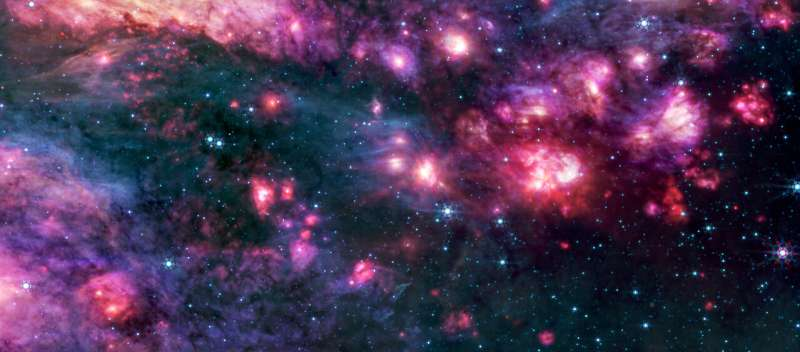
At the very center of the Milky Way lies Sagittarius A*, the supermassive black hole that anchors our galaxy. For decades, astronomers have considered it something of an underachiever. Compared to the blazing, energetic black holes seen in other galaxies, Sagittarius A* is remarkably dim, barely emitting enough radiation to draw attention. But new evidence suggests this calm behavior is misleading. Our galaxy’s black hole may have experienced powerful and dramatic outbursts in the surprisingly recent past.
This new insight comes from observations made using XRISM, a next-generation X-ray space telescope launched in 2023 through a collaboration between NASA and the Japan Aerospace Exploration Agency (JAXA). Thanks to its extraordinary ability to measure X-ray energy with extreme precision, XRISM has given scientists an unprecedented look into the history of activity near the Milky Way’s core.
A Quiet Black Hole With a Not-So-Quiet History
Sagittarius A* sits about 26,000 light-years from Earth and contains roughly four million times the mass of the Sun. Despite this enormous mass, it is one of the faintest known supermassive black holes, especially when compared to the brilliant quasars and active galactic nuclei found elsewhere in the universe.
This apparent inactivity has long puzzled astronomers. Many supermassive black holes glow intensely because they are actively feeding on surrounding gas and dust. As material spirals inward, it heats up and releases powerful radiation, especially in X-rays. Sagittarius A*, by contrast, barely shines at all.
However, new observations suggest that this quiet state is temporary rather than permanent.
Molecular Clouds as Cosmic Time Capsules
Surrounding Sagittarius A* are several massive molecular clouds, enormous collections of gas and dust drifting through the galactic center. These clouds play a crucial role in the new discovery. They can act like cosmic mirrors, reflecting X-rays that pass through them.
When a black hole produces a sudden burst of X-rays, those photons travel outward at the speed of light. Some of them strike nearby molecular clouds and are scattered toward Earth. Because of the distances involved, astronomers see these reflections hundreds of years after the original outburst, creating what scientists call X-ray light echoes.
Previous X-ray telescopes detected hints of such echoes, but their limited energy resolution made it difficult to determine what caused them. Were they reflections of ancient black hole flares, or were they produced by other energetic processes such as cosmic rays interacting with the gas?
XRISM finally provided a clear answer.
XRISM’s Breakthrough Capabilities
XRISM represents a major leap forward in X-ray astronomy. While older X-ray telescopes could measure photon energies to an accuracy of about one part in 10 or 100, XRISM can resolve energies to one part in 1,000. This improvement allows astronomers to distinguish extremely fine details in X-ray spectra, similar to switching from a blurry snapshot to a sharp, high-definition image.
Using XRISM, researchers focused on a particular molecular cloud near the galactic center known as G0.11–0.11. They examined two extremely narrow iron (Fe Kα) emission lines produced within the cloud. The precise shape, energy, and structure of these lines provided critical clues.
By analyzing these features in detail, scientists were able to determine the motion of the cloud and compare it with existing radio observations. Even more importantly, they could test competing explanations for the X-ray glow.
Evidence of a Past X-Ray Outburst
The XRISM data strongly ruled out the idea that cosmic rays were responsible for the observed X-rays. Instead, the spectral signatures matched what would be expected if the cloud were reflecting an intense X-ray flare from Sagittarius A*.
This means that sometime within the past few hundred to roughly 1,000 years, the Milky Way’s black hole experienced a dramatic increase in activity. During this period, Sagittarius A* likely emitted X-rays with a luminosity of around 10³⁸ ergs per second, many orders of magnitude brighter than its current output.
Because different molecular clouds are located at different distances from the black hole, astronomers can use multiple light echoes to reconstruct a timeline of past flares, much like using echoes in a cave to understand its shape and size.
Why This Discovery Matters
This finding has significant implications for our understanding of both Sagittarius A* and supermassive black holes in general.
First, it challenges the assumption that Sagittarius A* has always been quiet. Instead, it appears to go through cycles of activity and dormancy, much like other black holes, but on timescales that are difficult to observe directly.
Second, it demonstrates the extraordinary power of XRISM. For the first time, astronomers can measure incredibly subtle features in X-ray spectra that were previously inaccessible. This opens the door to studying black hole histories not just in the Milky Way, but potentially in other galaxies as well.
Finally, the discovery highlights the value of cosmic archaeology. By studying how light from past events interacts with its environment, scientists can uncover details about phenomena that occurred long before modern astronomy existed.
Understanding Supermassive Black Holes More Broadly
Supermassive black holes are found at the centers of nearly all large galaxies, yet their origins remain one of astronomy’s biggest mysteries. Some theories suggest they formed from the collapse of massive early stars, while others propose they grew from smaller black holes merging over time.
What is clear is that their activity has a profound impact on their host galaxies. Powerful black hole outbursts can heat surrounding gas, suppress star formation, and reshape entire galactic environments. Even relatively short-lived flares, like those inferred for Sagittarius A*, may have influenced conditions in the Milky Way’s core.
The new XRISM observations suggest that our galaxy’s central black hole has likely played a more dynamic role in shaping its surroundings than previously believed.
What Comes Next
The study of G0.11–0.11 is just the beginning. Astronomers expect XRISM to examine many more molecular clouds near the galactic center, building a more complete picture of Sagittarius A*’s past behavior. Over time, this could reveal patterns in how often such flares occur and how long they last.
As XRISM continues its mission, it is likely to uncover additional surprises—not only about our own galaxy, but about black holes across the universe.
For a black hole once thought to be boringly quiet, Sagittarius A* is suddenly proving to have a far more explosive history than anyone imagined.
Research paper:
https://arxiv.org/abs/2601.02482