Plasma Rings Around M Dwarf Stars Offer New Clues to Planetary Habitability
Astronomers are uncovering new ways to understand how stars shape the planets that orbit them, and a recent discovery involving plasma rings around M dwarf stars is opening up an especially intriguing path forward. This research shows that certain young M dwarf stars naturally host large structures of ionized gas that act like built-in space weather stations, offering rare insight into the particle environments surrounding these stars and the possible consequences for planetary habitability.
The work is led by Luke G. Bouma of the Carnegie Institution for Science, in collaboration with Moira Jardine from the University of St. Andrews, and was presented at the 247th American Astronomical Society meeting. The findings are also published in The Astrophysical Journal Letters, highlighting their importance to the broader astrophysics community.
Why M Dwarf Stars Matter So Much
M dwarf stars are the most common type of star in the Milky Way. They are smaller, cooler, and dimmer than the Sun, yet they frequently host Earth-sized rocky planets. Because of this, they are a major focus of exoplanet research and the ongoing search for potentially habitable worlds.
However, planets around M dwarfs often face harsh conditions. Many orbit very close to their stars, exposing them to intense radiation, frequent stellar flares, and strong particle outflows. These factors can strip atmospheres, alter surface chemistry, and make long-term habitability far more challenging. Understanding how these stars interact with their planets requires studying not just their light, but also their space weather—the flow of charged particles and magnetic activity emitted by the star.
The Challenge of Studying Stellar Space Weather
While astronomers are very good at measuring starlight, studying stellar particles is far more difficult, especially at great distances. In our own solar system, spacecraft can directly sample solar wind and magnetic storms, revealing how particles shape planetary environments. For distant stars, that kind of direct measurement is impossible.
This limitation has long frustrated researchers, because particle environments can sometimes play a larger role than radiation in determining planetary outcomes. Stellar winds and magnetic storms can erode atmospheres, affect surface conditions, and influence whether a planet can remain stable over billions of years.
A Curious Clue: Mysterious Dimming Patterns
The breakthrough came from studying a peculiar group of stars known as complex periodic variables. These are young, rapidly rotating M dwarfs that show repeating dips in brightness. For years, astronomers debated whether these dimming events were caused by starspots on the stellar surface or by material orbiting the star.
Bouma and Jardine took a closer look by creating detailed spectroscopic observations over time, effectively building what they describe as “spectroscopic movies” of one such star, TIC 141146667. These observations allowed them to track how material around the star was moving and changing.
The Discovery of Plasma Tori
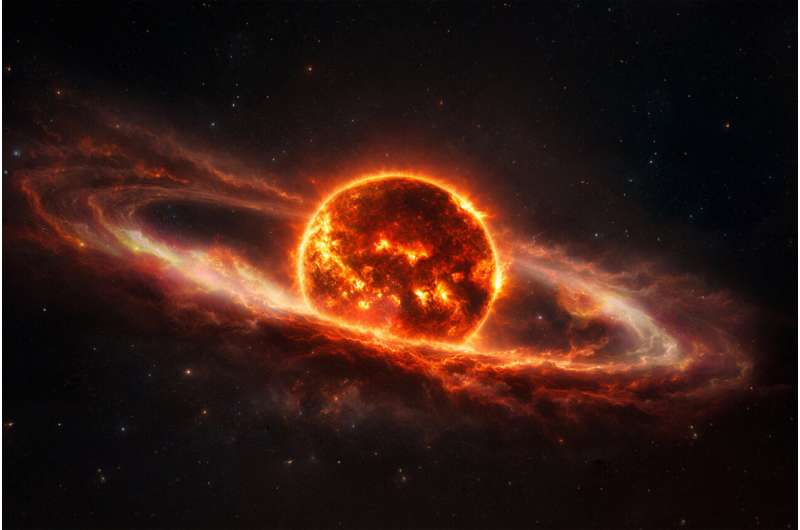
The results were striking. The dimming events were not caused by surface features, but by large clumps of cool plasma trapped in the star’s magnetic field. This plasma forms a doughnut-shaped structure called a torus, orbiting the star while being dragged along by its magnetic field and rapid rotation.
In the case of TIC 141146667, the plasma torus is sculpted into a complex shape, including two dense, pinched clumps on opposite sides of the star. As these clumps pass in front of the star from our point of view, they block some of the light, creating the recurring dips in brightness observed by astronomers.
Naturally Occurring Space Weather Stations
Once this structure was understood, the dimming events stopped being a mystery and became something far more useful. The plasma torus acts as a natural space weather station, revealing how particles behave close to the star.
By studying these plasma rings, astronomers can determine where the material is concentrated, how fast it moves, and how strongly it is controlled by the star’s magnetic field. This provides a rare window into stellar particle environments—something that is otherwise nearly impossible to measure for distant stars.
How Common Are These Plasma Rings?
Based on their analysis, Bouma and Jardine estimate that at least 10% of M dwarf stars may host similar plasma features during their early stages of life. This suggests that these space weather stations are not rare oddities, but a relatively common phase in the evolution of young low-mass stars.
Because many M dwarfs host planets, this also means that a significant number of planetary systems may be shaped by these intense plasma environments early on.
What This Means for Planetary Habitability
Understanding space weather is essential for assessing whether planets can remain habitable. Stellar particles can strip away atmospheres, especially on small rocky planets with weaker gravity. They can also affect atmospheric chemistry and surface radiation levels, influencing whether liquid water and stable climates are possible.
The plasma torus provides a way to connect stellar magnetic activity with the conditions planets actually experience. This helps scientists build more accurate models of planet–star interactions, particularly for M dwarf systems that differ greatly from our own solar system.
An Open Question: Where Does the Plasma Come From?
One major question remains unanswered: the origin of the plasma itself. It is not yet clear whether the material comes directly from the star, possibly through stellar outflows or magnetic activity, or whether it could come from an external source, such as material associated with planets or debris in the system.
Future observations aim to track the source of this plasma and determine how it evolves over time. Answering this question could further clarify how stars and planets exchange material and energy.
Additional Context: Magnetospheres and Stellar Evolution
Magnetic fields play a crucial role in shaping stellar environments. Young stars, especially rapidly rotating ones, tend to have strong magnetic fields that trap and guide charged particles. As stars age and slow down, their magnetic activity generally decreases.
Studying plasma tori around young M dwarfs offers insight not just into habitability, but also into stellar evolution itself, showing how magnetic fields and rotation interact during the early life of a star.
A Serendipitous Step Forward
This discovery highlights how unexpected observations can transform scientific understanding. What once appeared to be odd, unexplained brightness dips are now recognized as powerful tools for studying space weather around distant stars.
While scientists still do not know whether any planets around M dwarfs are truly hospitable to life, this work makes one thing clear: space weather must be part of the conversation. By revealing how particles move and interact near these stars, plasma rings are giving astronomers a new way to evaluate the environments where planets form and evolve.
Research paper:
https://doi.org/10.3847/2041-8213/ade39a