First Galaxy-Wide Wobbling Black Hole Jet Discovered in a Disk Galaxy
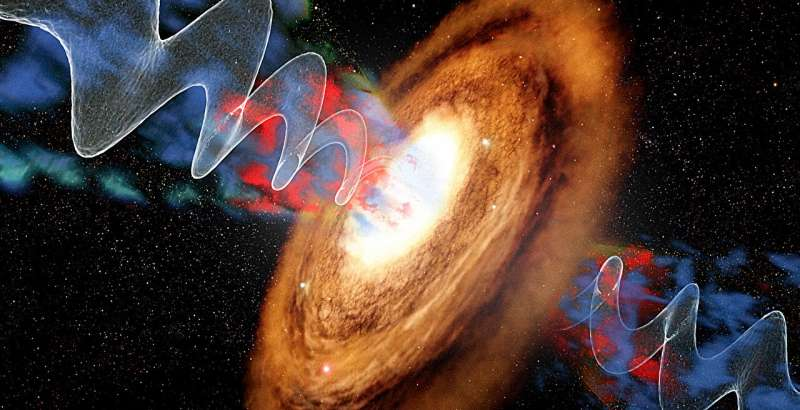
Astronomers have identified something genuinely extraordinary in a nearby galaxy: the first-ever galaxy-wide, wobbling black hole jet found inside a disk galaxy. Using a powerful combination of optical, infrared, and radio telescopes, researchers uncovered a vast stream of super-heated gas stretching tens of thousands of light-years across the galaxy VV 340a. This discovery provides the clearest evidence yet that a supermassive black hole can dramatically reshape its entire host galaxy, not just its immediate surroundings.
The findings come from an international research team led by scientists at the University of California, Irvine and Caltech/IPAC, and were published in the journal Science. What makes this discovery especially compelling is not just the scale of the outflow, but where it is happening—inside a star-forming disk galaxy rather than the massive elliptical galaxies where such extreme black hole activity is usually found.
A Galaxy with an Unexpected Personality
VV 340a is a nearby disk galaxy that is currently in the early stages of merging with another galaxy. Disk galaxies like this one are typically rich in gas and actively forming stars. Until now, astronomers believed that powerful, large-scale jets from supermassive black holes were mostly confined to older, gas-poor elliptical galaxies.
This discovery challenges that assumption in a big way.
Observations revealed massive structures of energized gas extending up to 20,000 light-years from the galaxy’s center, far beyond anything previously observed in a similar system. These structures provide a long-term record of intense activity driven by the galaxy’s central black hole over millions of years.
How Astronomers Saw the Whole Picture
The breakthrough came from combining data across multiple wavelengths, each revealing a different piece of the puzzle.
The Keck Cosmic Web Imager (KCWI) on the Keck II telescope in Hawaiʻi played a crucial role by tracing cooler, lower-energy gas far outside the galaxy’s main disk. This gas forms a long, spear-like structure aligned with the galaxy’s center, acting as a fossil record of sustained outflow activity.
Meanwhile, NASA’s James Webb Space Telescope observed intensely energized coronal gas near the galaxy’s core. Coronal gas is plasma heated to extreme temperatures and is usually confined to regions only a few hundred parsecs wide. In VV 340a, however, this gas stretches across several thousand parsecs, making it the most extended coronal gas structure ever detected.
Completing the picture, radio observations from the Karl G. Jansky Very Large Array (VLA) revealed a pair of plasma jets launched from the black hole. These jets twist into a distinctive helical, S-shaped pattern, providing direct evidence of jet precession—a slow wobbling motion in the jet’s direction over time.
What Does “Jet Precession” Actually Mean?
Jet precession occurs when the direction of a black hole’s jet gradually changes, similar to how a spinning top wobbles as it slows down. This can happen if the black hole’s spin axis is misaligned with its surrounding accretion disk, or if gravitational interactions are at play.
In the case of VV 340a, the precessing jet is especially remarkable because it operates on kiloparsec scales, meaning it affects a huge portion of the galaxy. This is the first time astronomers have observed a precessing jet of this size actively driving a massive gas outflow in a disk galaxy.
Researchers suspect that a second supermassive black hole—possibly the result of the ongoing galaxy merger—could be responsible for the jet’s wobble. Future high-resolution radio observations are planned to investigate this possibility further.
A Jet Powerful Enough to Shut Down Star Formation
One of the most significant outcomes of this discovery is its impact on the galaxy’s future.
As the jet travels outward, it slows down and entrains cooler gas, dragging it along at lower speeds. This process strips VV 340a of star-forming material at a rate equivalent to forming nearly 20 Suns every year. Over time, this level of gas loss can dramatically suppress or even halt future star formation.
This phenomenon is a striking example of active galactic nucleus (AGN) feedback, where energy released by a black hole regulates the growth and evolution of its host galaxy. While AGN feedback has long been theorized and observed in massive ellipticals, seeing it so clearly in a disk galaxy is a major surprise.
Why This Discovery Changes How We Think About Galaxies
The fact that such a powerful, galaxy-wide outflow exists in a relatively young, star-forming galaxy forces astronomers to rethink long-standing ideas about galaxy evolution.
It suggests that supermassive black holes can exert dramatic influence much earlier in a galaxy’s life than previously believed. It also raises intriguing questions about our own Milky Way. While there is no clear evidence of a similar event in our galaxy’s past, this discovery shows that such extreme activity cannot be ruled out.
More broadly, it hints that galaxy-wide black hole-driven outflows may be more common than we currently realize, simply difficult to detect without the right combination of instruments.
Understanding Black Hole Jets in a Broader Context
Black hole jets are narrow beams of relativistic particles launched from the regions near a supermassive black hole’s event horizon. These jets can travel vast distances, interacting with gas both inside and outside their host galaxies.
Jets are typically associated with radio-loud active galaxies, where they can extend for millions of light-years into intergalactic space. However, most known examples exist in elliptical galaxies. The VV 340a jet stands out because it operates within the disk itself, directly reshaping the galaxy’s internal gas supply.
This discovery highlights the importance of multi-wavelength astronomy. Without optical data from Keck, infrared data from Webb, and radio data from the VLA working together, the full scale and impact of this phenomenon would have remained hidden.
What Comes Next
Astronomers are only beginning to understand how common these galaxy-wide, jet-driven outflows may be. Future observations will focus on confirming whether VV 340a hosts a binary supermassive black hole system and on searching for similar systems elsewhere in the universe.
With next-generation observatories and deeper surveys, researchers hope to uncover more examples that will help refine models of black hole growth, galaxy evolution, and cosmic feedback.
For now, VV 340a stands as a striking reminder that black holes—even when buried deep inside seemingly ordinary galaxies—can wield astonishing influence on a cosmic scale.
Research paper:
https://www.science.org/doi/10.1126/science.adp8989