Polar Weather on Jupiter and Saturn Is Revealing Clues About What Lies Deep Inside These Giant Planets
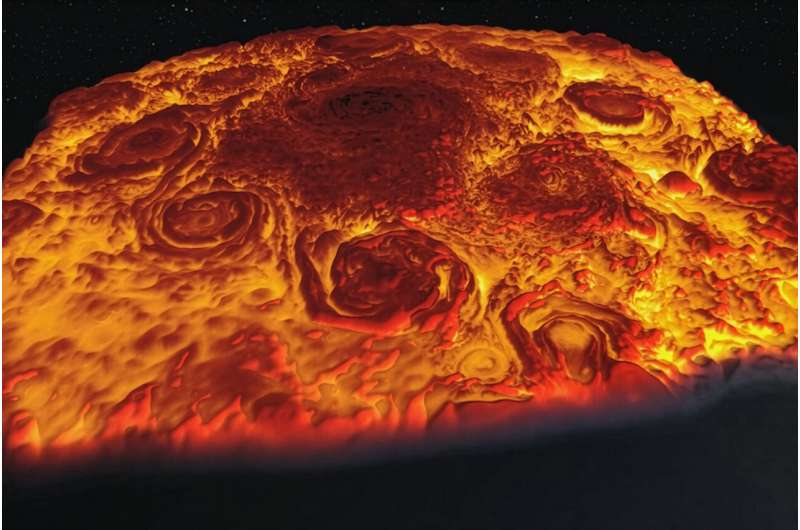
For years, spacecraft flying past Jupiter and Saturn have sent back stunning and sometimes puzzling images of their polar regions. What scientists saw was unexpected: although the two planets are similar in size and composition, their polar weather systems look dramatically different. Jupiter hosts a cluster of massive cyclones packed together near its poles, while Saturn is dominated by a single, enormous vortex with a striking hexagonal shape at its north pole.
This long-standing mystery has now taken a major step toward an explanation. New research from scientists at the Massachusetts Institute of Technology (MIT) suggests that these surface weather patterns may be shaped by something far deeper — the internal structure of the planets themselves. In other words, what we see swirling above the clouds could be hinting at what’s happening thousands of kilometers below them.
What Makes Jupiter and Saturn’s Poles So Different?
Jupiter and Saturn are both gas giants, meaning they are made mostly of hydrogen and helium and lack a solid surface like Earth. They are also similar in size and rotate rapidly, conditions that tend to produce strong atmospheric circulation. Because of these similarities, scientists long assumed their polar weather should look somewhat alike.
Instead, spacecraft observations revealed a striking contrast.
At Jupiter’s north pole, images from NASA’s Juno spacecraft, which has been orbiting the planet since 2016, show a central polar cyclone surrounded by eight smaller cyclones. Each of these storms is enormous, measuring roughly 3,000 miles across, nearly half the diameter of Earth. The arrangement looks orderly, stable, and surprisingly long-lasting.
Saturn, on the other hand, presents a very different picture. Data from NASA’s Cassini spacecraft, which orbited Saturn for 13 years before ending its mission in 2017, revealed a single massive polar vortex at the planet’s north pole. This vortex is about 18,000 miles wide and has a distinctive six-sided, hexagonal shape, a feature that has fascinated scientists since it was first discovered in the early 1980s.
The big question has always been: why do two similar planets produce such different polar storms?
A New Explanation Rooted in Planetary Interiors
The new study, led by Wanying Kang, an assistant professor in MIT’s Department of Earth, Atmospheric and Planetary Sciences, and Jiaru Shi, an MIT graduate student, proposes a surprisingly simple but powerful idea. According to their research, the difference comes down to the “softness” or “hardness” of the base of a polar vortex, which is directly related to the planet’s interior composition.
The researchers describe a polar vortex as something like a spinning cylinder that extends downward through multiple atmospheric layers. While we can only see the top of this structure, its behavior depends strongly on what’s happening at its base.
If the material beneath the vortex is softer and lighter, the vortex cannot grow very large. This limitation allows multiple vortices to coexist, forming a clustered pattern like the one observed on Jupiter.
If the base is harder and denser, the vortex can grow much larger. Over time, it can absorb neighboring vortices, eventually forming a single dominant system, like Saturn’s massive polar cyclone.
How the Simulations Were Done
To test this idea, the MIT team used computer simulations of fluid dynamics. Although polar vortices are technically three-dimensional structures, the researchers used a two-dimensional model to simplify the problem.
This approach works because Jupiter and Saturn rotate extremely fast. In such rapidly rotating systems, fluid motion tends to be uniform along the planet’s rotation axis. This allows scientists to reduce a complex 3D problem into a more manageable 2D one without losing the essential physics.
The model they adapted is based on equations commonly used to study cyclones on Earth, especially those at mid-latitudes. The team modified these equations to reflect conditions near the poles of gas giants.
In each simulation, the researchers varied key planetary properties, including:
- Planet size
- Rotation rate
- Internal heating
- Density and softness of the vortex base
They then introduced random motion, or “noise,” into the system, mimicking the chaotic atmospheric conditions that naturally exist on these planets. From there, they watched how the fluid evolved over time.
Some simulations produced a single large vortex, while others naturally settled into multiple smaller vortices. After analyzing many scenarios, one factor stood out above all others: the physical properties at the base of the vortex.
What This Means for Jupiter and Saturn
If this mechanism accurately reflects what’s happening on Jupiter and Saturn, it suggests that Jupiter’s interior may be composed of softer, lighter material, while Saturn’s interior may contain denser, heavier components.
This idea fits well with other hints from planetary science. Saturn is thought to be more metal-rich than Jupiter and may contain more condensable materials deep inside, leading to stronger internal layering, or stratification. Such stratification would create the “harder” base needed for a single, planet-spanning vortex to form.
In contrast, Jupiter’s interior may be more gradually layered, preventing any one vortex from growing large enough to dominate the pole.
Why Surface Weather Matters So Much
One of the most exciting aspects of this research is its broader implication. Directly studying the interiors of gas giants is extremely difficult, since we cannot drill into them or land probes deep inside their atmospheres for long periods.
This study suggests that surface weather patterns can act as indirect probes of a planet’s interior. By carefully observing atmospheric motion, scientists may be able to infer properties of regions far below the visible clouds.
This approach could eventually be applied not only to Jupiter and Saturn, but also to exoplanets, many of which are gas giants orbiting distant stars.
A Closer Look at Polar Vortices on Gas Giants
Polar vortices are not unique to Jupiter and Saturn. Earth also has polar vortices, although they are far smaller and less stable. What makes gas giant vortices special is their sheer scale and longevity.
On Jupiter and Saturn, these systems can persist for years or even decades, shaped by rapid rotation, deep atmospheres, and powerful internal heat sources. Understanding how these vortices form and evolve is a key step toward understanding planetary weather as a whole, including why storms behave so differently across the solar system.
The Bigger Picture in Planetary Science
This research highlights how interconnected planetary systems really are. Atmospheric dynamics, interior composition, and planetary evolution all influence one another. A storm at the pole is not just a weather feature; it is a visible signature of deep physical processes.
As spacecraft missions continue and simulation tools improve, scientists expect to refine these models further. Future data from Jupiter, Saturn, and beyond may confirm whether vortex softness truly is the missing link between surface weather and planetary interiors.
For now, this study offers a compelling and elegant explanation for one of the solar system’s most intriguing contrasts.
Research paper:
https://doi.org/10.1073/pnas.2500791123