South Pole Telescope Detects Energetic Stellar Flares Near the Center of the Galaxy
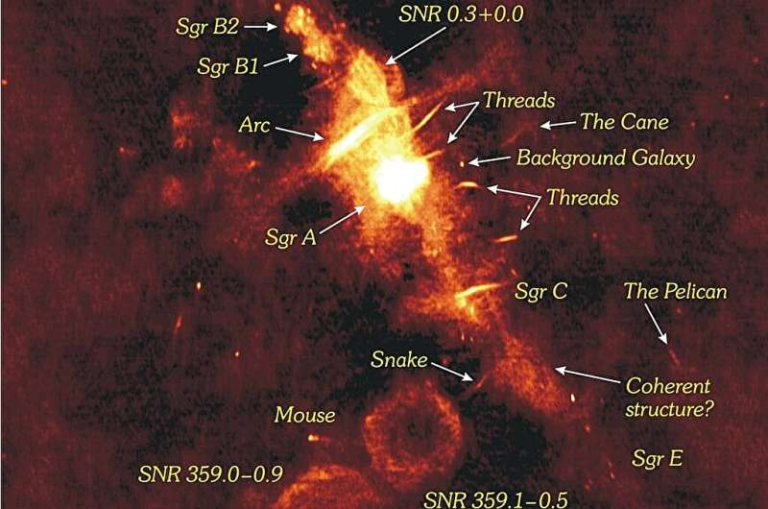
Scientists working with the South Pole Telescope (SPT) have made an exciting and unexpected discovery deep within the heart of the Milky Way. While surveying the Galactic Center, the team detected powerful, short-lived bursts of light coming from two known accreting white dwarf systems. These events stand out not just because of where they occurred, but because of how they were observed—in millimeter wavelengths, something that had never been done before for this kind of stellar activity.
This finding marks a major milestone for time-domain astronomy and highlights how instruments originally built for one purpose can end up revealing entirely new aspects of the universe.
A First for Millimeter-Wavelength Astronomy
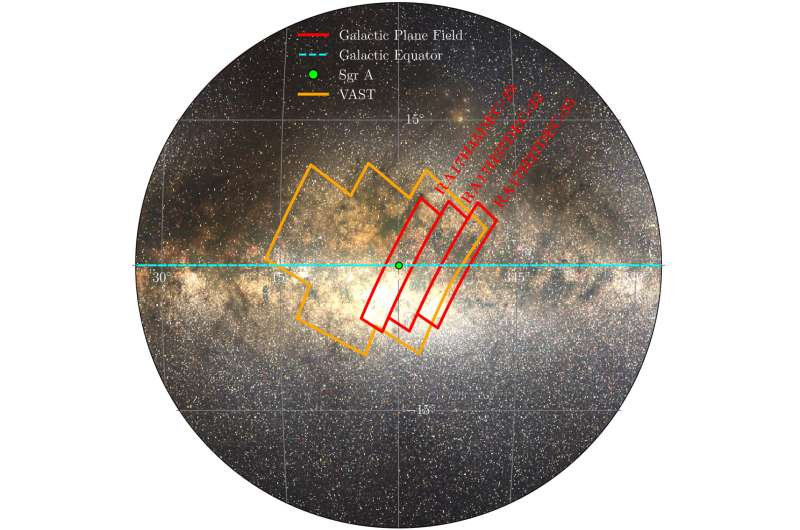
The South Pole Telescope was originally designed to study the cosmic microwave background, the faint afterglow of the Big Bang. Over time, its capabilities expanded, allowing astronomers to conduct detailed surveys of the Galactic Plane, including regions near the center of the Milky Way, one of the most crowded and complex parts of the sky.
During these surveys, researchers identified two energetic flares—brief but intense increases in brightness—originating from accreting white dwarf systems. Each flare lasted for roughly one day, making them short-lived on astronomical timescales, yet long enough to be clearly distinguished from background noise.
What makes this especially notable is that millimeter-band transient discoveries are extremely rare. Most stellar flares and explosive events are typically detected in optical, X-ray, or radio wavelengths. Capturing them at millimeter wavelengths opens an entirely new observational window into high-energy processes happening in dense stellar environments.
What Exactly Was Observed?
The flares were detected as part of the SPT-3G Galactic Plane Survey, which repeatedly scans a large section of the Milky Way rather than focusing on pre-selected targets. This approach allows astronomers to catch unexpected, transient events that might otherwise be missed.
Key observational details include:
- The flares came from two previously known accreting white dwarf systems
- Each event lasted about one day
- The brightness and duration place strong constraints on the size and physical mechanism of the emitting region
- The detections occurred near the Galactic Center, a region heavily obscured in visible light but accessible at millimeter wavelengths
Because the survey continuously revisits the same regions, researchers could confirm that these were genuine transient events rather than long-term variations.
Understanding Accreting White Dwarf Systems
A white dwarf is the dense, compact remnant left behind after a Sun-like star exhausts its nuclear fuel. In some binary systems, a white dwarf orbits closely with a companion star. When the stars are close enough, the white dwarf’s strong gravity can pull gas from its companion.
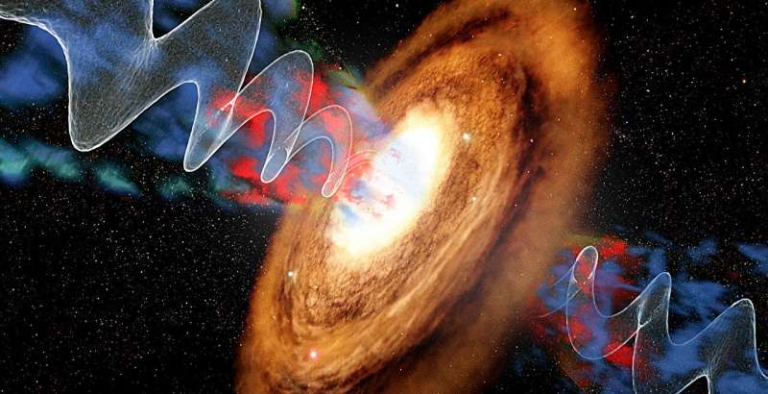
This stolen material doesn’t fall directly onto the white dwarf. Instead, it forms a swirling accretion disk, heating up as it spirals inward. Accretion disks are known to be unstable and highly dynamic, producing variability across the electromagnetic spectrum.
The systems detected by the South Pole Telescope fall squarely into this category, making them ideal laboratories for studying extreme physics under conditions that cannot be replicated on Earth.
What Caused These Flares?
The research team suspects the flares were triggered by sudden magnetic explosions within the accretion flow. This process is similar in principle to solar flares, where magnetic reconnection rapidly releases stored magnetic energy.
However, the environment around a white dwarf is far more extreme than the surface of the Sun. In accretion disks, magnetic reconnection can occur at much higher densities and energies, producing intense, short-lived bursts of radiation that can be observed across multiple wavelengths.
If this interpretation is correct, these millimeter flares provide a new way to probe the magnetic physics of accretion disks, which plays a critical role in:
- Angular momentum transport
- Disk heating
- Outflow and jet formation
- Long-term evolution of compact binary systems
Why the Galactic Center Matters
The center of the Milky Way is one of the most challenging regions of the sky to study. Dense clouds of gas and dust block visible light, making traditional optical surveys less effective. Millimeter-wavelength observations, however, can penetrate this dust, revealing activity that would otherwise remain hidden.
By detecting transient events in this region, the South Pole Telescope demonstrates that millimeter astronomy can capture not just static structures, but also dynamic, fast-changing phenomena. This is a major shift in how astronomers think about the role of millimeter-wave instruments.
The Team Behind the Discovery
The analysis was led by Yujie Wan, a graduate student at the University of Illinois Urbana-Champaign, as part of the international South Pole Telescope collaboration. Researchers developed specialized techniques to identify transients—signals that appear and disappear over short timescales—within a massive dataset collected over multiple observing seasons.
Tom Maccarone, a professor of physics and astronomy at Texas Tech University, joined the project to provide expertise on interacting binary stars. His background proved crucial in interpreting the nature of the newly detected flares.
The team has searched for transients for only two years so far, yet has already uncovered two remarkable events, suggesting that many more discoveries may lie ahead.
What Comes Next for the Survey?
The SPT-3G Galactic Plane Survey will continue observing the Milky Way for about one month each year, gradually building a longer and more sensitive time-domain record of the Galactic Center region.
With each new observing season, the survey improves its ability to detect rare and short-lived events. Over time, this could lead to:
- A growing catalog of millimeter-wavelength transients
- New insights into compact binary evolution
- A better understanding of how magnetic fields behave in extreme environments
The results strongly suggest that millimeter astronomy is no longer limited to mapping the static universe. It can also reveal the Milky Way in motion, catching brief flashes of energy that reshape our understanding of stellar systems.
Why This Discovery Is So Important
This work shows that opening a new observational window almost always leads to surprises. By looking at familiar objects in an unfamiliar way, astronomers are uncovering phenomena that challenge existing assumptions and push theoretical models forward.
The detection of energetic stellar flares at millimeter wavelengths demonstrates that even well-studied systems like accreting white dwarfs still have secrets left to reveal, especially when observed with new tools and fresh perspectives.
Research paper:
Detection of Millimeter-wavelength Flares from Two Accreting White Dwarf Systems in the SPT-3G Galactic Plane Survey – The Astrophysical Journal (2026)
https://doi.org/10.3847/1538-4357/ae2de8