Investigating a Bright Blue Plume Left Behind by Hurricane Melissa
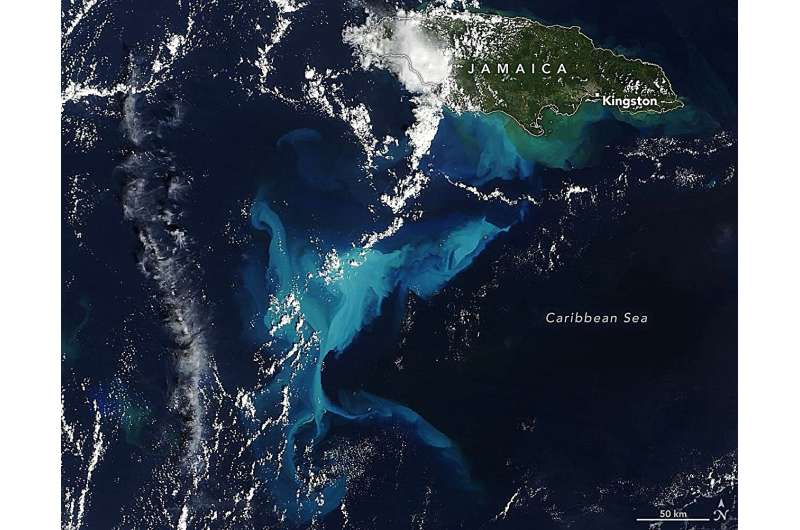
Hurricane Melissa will be remembered not only for its devastating impact on Jamaica but also for the striking and unusual bright blue plume it left behind in the Caribbean Sea. In the days following the storm, NASA scientists observed what may be the largest carbonate sediment resuspension event ever recorded by satellites, turning normally dark waters into a vivid, almost surreal shade of blue. This event has become a major point of interest for oceanographers, climate scientists, and remote-sensing experts around the world.
Hurricane Melissa made landfall in Jamaica on October 28, 2025, as a Category 5 storm, packing sustained winds of 295 kilometers (185 miles) per hour. The storm carved a wide path of destruction across the island, displacing tens of thousands of people, damaging or destroying more than 100,000 structures, severely impacting farmland, and leaving forests brown, stripped, and battered. While the human cost was immense, the hurricane also triggered a rare and scientifically valuable natural event offshore.
Before slamming into land, Melissa lingered over the Caribbean Sea south of Jamaica, moving slowly and churning the ocean with exceptional force. This prolonged interaction with the sea created what scientists later described as a large-scale natural oceanography experiment. When the clouds finally cleared a couple of days after landfall, satellites revealed something extraordinary.
On October 30, 2025, NASA’s Terra satellite, equipped with the MODIS (Moderate Resolution Imaging Spectroradiometer) instrument, captured images of vast swaths of water glowing bright blue south of Jamaica. The color was caused by massive amounts of sediment stirred up from the seafloor, specifically from a carbonate platform known as Pedro Bank.
Pedro Bank is a submerged plateau lying under about 25 meters (80 feet) of water and is slightly larger than the U.S. state of Delaware. Under normal conditions, it is only faintly visible in natural-color satellite imagery. However, powerful disturbances such as hurricanes or strong cold fronts can temporarily reveal its presence. In this case, Hurricane Melissa provided more than enough energy to do just that.
The sediments lifted from Pedro Bank are rich in calcium carbonate (CaCO3) and are composed largely of biological material. These include calcified red algae, flaky sands formed from the remains of Halimeda macroalgae, and fine carbonate mud. The unique, wing-like shape of Halimeda sand grains makes them especially easy to lift and transport in turbulent water, while finer mud particles can remain suspended for longer periods. When these materials are churned into the water column, they scatter sunlight in a way that produces a distinctive Maya blue coloration.
This blue hue is very different from the greenish-brown sediment plumes typically seen near river mouths, where swollen rivers carry soil and organic matter out to sea. That contrast helped scientists quickly identify the source of the plume as marine carbonate sediment rather than land-based runoff.
Researchers noted that Hurricane Melissa generated tremendous stirring power in the water column. While other storms have caused similar effects in the past, none were comparable in scale. For example, Hurricane Beryl in July 2024 caused some brightening around Pedro Bank, but the extent was minor compared to what Melissa produced. Scientists emphasized that acknowledging the human toll of such storms is essential, but from a geophysical perspective, this was an extraordinary and rare observation.
Detailed satellite tracking showed that sediment suspension was visible not only over Pedro Bank but also across other nearby shallow banks, indicating that Melissa affected a total area of about 37,500 square kilometers. This is more than three times the area of Jamaica, making it one of the largest documented sediment resuspension events in the satellite era. Based on decades of studying carbonate sediment transport, experts believe this may be the largest such event ever observed from space.
Beyond its sheer size, the plume revealed complex ocean dynamics. The suspended sediment acted as a natural tracer, illuminating surface currents and swirling eddies. Some portions of the plume extended into the Caribbean Current, which flows west and north, while other patterns suggested the influence of Ekman transport, a wind-driven process that moves surface water at an angle to prevailing winds. In the southern part of the plume, scientists observed the sediment dividing into three distinct branches after encountering small reefs. One eastern branch displayed a cascading, stair-step pattern as sediment gradually sank back toward the seafloor.
Like most resuspension events, the dramatic coloration of the water was temporary. The bright blue tones faded after about seven days as sediment settled out of the water column. However, the effects on Pedro Bank itself may be far more lasting. Scientists suspect the hurricane’s intensity caused what could be described as a near-total wipe of the benthic ecosystem. Seagrasses, algae, and other organisms living on and around the bank were likely heavily damaged or destroyed, and how quickly—or even if—the ecosystem will recover remains uncertain.
One of the most important implications of this event lies in its connection to the global carbon cycle. Tropical cyclones play a key role in moving carbon from shallow marine environments to deeper waters, where it can remain sequestered for long periods. When carbonate sediments are transported to depth, they may also dissolve, influencing ocean chemistry and long-term carbon storage. Events like the Pedro Bank plume provide rare opportunities to observe and quantify these processes in action.
Advances in satellite technology have made it possible to study such events in unprecedented detail. Near-continuous ocean observations have helped scientists refine methods for estimating how much sediment reaches the deep ocean after major storms. Recent work on hurricanes affecting the West Florida Shelf, including Hurricane Ian, laid the groundwork for interpreting what happened after Melissa. Looking ahead, data from NASA’s PACE (Plankton, Aerosol, Cloud, ocean Ecosystem) mission, launched in February 2024, are expected to significantly improve scientists’ ability to analyze sediment composition, movement, and ecological impact using hyperspectral observations.
The Pedro Bank event following Hurricane Melissa stands out as a singular natural experiment, one that cannot be recreated artificially. It offers insights into physical oceanography, marine ecology, sediment dynamics, and Earth’s carbon system all at once. For researchers, it was like watching an entire course in oceanography unfold in real time, driven by one of nature’s most powerful forces.
Research reference:
https://earthobservatory.nasa.gov/features/PedroBankSedimentResuspension