A 120-Million-Year-Old Fossil Bird That Likely Choked to Death on Rocks Has Scientists Asking New Questions
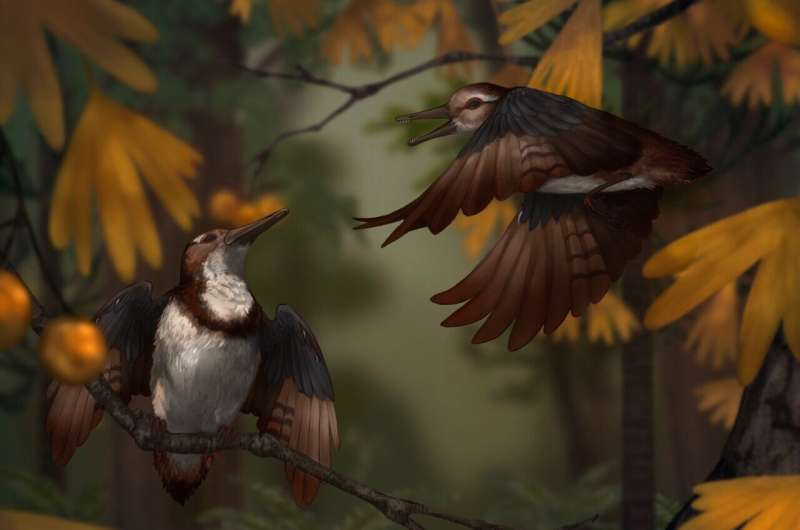
A remarkable fossil discovery from northeastern China is giving scientists one of the clearest — and strangest — glimpses yet into how an individual prehistoric bird may have died. The fossil belongs to a tiny bird that lived around 120 million years ago, during the Early Cretaceous period, and the evidence preserved inside its body suggests a very unusual cause of death: it likely choked on a massive clump of rocks lodged in its throat.
The bird has been identified as a completely new species named Chromeornis funkyi, and while its death appears unusually well documented for the fossil record, the reason behind its behavior remains a mystery that opens new questions about early bird biology, illness, and evolution.
A Tiny Bird with an Unusual Fossil Clue
The fossil was discovered in the Jiufotang Formation in China, a site famous for its exceptionally preserved fossils of early birds, dinosaurs, fish, and plants. It is currently housed at the Shandong Tianyu Museum of Nature, which contains thousands of fossil bird specimens.
Chromeornis funkyi was roughly the size of a modern sparrow, making it one of the smaller birds known from this time period. Despite its small size, it shared several features with a larger group of early birds called longipterygids, including large, prominent teeth at the tip of its beak. These teeth suggest a diet that likely included insects or small vertebrates.
When the fossil was first examined, researchers immediately noticed something that set it apart from every other fossil bird known so far. Preserved in the region of the esophagus, right against the neck bones, was a dense cluster of tiny stones. This mass was impossible to ignore and raised immediate questions about how and why it was there.
More Than 800 Stones in the Throat
Detailed examination revealed that the fossil contained more than 800 tiny stones, packed tightly together in the bird’s throat. These stones appeared as a gray mass in imaging and were clearly located above the stomach, not inside it.
This placement was critical. Many animals, including modern birds, swallow stones known as gastroliths to help grind food in a muscular stomach called a gizzard. However, gastroliths are typically found deep in the digestive system, not lodged in the esophagus.
To rule out the possibility that these stones were simply part of a normal digestive process, researchers conducted CT scans of the fossil. They compared the results with scans from other fossil birds that are known to have had gizzards and gastroliths.
The results were striking. Not only did Chromeornis have far more stones than any known gizzard-bearing bird, but many of the particles were also unusually low in density. Some appeared to be clay-like pellets rather than solid stones, which would have been useless for grinding food.
Based on the number, density, and position of the stones, scientists concluded with high confidence that these were not gizzard stones and that the bird did not swallow them as part of normal feeding behavior.
Evidence the Stones Were Swallowed in Life
Another critical question was whether the stones had entered the fossil after death, perhaps washing into the body during burial. Chemical analysis and spatial arrangement ruled this out.
The stones were tightly clustered in a way that strongly suggests they were swallowed while the bird was alive. Their chemical composition also differed from surrounding sediment, indicating they were not simply deposited by water currents after death.
This makes Chromeornis funkyi the first known fossil animal ever found with such a large mass of stones preserved in its throat, rather than in its stomach or surrounding sediment.
A Likely Cause of Death
With the evidence in hand, researchers believe the most plausible explanation is that the bird choked to death. The mass of stones appears to have become lodged in the esophagus, blocking the airway or preventing breathing.
One leading hypothesis is that the bird may have been ill or under physiological stress. In modern animals, sickness can sometimes trigger abnormal behaviors, including the ingestion of non-food objects — a condition known as pica.
The researchers suggest that Chromeornis may have swallowed an excessive number of stones while unwell and then attempted to regurgitate them as a single mass. Unfortunately, the clump was likely too large to pass back up the throat, resulting in fatal choking.
While this explanation cannot be proven definitively, it fits both the physical evidence and what is known about abnormal feeding behaviors in living birds.
Why This Fossil Is Scientifically Important
It is extremely rare for paleontologists to identify the cause of death of a specific individual in the fossil record. Most fossils preserve bones without any indication of what actually killed the animal.
In this case, the preserved stones provide a direct, physical clue linking behavior to death. Even though scientists cannot yet explain why the bird swallowed the stones, they are confident that the act of regurgitation and blockage of the esophagus caused its death.
Beyond the dramatic circumstances of its demise, Chromeornis funkyi also represents a new species of early bird, adding to the known diversity of prehistoric avian life.
The Bigger Picture: Early Birds and Extinction
Chromeornis belonged to a group of birds called enantiornithines, which dominated the skies during the Cretaceous period. These birds were incredibly diverse and widespread, occupying ecological roles similar to many modern birds.
However, despite their success, enantiornithines went completely extinct when a massive asteroid struck Earth about 66 million years ago. Only one lineage of birds survived that event — the ancestors of all modern birds alive today.
Studying fossils like Chromeornis helps scientists understand why some bird lineages survived while others did not. Factors such as diet, reproduction, growth rates, and physiology may all have played roles in determining survival during catastrophic environmental changes.
Researchers believe that learning more about extinct birds could even offer insights into modern extinction risks, especially as today’s species face rapid environmental disruption.
Why the Name Chromeornis Funkyi?
The species name has a fun origin. Chromeornis funkyi was named after the electronic funk band Chromeo, a nod to the idea that birds are closely associated with sound and vocalization. While this ancient bird almost certainly did not sing like modern birds, it likely produced some form of calls or vocal signals.
The band reportedly embraced the honor, making Chromeornis one of the more lightheartedly named dinosaurs — since birds are technically living dinosaurs.
Extra Context: Gastroliths in Birds
Gastroliths are common in many animals, including crocodiles, dinosaurs, and birds. In modern birds like chickens, swallowed stones are stored in the gizzard to help grind food.
What makes Chromeornis so unusual is that enantiornithine birds generally show no evidence of having a gizzard-based digestive system. This fossil reinforces that idea and highlights how digestive strategies varied widely among early birds.
The discovery also shows that behaviors seen in modern animals, such as abnormal ingestion during illness, may have deep evolutionary roots.
Research Reference
A new small-bodied longipterygid (Aves: Enantiornithes) from the Aptian Jiufotang Formation preserving unusual gastroliths, Palaeontologica Electronica (2025)
https://palaeo-electronica.org/content/2025/XXXX-new-longipterygid-gastroliths