Eye-Opening Research Shows Greenland Sharks Can Maintain Vision for Centuries Through Powerful DNA Repair
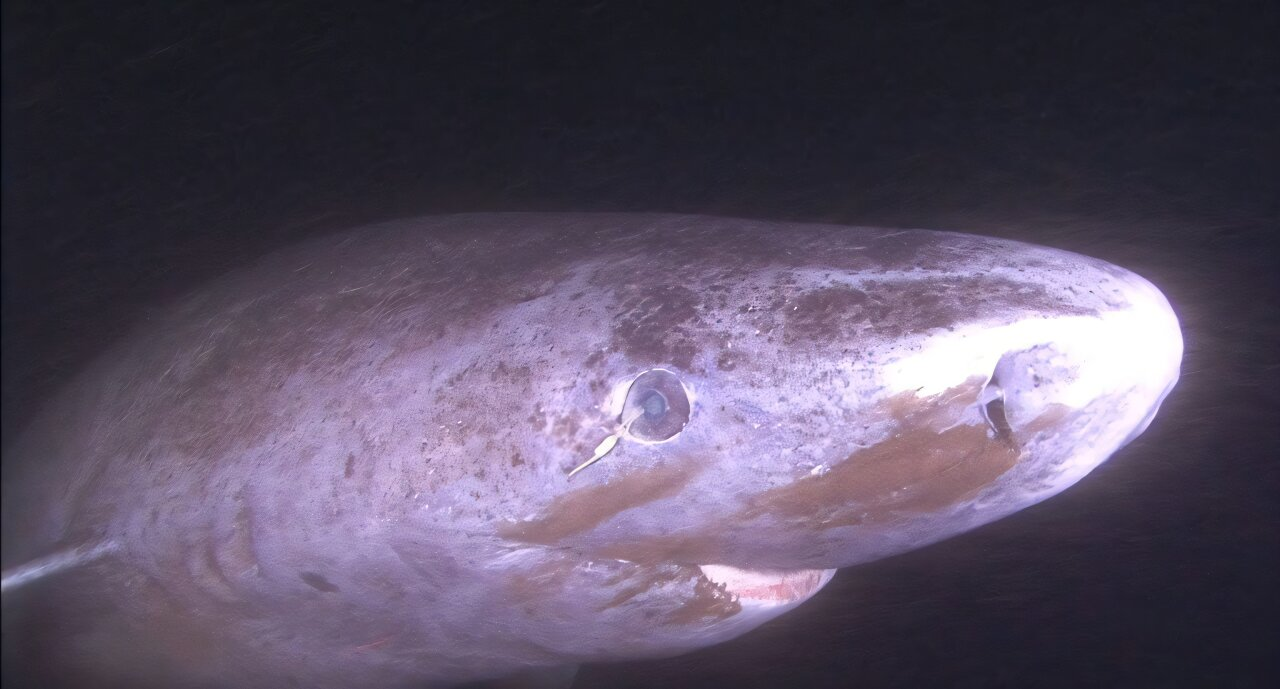
For decades, scientists believed the Greenland shark was more or less blind. Living in the dark, icy depths of the Arctic Ocean and often carrying parasites attached directly to its eyes, the massive and mysterious shark seemed like a creature that had little use for vision. New research now turns that assumption on its head. A detailed scientific study reveals that Greenland sharks not only retain functional eyesight, but are able to preserve it for hundreds of years, thanks to remarkable biological mechanisms that protect their eyes from aging and damage.
The research, led by Dorota Skowronska-Krawczyk, an associate professor of physiology and biophysics at the University of California, Irvine, offers fresh insight into how vision, aging, and longevity intersect in one of the longest-living vertebrates on Earth. Some Greenland sharks are estimated to live up to 400 years, making them a rare window into extreme biological endurance.
Challenging the Long-Held Belief That Greenland Sharks Are Blind
Greenland sharks inhabit deep, cold waters where sunlight barely penetrates. On top of that, many of them carry a parasitic copepod that latches onto the cornea, giving their eyes a cloudy, damaged appearance. Because of this, scientists long assumed that vision had little importance for the species and that the sharks relied mostly on smell or movement detection to survive.
However, while examining video footage of Greenland sharks, Skowronska-Krawczyk noticed something unexpected: the sharks were actively moving their eyes toward light sources. This behavior suggested that their visual systems were doing far more than previously believed.
From an evolutionary standpoint, this observation raised an important question. If an organ is no longer useful, evolution tends to reduce or eliminate it over time. The fact that Greenland sharks retained complex eye structures hinted that vision still plays a meaningful role in their lives.
Studying the Eyes of One of the World’s Oldest Animals
To investigate further, researchers analyzed eyes collected from Greenland sharks caught between 2020 and 2024 near the University of Copenhagen’s Arctic Station on Disko Island, Greenland. The sharks were captured using scientific long lines, and their eyes were carefully removed, preserved, and sent to laboratories for in-depth study.
The examination was a collaborative effort involving researchers from UC Irvine, the University of Basel in Switzerland, the University of Copenhagen, Indiana University South Bend, and the Virginia Institute of Marine Science. This multidisciplinary team brought together expertise in molecular biology, evolutionary biology, marine science, and ophthalmology.
In the lab, scientists conducted histological analysis, which looks at tissue structure under a microscope, along with molecular and genetic studies. The results were striking.
No Signs of Retinal Degeneration After Centuries
Despite the extreme ages of the sharks studied, researchers found no evidence of retinal cell death or degeneration. The retinas were structurally intact, healthy, and functioning in ways that closely resemble those of much younger animals.
One of the most important findings involved rhodopsin, a light-sensitive protein essential for vision in dim environments. The rhodopsin found in Greenland shark retinas remains active and is tuned specifically to detect blue light, which travels farther than other wavelengths in deep ocean water. This adaptation allows the sharks to see in conditions where light is scarce.
The study also showed that Greenland sharks rely primarily on rod cells, which are responsible for low-light vision, while cone cells used for color and bright-light vision are reduced. This setup makes perfect sense for an animal living hundreds of meters below the ocean surface.
DNA Repair as the Key to Lifelong Vision
Perhaps the most groundbreaking aspect of the research is the discovery of a strong DNA repair mechanism operating in the shark’s retinal cells. Over time, DNA damage naturally accumulates in living tissues due to environmental stress, metabolic processes, and aging. In humans and many other animals, this damage eventually leads to cell dysfunction and diseases such as macular degeneration or glaucoma.
In Greenland sharks, however, genes linked to DNA repair are highly active, preventing this damage from building up. This biological maintenance system appears to protect the retina over centuries, allowing vision to remain stable even as the shark ages far beyond the lifespan of most vertebrates.
This discovery has significant implications beyond marine biology. Understanding how these DNA repair pathways work could eventually inform human medical research, especially in the treatment and prevention of age-related eye diseases.
Parasites Don’t Completely Block Vision
Another surprising finding is that the eye parasites commonly seen on Greenland sharks do not completely block their ability to see. While the parasites attach to the cornea and may reduce clarity, enough light still reaches the retina to allow functional vision.
This helps explain why Greenland sharks have retained such a well-preserved visual system. Vision may not be sharp or detailed like that of surface-dwelling animals, but it is clearly useful and functional, especially in detecting movement and light contrasts in dark environments.
Why This Research Matters for Aging Science
Greenland sharks are already famous for their longevity, which was first highlighted in a 2016 study that used radiocarbon dating of eye tissue to estimate their age. This new research adds another layer to the story, showing that extreme lifespan does not necessarily mean a decline in sensory function.
The findings challenge the idea that aging must always involve gradual deterioration. Instead, they suggest that some species have evolved biological safeguards that actively preserve tissues for centuries. Studying these systems may help scientists better understand why aging happens and how it might be slowed or managed.
What We Can Learn From Greenland Sharks
Beyond vision, Greenland sharks offer clues about how long-lived animals maintain healthy tissues across their entire bodies. Their slow metabolism, cold environment, and genetic adaptations likely all contribute to their extraordinary lifespan.
Researchers are particularly interested in how these sharks avoid common age-related problems such as cancer, neurodegeneration, and tissue breakdown. Vision is just one piece of a much larger biological puzzle.
Extra Insight: Why Vision Still Matters in the Deep Sea
Even in near-darkness, vision can be a powerful tool. Many deep-sea animals rely on subtle light cues, bioluminescence, and movement detection to find food and avoid threats. Maintaining vision, even in a simplified form, can offer a survival advantage.
For Greenland sharks, which are slow-moving scavengers and predators, being able to detect light and motion may help them locate prey, navigate their environment, and interact with other marine species.
Looking Ahead
The researchers behind this study emphasize that continued funding and support are essential to further explore these findings. As interest grows in aging research and regenerative medicine, animals like the Greenland shark could play a crucial role in shaping future scientific breakthroughs.
This study not only reshapes our understanding of a mysterious Arctic giant but also opens the door to new questions about how life can endure—and even thrive—over centuries.
Research paper reference:
https://www.nature.com/articles/s41467-025-67429-6