Farm Demonstration Networks Are Driving a Major Increase in Cover Crop Adoption, New University of Illinois Study Finds
A new study from the University of Illinois Urbana-Champaign is offering strong evidence that one of the biggest barriers to conservation farming in the United States may not be money, but learning and trust. According to the research, farm demonstration networks—programs where selected farmers adopt and showcase conservation practices—can significantly increase the adoption of cover crops, one of the most widely promoted yet underused tools in sustainable agriculture.
Cover crops are planted between main crop cycles and are known to improve soil health, reduce nutrient runoff, protect water quality, and lower greenhouse gas emissions. Despite these benefits and the availability of substantial federal subsidies, cover crops are currently used on only about 5% of U.S. agricultural land. This low adoption rate persists even though the federal government spends billions of dollars annually on cost-share programs and conservation incentives.
The new study, published in Conservation Letters, suggests that financial incentives alone are not enough. Instead, peer-based learning and visibility appear to play a critical role in encouraging farmers to adopt new practices.
What the Study Looked At
The researchers focused on a farm demonstration program in eastern Wisconsin that was rolled out gradually across neighboring watershed regions. This phased rollout created a unique opportunity to study how cover crop adoption changed over time and space as the program expanded.
Rather than relying on surveys or self-reported data, the research team used remote sensing and satellite imagery to track changes in cover crop acreage. This allowed them to observe real-world behavior across large areas and multiple years, providing a quantitative analysis that had not previously been done for demonstration farm programs.
By comparing satellite data from before and after the program’s implementation—and by analyzing differences between areas with and without demonstration farms—the researchers were able to isolate the program’s impact.
A Clear Increase in Adoption
The results were striking. Within four years of the program’s implementation, cover crop adoption in the program region increased from about 6% to 9%. While that may sound modest at first glance, it represents a 50% increase over baseline levels, which is substantial for a practice that has historically been slow to spread.
Importantly, the researchers ruled out other possible explanations for this increase. Changes in state policy, shifts in farm income, and broader agricultural trends were all considered and controlled for. The remaining effect was strongly linked to the presence of the demonstration network itself.
Why Proximity Matters
One of the most interesting findings was the role of geographic proximity. The study found that adoption rates were even higher among farms located within 5 to 10 kilometers of a demonstration farm.
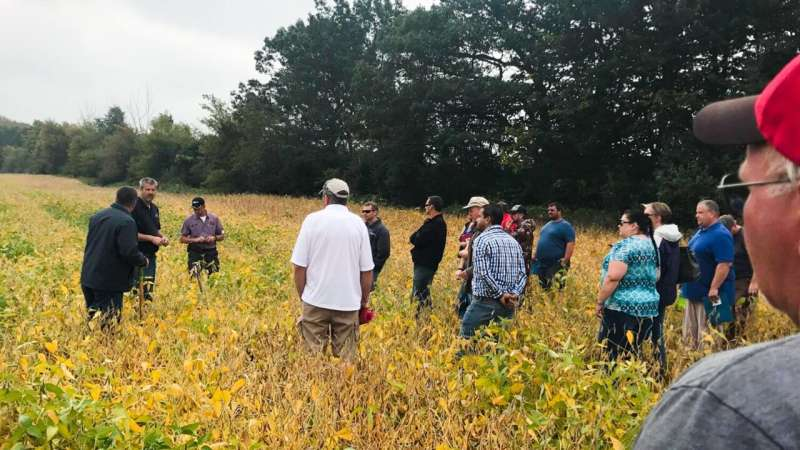
This suggests that seeing practices in action matters. Farmers who pass by fields planted with cover crops, attend nearby field days, or talk directly with demonstration farmers are more likely to try the practice themselves. The visibility of real-world results appears to reduce uncertainty and lower the perceived risks associated with changing long-standing farming routines.
In short, farmers are more likely to adopt new practices when they can see neighbors successfully using them.
Adoption Takes Time
Another key insight from the study is that adoption does not happen overnight. The researchers observed that increases in cover crop use typically began one year after the demonstration program became active in a given area.
This delay makes sense. Demonstration farmers first need time to plant and manage cover crops themselves. Only after others see the results—both positive outcomes and practical challenges—does wider adoption begin.
Adoption continued to rise for several years, eventually peaking around four years after program implementation. This pattern suggests a gradual diffusion of knowledge, trust, and social acceptance, rather than a quick response to incentives or mandates.
Why Demonstration Networks Work
Farm demonstration networks address several barriers that traditional conservation programs struggle to overcome:
- Learning curves associated with new practices
- Upfront costs and perceived risks
- Uncertainty about local effectiveness
- Lack of trusted information sources
By relying on farmer leaders rather than top-down messaging, these programs tap into peer-to-peer learning, which has long been recognized as one of the most powerful drivers of behavior change in agriculture.
The study’s findings support the idea that demonstration networks should be viewed as a complement to payment-based programs, not a replacement. Financial incentives may encourage initial interest, but social learning helps sustain and expand adoption.
Lessons for Future Conservation Programs
Although this study focused specifically on cover crops, its implications extend to other conservation practices such as nutrient management, reduced tillage, and water protection strategies.
Two lessons stand out:
First, the density of demonstration farms matters. Programs that invest in training and supporting more demonstration leaders may see broader regional impacts, especially if those leaders are strategically distributed.
Second, long-term funding and planning are essential. Because adoption unfolds over several years, short-term pilot programs may underestimate the true impact of demonstration-based approaches.
A Broader Look at Cover Crops
Cover crops have gained increasing attention in recent years due to their role in climate-smart agriculture. Common species include cereal rye, clover, radishes, and vetch, each offering different benefits such as nitrogen fixation, erosion control, or weed suppression.
However, adoption has remained uneven due to challenges like additional labor, equipment needs, and uncertainty about yield impacts. Studies like this one help clarify how information networks and social dynamics can help overcome those barriers.
As policymakers and agricultural organizations look for ways to improve the effectiveness of conservation spending, this research provides strong evidence that who delivers the message may matter just as much as how much money is offered.
Why This Study Stands Out
What makes this research especially notable is its methodological rigor. By combining satellite data, spatial analysis, and a phased program rollout, the researchers produced one of the clearest causal links yet between demonstration programs and conservation adoption.
It moves the conversation beyond anecdotal success stories and provides measurable proof that demonstration networks can change farming behavior at scale.
For a country investing billions in conservation, that insight could have long-lasting implications for how programs are designed and evaluated.
Research Paper:
https://doi.org/10.1111/conl.13164