Genetic Breakthrough Offers New Hope for Rice Facing High Nighttime Temperatures
Researchers have taken a significant step toward protecting global rice production from the growing threat of rising nighttime temperatures. A team from the Arkansas Agricultural Experiment Station has uncovered how a powerful genetic regulator in rice, known as HYR (short for Higher Rice Yield), can help the crop maintain both yield and grain quality even when night temperatures climb to levels that usually cause severe damage.
For context, rice is extremely sensitive during its flowering and grain-filling stages. Just two or three nights above 82.4 Fahrenheit can cause up to 90% yield loss and lead to a quality problem called grain chalkiness—a visible white, opaque texture that weakens grain structure, reduces milling output, and lowers cooking quality. As climate models predict warmer nights across major rice-producing regions, understanding how rice genetics responds to nighttime heat has become critical.
How HYR Was Discovered and Why It Matters
HYR did not appear suddenly in recent research; it traces back to a 2014 genome-wide regulatory association study led by Professor Andy Pereira. His team identified HYR as a central master regulator of rice growth and stress response. Unlike typical genes that control just one or two functions, HYR acts as a genetic hub, switching on an extensive network of downstream genes involved in photosynthesis, energy production, and grain development.
In earlier experiments, Pereira’s group demonstrated that activating HYR boosted rice yield under both normal agricultural conditions and periods of drought stress. This already suggested that HYR was tied to the plant’s deepest survival mechanisms. But the more recent work, conducted with research scientist Julie Thomas, goes further by connecting HYR directly to resilience against high nighttime temperatures.
What the New Study Reveals About HYR’s Role in Nighttime Heat Tolerance
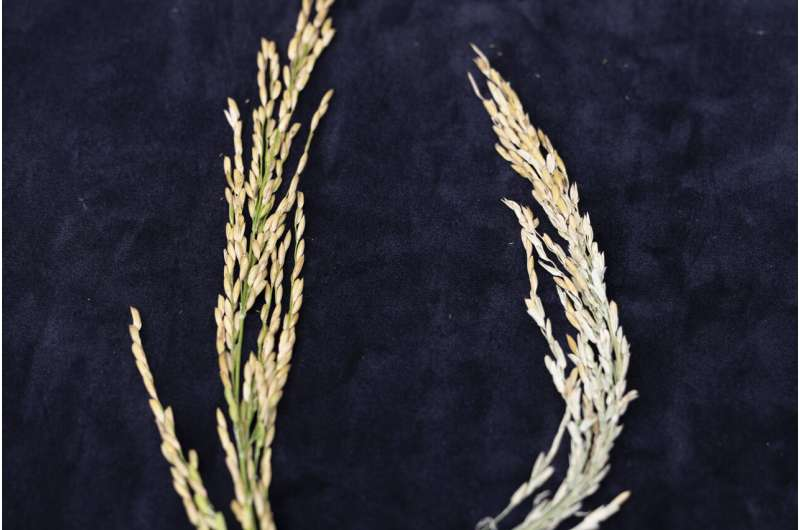
Pereira and Thomas examined how HYR behaves in a widely cultivated rice variety known for its high levels of chalkiness. When they overexpressed HYR—meaning the plant produced more of the HYR protein than usual—the results were striking. Even when exposed to repeated 88-degree Fahrenheit nights inside controlled greenhouse conditions, these HYR-enhanced plants showed normal grain filling, improved seed set, and significantly reduced chalk formation.
In contrast, typical rice plants subjected to the same temperatures displayed sterility, unfilled florets, and serious disruptions in pollen viability—all of which lead to drastic yield losses.
The HYR-activated plants managed to sustain:
- Stable photosynthetic efficiency
- Stronger cell wall integrity
- More stable starch granule structure
- Improved carbon metabolism throughout grain filling
All of these processes normally degrade under heat stress, particularly at night when the plant relies heavily on its stored daytime energy. HYR’s ability to keep these systems functioning appears to be the key reason for the reduced chalkiness and higher yields observed in the study.
Expanding the Search: Global HYR-Related Haplotypes
To understand how widely applicable HYR might be, Thomas worked with Awais Riaz, a Fulbright graduate student, to study HYR-associated haplotypes across rice cultivars worldwide. Haplotypes are groups of genetic markers that tend to appear together, and they can reveal how genetic variation relates to important traits.
Their analysis identified distinct HYR-related haplotypes linked to critical factors such as:
- Energy production efficiency
- Plant metabolism
- Grain quality characteristics
This means HYR’s influence is not limited to a single rice variety—it appears across diverse global cultivars, giving breeders a broad foundation to work from.
HYR Is Not Alone: Other Genetic Regulators in the Network
Pereira’s lab has also pinpointed additional transcription factors that help rice tolerate drought, heat, and disease. Like HYR, these regulators operate within genetic networks controlling:
- Photosynthesis pathways
- Carbon allocation and processing
- Plant water balance
- Hormone signaling that governs stress response
Together, these genes form a coordinated molecular system designed to help rice adapt to challenging environments. HYR stands out because of its strong upstream position in this network, meaning its activation influences numerous downstream responses at once.
Why High Nighttime Temperatures Hurt Rice So Much
Nighttime heat is uniquely damaging to rice for several reasons:
- The plant cannot cool off or recover from daytime stress.
- Respiration rates increase, using up energy needed for grain production.
- Starch synthesis becomes unstable, leading to chalky grains.
- Pollen becomes less viable, reducing fertilization success.
This combination makes nighttime heat more harmful than many forms of daytime stress. Unfortunately, global nighttime temperatures are rising faster than daytime temperatures in many regions, increasing the urgency of this research.
What This Means for Rice Breeding and Climate Resilience
HYR’s identification as a major regulator offers several future pathways:
- Conventional breeding
Breeders can screen for natural HYR-linked haplotypes to develop new heat-tolerant varieties. - Marker-assisted selection
HYR-related markers allow breeders to incorporate resilience traits more precisely and quickly. - Genetic overexpression strategies
As demonstrated in the greenhouse, boosting HYR activity could significantly reduce chalkiness and stabilize yield. - Integration with other stress-tolerance genes
Since several regulators have been identified, future rice varieties could combine multiple traits for drought, heat, and disease resilience.
Given that rice feeds more than half the world’s population, improving its resilience has enormous implications for food security.
Additional Context: Why Grain Chalkiness Is a Serious Problem
Chalkiness is not merely a cosmetic issue. It directly affects:
- Milling efficiency: Chalky grains break easily.
- Market value: Buyers prefer translucent, non-chalky grains.
- Cooking quality: Chalky rice absorbs water unevenly and may cook inconsistently.
- Consumer perception: Many markets view chalkiness as lower quality.
High nighttime temperatures are one of the biggest drivers of chalkiness, making HYR-driven reductions especially meaningful.
The Future of Heat-Resilient Rice
As climate change continues to shift temperature patterns, especially nighttime temperatures, solutions like HYR may play a central role in keeping rice production stable. The research uncovers not just one genetic mechanism but a framework for understanding how rice naturally responds to heat stress—and how we can strengthen that response.
Breeding programs worldwide may soon be able to use HYR and related regulators to help rice maintain:
- Yield stability
- Grain quality
- Photosynthetic strength
- Overall plant resilience
This marks a promising direction for agricultural genetics in a warming world.