How Light Reflecting Off Leaves Could Help Scientists Detect Dying Forests Early
Early warning signs are everything when it comes to forest health. Once trees begin showing visible damage from drought, disease, or pests, it is often already too late for meaningful intervention. A new scientific study suggests that the way light reflects off leaves may provide researchers with a powerful early-detection tool—one that works at the genetic level and can be scaled to monitor entire forests from the sky.
This research, conducted by scientists at the University of Notre Dame and published in Communications Earth & Environment in 2025, connects hyperspectral reflectance—data captured by advanced sensors—to gene expression inside tree leaves. The findings could transform how forest health is monitored, especially in regions increasingly threatened by drought, disease, and wildfires.
Why Monitoring Forest Health Is So Difficult
Forests are vast, complex ecosystems, and assessing their overall health has always been a challenge. Traditional methods rely on field sampling, where researchers physically collect plant material and analyze it in laboratories. While accurate, this approach is time-consuming, expensive, and impractical for monitoring large forested areas.
Modern genomics can reveal which genes are active inside a plant, offering insight into stress responses, water availability, and disease resistance. However, large-scale genomic sampling across forests remains financially and logistically prohibitive.
Remote sensing—using aircraft or satellites to capture images of forests—has helped bridge this gap. These tools can already measure canopy structure, tree height, and general vegetation condition. The problem is that most current analyses lack biological depth, meaning they don’t reveal what is happening at the molecular or cellular level inside trees.
This new study attempts to close that gap.
Linking Light Reflectance to Gene Activity
At the center of the research is spectral reflectance, a measure of how much light a leaf reflects at different wavelengths in the visible and near-infrared spectrum. Every leaf has a unique reflectance pattern based on its chemical composition, structure, water content, and physiological condition.
Until now, reflectance data has mainly been used to infer physical traits like chlorophyll levels or moisture content. What the Notre Dame team set out to test was whether reflectance could also be linked to specific gene expression patterns.
The answer turned out to be yes.
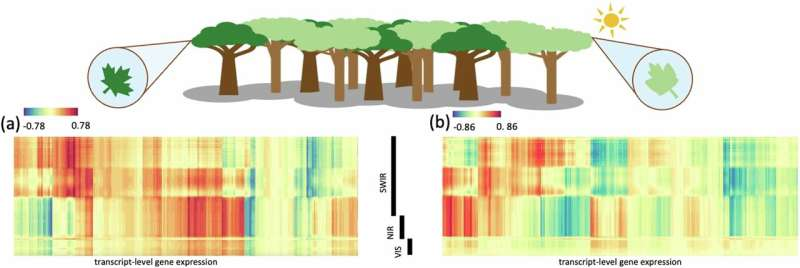
The researchers discovered that reflectance at particular wavelengths strongly correlates with the activity of genes involved in photosynthesis, drought response, water regulation, and plant defense mechanisms. In more than half of the genes studied, distinct reflectance “signatures” consistently appeared when those genes were active.
This means that reflected light can serve as a proxy for molecular processes happening inside leaves.
Fieldwork Across the Upper Midwest
To test this idea in real-world conditions, the research team collected leaf samples from two widespread North American tree species: sugar maple and red maple. Sampling took place at the University of Notre Dame Environmental Research Center (UNDERC), located in northern Wisconsin and Michigan’s Upper Peninsula.
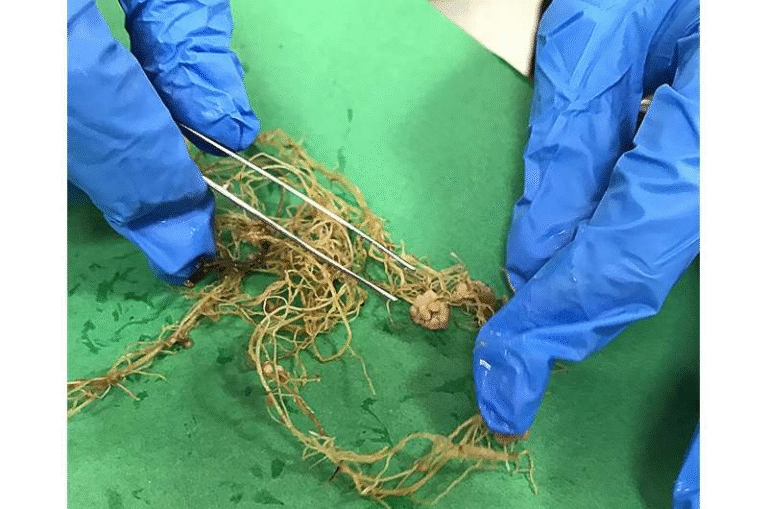
Each leaf sample underwent a two-step process. First, researchers measured reflectance directly from the leaf surface using specialized sensors. Immediately after, the leaves were preserved for gene expression analysis in the lab.
The genetic analysis focused on genes linked to:
- Water stress and drought tolerance
- Photosynthetic efficiency
- Responses to pests and pathogens
- General stress signaling pathways
By pairing reflectance data with gene expression results, the researchers were able to identify statistically strong relationships between specific wavelengths of light and specific genetic responses.
Scaling From Leaves to Entire Forests
While this study was conducted at the leaf level, its implications extend far beyond individual trees. According to the researchers, these findings could be scaled up to allow genomic-level monitoring of whole forests.
Modern aircraft and satellites already carry hyperspectral sensors capable of capturing reflectance data across thousands of wavelengths. If reflectance can reliably predict gene expression, then scientists could potentially map stress responses across entire landscapes without touching a single leaf.
The research team points to earlier work from 2024, published in PLOS Biology, which used artificial intelligence and satellite imagery to map tree species across the U.S. National Ecological Observatory Network. That AI model was able to identify tree species based on canopy images alone.
When species identification models are combined with:
- reflectance-based gene expression predictions, and
- species-specific genetic profiles,
scientists could generate detailed health assessments for individual trees or forest regions.
Why Early Detection Matters
One of the most promising aspects of this research is its potential for early intervention. Genetic changes often occur long before visible symptoms like leaf discoloration, canopy thinning, or dieback.
Detecting stress at the genomic level could help land managers:
- Identify drought-stressed trees before irreversible damage occurs
- Spot disease outbreaks in their earliest stages
- Prioritize areas for conservation or treatment
- Reduce wildfire risk by addressing weakened vegetation early
In an era of climate change and increasing environmental extremes, such early-warning systems could prove critical.
The Role of Hyperspectral Imaging
Hyperspectral imaging differs from standard photography by capturing data across hundreds of narrow wavelength bands instead of just red, green, and blue. This allows scientists to detect subtle differences in reflectance tied to:
- Pigment composition
- Leaf water content
- Cellular structure
- Biochemical compounds
These same factors influence gene activity, which helps explain why reflectance and gene expression are so closely linked.
As hyperspectral sensors become more common on satellites, drones, and even platforms like the International Space Station, the ability to apply this research at scale becomes increasingly realistic.
Collaboration Across Disciplines
The study highlights the importance of interdisciplinary collaboration. Ecologists, genomic scientists, remote sensing experts, and data scientists all played essential roles in designing the experiment, analyzing the data, and interpreting the results.
The research team included postdoctoral scholars, graduate students, and former students, reflecting a collaborative approach that bridges traditionally separate scientific fields. This kind of integration is increasingly necessary as environmental challenges grow more complex.
What This Means for the Future of Forest Science
By demonstrating a direct link between light reflectance and gene expression, this study opens the door to a new way of understanding forests—not just as collections of trees, but as living systems whose molecular health can be monitored remotely.
While more research is needed to expand this approach to additional species and environments, the foundation has been laid. The ability to detect forest decline early, accurately, and at scale could reshape conservation strategies worldwide.
Research paper:
https://www.nature.com/articles/s43247-025-02696-1