How Scientists Are Re-Engineering Photosynthesis to Strengthen Global Food Security
Photosynthesis sits quietly at the foundation of human civilization. Every grain of rice, every loaf of bread, and every vegetable on a dinner plate traces its energy back to sunlight captured by plants. Yet despite its central role, photosynthesis is far from perfect. Scientists have long known that this ancient process contains inefficiencies that limit how much food crops can produce—limitations that matter more than ever in a world facing climate change, population growth, and pressure on farmland.
A major new scientific review published in the journal Cell takes a deep look at how improving photosynthesis could help meet future food demands. Written by researchers from the University of Illinois and collaborators across eight institutions worldwide, the paper assesses where the field stands today and how close we are to turning theory into real-world agricultural gains.
Why Photosynthesis Deserves a Closer Look
At its core, photosynthesis is the process by which plants use sunlight, carbon dioxide, and water to produce sugars and oxygen. Those sugars fuel plant growth and, ultimately, nearly all food consumed by humans and animals. Fossil fuels, too, are ancient products of photosynthesis.
Despite its importance, photosynthesis evolved under conditions very different from modern agriculture. It was shaped by natural selection for survival, not for maximum efficiency or crop yield. As a result, modern crops often fail to capture and convert sunlight as effectively as they could.
The new review argues that even modest improvements in photosynthetic efficiency could translate into significant increases in food production, without requiring more land, water, or fertilizer.
A Decade of Progress Revisited
This paper builds on an influential review published ten years ago by several of the same authors, including plant biologists Stephen Long and Amy Marshall-Colon, along with Chinese Academy of Sciences researcher Xin-Guang Zhu. That earlier work outlined theoretical pathways for improving photosynthesis.
What’s different now is that many of those ideas have moved beyond the lab. According to the authors, the last decade has seen rapid advances, with multiple photosynthesis-enhancing strategies now tested in real crops under field conditions.
The new review reflects on what has worked, what still needs development, and which approaches hold the greatest promise for boosting yields in a changing climate.
The Scientists Behind the Study
The review was coauthored by University of Illinois researchers Stephen Long, Amy Marshall-Colon, and Lisa Ainsworth, along with chemical and biomolecular engineering professor Diwakar Shukla. The team includes experts in plant biology, engineering, modeling, and computational biology.
Many of the authors are part of Realizing Increased Photosynthetic Efficiency (RIPE), an international research initiative based at the Carl R. Woese Institute for Genomic Biology. RIPE focuses specifically on enhancing photosynthesis in food crops and is supported by Gates Agricultural Innovations (Gates Ag One).
The paper also carries emotional weight within the scientific community. Both Stephen Long and Amy Marshall-Colon passed away earlier this year, making the publication a reflection of their long-term vision for feeding the world through science.
Rubisco: The Enzyme at the Center of Attention
One of the most important targets discussed in the review is Rubisco, the enzyme responsible for capturing carbon dioxide and turning it into sugars. Rubisco is essential—but flawed.
Instead of always binding carbon dioxide, Rubisco sometimes reacts with oxygen. This mistake triggers a wasteful process called photorespiration, which consumes energy and reduces overall efficiency.
The review outlines several strategies scientists are using to address this problem:
- Engineering improved versions of Rubisco through lab-directed evolution so it makes fewer mistakes.
- Encouraging plants to produce more Rubisco, increasing total carbon fixation despite inefficiencies.
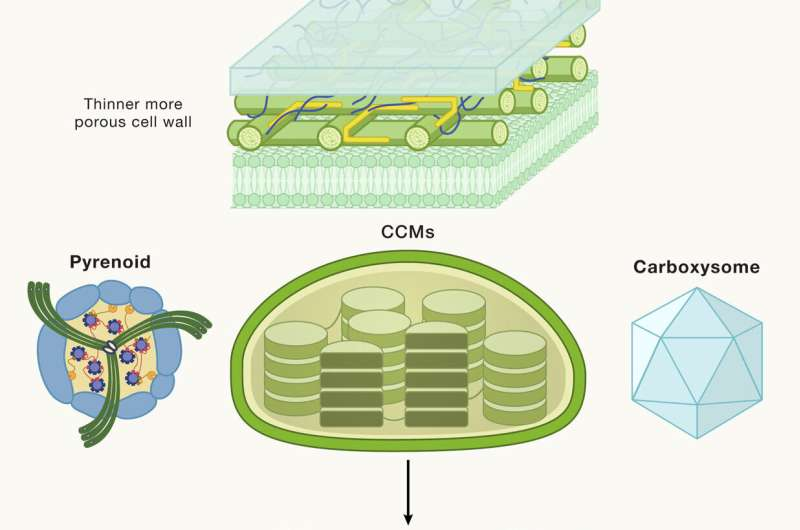
- Designing carbon-concentrating mechanisms that raise carbon dioxide levels around Rubisco, reducing oxygen interference.
- Introducing synthetic photorespiration bypass pathways that recycle energy more efficiently when mistakes occur.
Some of these approaches have already increased photosynthetic carbon gain and crop yields in field trials, a major milestone for the field.
Making Better Use of Sunlight
Photosynthesis isn’t just about chemistry—it’s also about how plants capture light. In dense crop fields, upper leaves often absorb more sunlight than they need, while lower leaves remain shaded and underproductive.
The review highlights research focused on reshaping plant architecture to encourage cooperation rather than competition among leaves. Strategies include:
- Adjusting leaf angles so sunlight penetrates deeper into the canopy.
- Modifying chlorophyll levels to prevent upper leaves from absorbing excessive light.
- Improving how quickly plants switch from protective modes in bright sunlight to efficient light-harvesting under cloudy conditions.
These changes help crops distribute light more evenly, increasing total photosynthesis across the plant.
Technology Driving Faster Discovery
One reason progress has accelerated is the arrival of powerful new tools. The authors point to advances such as:
- Dynamic protein modeling, which allows researchers to simulate how enzymes like Rubisco behave in real time.
- Advanced imaging techniques that reveal the internal air spaces of leaves and how gases move through them.
- Improved computational models that link molecular changes to whole-plant and field-scale outcomes.
Together, these tools make it possible to test ideas faster and predict which strategies are most likely to succeed in real agricultural environments.
From Theory to Fields
Perhaps the most important message of the review is that photosynthesis enhancement is no longer speculative. Over the past decade, the field has moved from proof-of-concept experiments in model plants to field testing in food crops.
According to the authors, this transition marks a turning point. Improving photosynthesis is now considered an achievable and practical component of modern crop improvement, rather than a distant scientific dream.
Why This Matters for Global Food Security
Improving photosynthesis offers a rare opportunity: producing more food without expanding farmland. That means less pressure on forests and natural ecosystems, better resilience to climate stress, and more stable yields for farmers.
As global temperatures rise and weather patterns become more unpredictable, crops with enhanced photosynthetic efficiency may be better equipped to maintain productivity under stress.
The Bigger Picture of Photosynthesis Research
Beyond agriculture, photosynthesis research influences fields like renewable energy, carbon capture, and climate modeling. Understanding how plants manage energy and carbon continues to inspire innovations far outside farming.
This review reinforces the idea that photosynthesis—an ancient process refined over billions of years—still has untapped potential when guided by modern science.
Research Paper Reference:
Stephen P. Long et al., Feeding from the sun—Successes and prospects in bioengineering photosynthesis for food security, Cell (2025).
https://doi.org/10.1016/j.cell.2025.10.033