How Scientists Discovered That Loggerhead Turtles Navigate by Actually Feeling Earth’s Magnetic Field
Loggerhead sea turtles have amazed scientists for decades with their ability to travel thousands of kilometers across open ocean with astonishing accuracy. These tiny hatchlings leave the very beach where they were born and begin a years-long journey across the Atlantic, somehow always knowing where they are and where to go next. For a long time, biologists knew that turtles use Earth’s magnetic field to guide themselves, but one critical question remained: How, exactly, are they sensing it?
A new study from researchers at the University of North Carolina at Chapel Hill has finally answered the mystery. It turns out that hatchling loggerheads don’t rely on a vision-based magnetic sense, as some theories proposed—they literally feel the magnetic field using magnetite particles in their bodies. This mechanism allows them to read their built-in geographic map. The team discovered this by training hatchlings to “dance” in response to certain magnetic fields, then temporarily disrupting that sense with a magnetic pulse.
Below is a detailed breakdown of what the researchers found, how they found it, and what this means for the broader scientific understanding of animal navigation.
How Loggerhead Turtles Use Magnetic Navigation
Loggerhead turtle hatchlings are born equipped with two distinct magnetic abilities:
- A magnetic compass, which tells them the direction they’re traveling.
- A magnetic map, which tells them where they are on Earth.
The compass sense likely comes from a light-dependent chemical reaction, while the map sense has been linked to tiny magnetite crystals inside the turtle’s tissues. These crystals physically move in response to magnetic fields, allowing the turtle to detect changes—essentially providing a tactile sense of magnetism.
The new research focused entirely on this map sense. Scientists wanted to know definitively whether the turtles use magnetite to feel magnetic fields or whether they rely instead on a light-activated mechanism that lets them “see” magnetic patterns. Resolving this question had major implications, not just for turtles but for the entire field of magnetoreception biology.
Teaching Turtles to “Dance” for Science
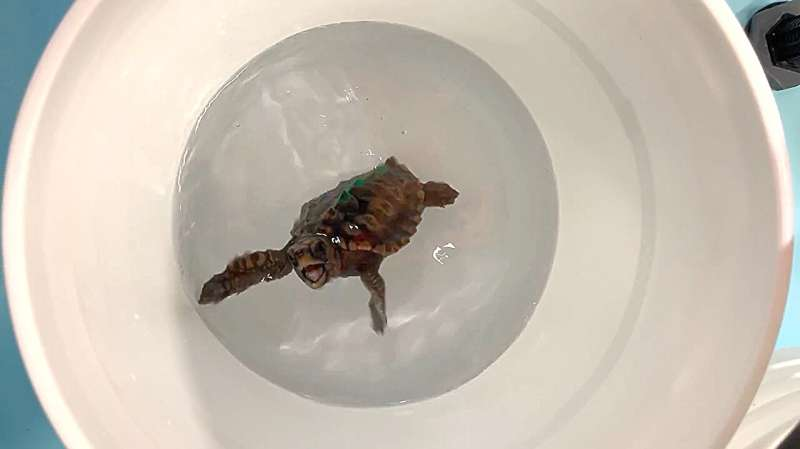
The key to cracking the mystery came from a clever behavioral discovery: hatchling turtles can be conditioned to associate a magnetic field with food. When they recognize the trained magnetic field later, they perform a unique behavior—something researchers refer to as the “dance.”
This dance includes:
- Lifting and tilting their bodies
- Opening their mouths
- Waggling their flippers in an excited display
It’s a clear, consistent signal that the hatchling recognizes a particular magnetic field. Researchers Kayla Goforth, Catherine Lohmann, Ken Lohmann, and colleagues used this learned behavior as an indicator of whether the turtles’ magnetic senses were functioning normally.
To condition the turtles, the team:
- Placed hatchlings in a specially controlled magnetic field that matched a real location on Earth.
- Fed them while they were in that field, so they learned to associate it with food.
- Repeated this process over several weeks until the turtles reliably danced when re-exposed to the same magnetic conditions.
Some turtles were trained to recognize the magnetic field around Turks and Caicos, while others learned the field associated with Haiti. The training took nearly two months, with researchers feeding and conditioning eight newly hatched loggerheads at a time.
Once the turtles demonstrated they could recognize the magnetic field by dancing, they were ready for the next stage of the experiment.
The Magnetic Pulse Test
This is where things get particularly interesting.
Magnetite-based senses can be temporarily disrupted by exposure to a strong magnetic pulse, whereas light-based magnetic senses remain unaffected. Scientists realized they could use this fact to determine exactly what mechanism the turtles relied on to recognize their magnetic map.
The experiment worked like this:
- Each hatchling was placed in a large metal coil capable of producing a strong magnetic pulse.
- The pulse was applied to temporarily scramble the magnetite crystals in the turtle’s body.
- Researchers immediately placed the turtle back into the magnetic field it had learned earlier.
- They observed whether the turtle still performed its excited dance.
The results were clear and consistent:
After receiving the magnetic pulse, the hatchlings danced far less or stopped dancing entirely.
This meant the turtles were no longer able to recognize the magnetic field they had been trained to associate with food. Since a magnetic pulse only interferes with magnetite-dependent senses—not light-based ones—this provided strong evidence that the turtles use the feeling-based magnetite mechanism to detect their location on Earth.
The compass sense, however, is known to be separate and likely light-based. So turtles use both systems: one for orientation and one for position.
Why This Finding Matters
This study adds a major piece to the puzzle of how migratory animals move with such precision. Loggerhead turtles are born into a world where they must navigate across huge ocean basins without guidance from parents, landmarks, or visible cues. The fact that they use two different magnetic senses—a tactile map sense and a visual/chemical compass sense—helps explain their extraordinary navigational abilities.
Some important implications include:
- Understanding how turtles navigate may help conservationists protect key migratory routes.
- Human-made disturbances (underwater cables, coastal development, magnetic pollution) could be evaluated for potential impacts on turtle magnetoreception.
- The results contribute to broader research on magnetite-based senses in other species, possibly including birds, fish, and even mammals.
- This might inspire future bio-inspired navigation technologies that don’t rely on GPS.
The researchers note that turtles probably integrate multiple cues in the wild—magnetic, visual, chemical, and environmental. But the magnetite-based map appears to be an essential foundation for their long-distance migrations.
Additional Background: Understanding Magnetoreception
Magnetoreception is one of the most mysterious senses found in the animal kingdom. Several animals have shown evidence of using Earth’s magnetic field for orientation or navigation, including:
- Birds
- Salmon
- Butterflies
- Lobsters
- Certain mammals
Two main mechanisms are known:
1. Magnetite-Based Detection
Uses microscopic magnetite particles. These physically realign in magnetic fields, similar to the needle of a compass. The movement is detected by sensory nerves.
2. Radical-Pair/Chemical Detection
This mechanism depends on light-activated molecules whose chemical reactions are influenced by magnetic fields. This would allow animals to “see” magnetic directions.
Loggerhead turtles appear to use both, but for different purposes. This dual sensing is rare and makes them an especially fascinating species for navigation research.
Additional Background: Loggerhead Turtle Migration
Loggerhead hatchlings from the southeastern United States enter the North Atlantic Gyre, a massive circular current system that carries them:
- From Florida into the North Atlantic
- Across toward the eastern Atlantic
- Down toward the Azores and Canary Islands
- Then eventually back toward North America
This journey can take many years. Throughout that time, the magnetic field varies subtly by latitude and longitude. Turtles use these variations like coordinates on a map. Tiny changes in magnetic inclination, field intensity, or angle tell them where they are.
Understanding how they interpret these clues helps explain how they manage one of the most impressive migrations of any marine animal.
Research Reference
Disruption of the Sea Turtle Magnetic Map Sense by a Magnetic Pulse
Journal of Experimental Biology (2025)
https://doi.org/10.1242/jeb.251243