Moderate Marine Heat Waves Are Quietly Shutting Down Sea Urchin Reproduction Along the Pacific Coast
Marine heat waves are becoming more frequent and more intense, and scientists have long known that extreme warm-water events can threaten marine life. But new research from a team at the University of California, Berkeley reveals something far more subtle — and potentially far more disruptive — happening beneath the surface. Even moderate increases in ocean temperature, well below the point of killing sea urchins, are causing these animals to significantly reduce or completely halt reproduction. This finding changes how we understand urchin population cycles and raises new questions about the resilience of coastal ecosystems in a warming world.
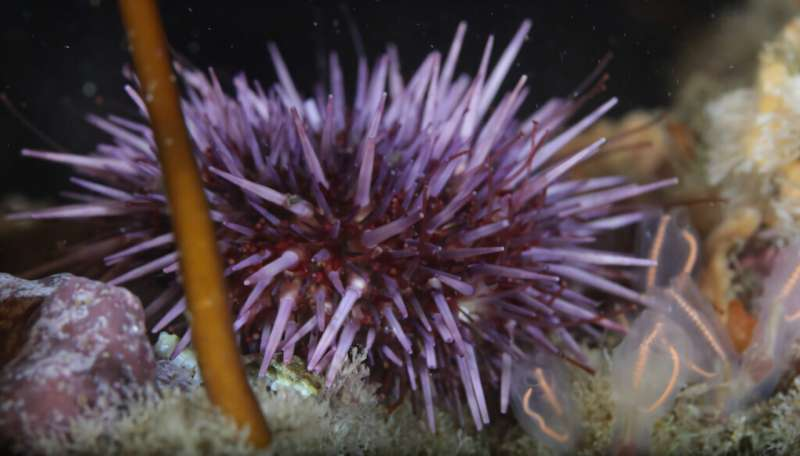
Sea urchins — especially the purple sea urchin, Strongylocentrotus purpuratus — play a central but often destructive role in kelp forest ecosystems along the Pacific Coast. In natural numbers, they help maintain ecological balance. But when populations explode, they can devour kelp forests so thoroughly that underwater landscapes become so-called urchin barrens, leaving fish, abalone, and other species without food or shelter. These boom-and-bust cycles have puzzled biologists for decades, with trends sometimes contradicting expectations. The new study offers a clear clue: reproductive shutdown triggered by heat stress well before lethal limits.
The research team analyzed 30 years of field data from the Pacific Coast, looking at long-term temperature records, larval counts, and adult sea urchin populations. They found that the patterns of larval scarcity after warm-water events couldn’t be fully explained by direct mortality. To investigate further, they conducted laboratory experiments on both red and purple sea urchins to test how sustained elevated temperatures affect both larvae and adult reproductive processes.
Past estimates suggested that adult sea urchins only approach lethal danger around 23 to 25 degrees Celsius, while larvae start dying around 20 to 22 degrees Celsius. The new experiments pushed beyond these assumptions. The researchers found that female adult urchins stop producing eggs when waters reach just 18 degrees Celsius — a temperature now regularly reached during today’s milder marine heat waves. This shutdown occurred even when the females were otherwise healthy and had ample food, which rules out nutritional stress as a cause. In simpler terms: the adults survive, but their ability to create the next generation quietly collapses.
This has major implications for understanding sudden drops in juvenile urchin numbers. For example, in Southern California, marine heat waves — especially those associated with El Niño — are frequently followed by a dramatic reduction in new juvenile urchins settling along the coast. Scientists used to assume larvae were dying in warm waters offshore. Instead, this study shows the issue likely begins earlier in the cycle: fewer eggs are produced during the months when they’re normally needed.
Timing plays a crucial role too. Heat waves that rise in late summer and extend into fall and early winter — months when females typically ramp up egg production — are especially damaging. While summer heat is less of a concern, warm conditions later in the year can cut off reproduction precisely when the species depends on it. This makes modern climate patterns, where warm periods stretch longer into the year, particularly troubling.
Interestingly, the effect varies along the coastline. Warmer Southern California waters already brush against the thresholds where gamete production is suppressed, so heat waves there directly reduce larval supply. In contrast, Northern California and British Columbia typically do not reach temperatures high enough to shut down egg production. Yet those northern regions sometimes see increases in larval abundance after heat waves, which further complicates how warming affects ecosystem balance in different locations. In northern areas, these larval increases can worsen kelp overgrazing, contributing to the creation or expansion of urchin barrens.
The study’s findings also ripple far beyond sea urchins. The researchers emphasize that other marine invertebrates — including abalone, mussels, oysters, and corals — may face similar reproductive suppression at temperatures below lethal limits. If true, many long-held assumptions about how marine populations respond to warming may need revision. Most climate vulnerability models rely on lethal stress thresholds, not sub-lethal reproductive impacts. This research shows that populations could decline — or even collapse — well before animals reach conditions that directly threaten their survival.
These discoveries are significant for anyone concerned with marine conservation, fisheries management, or ocean health. Understanding urchin reproduction is especially important because their population swings have such strong effects on kelp forests. Kelp forests are among the most productive ecosystems on Earth, supporting fish, invertebrates, marine mammals, and coastal fisheries. When urchins overpopulate, kelp forests vanish; when urchin populations crash, kelp can recover. Predicting these cycles accurately is essential for maintaining ecological balance.
The research underscores how little we still know about larval distribution. Sea urchins release huge numbers of eggs and sperm into the water, producing larvae that drift for weeks or months before settling back to shore. Scientists still cannot reliably track where these larvae travel or what happens to them in the open ocean. Because of this, any new information about how temperature affects early reproduction is a valuable piece of the puzzle.
To give this topic deeper context, it helps to understand more about the biology of sea urchins. Purple sea urchins have been expanding in some regions partly because their predators — such as sea otters and sunflower sea stars — have declined. The massive die-off of sunflower sea stars due to sea star wasting disease allowed urchin populations to surge in many areas, contributing to widespread kelp loss along the northern California coast. This has led to long-term “persistent barrens” where urchins survive in starvation mode and kelp cannot re-establish. These barren zones demonstrate how quickly ecosystems can shift when one population grows unchecked.
Sea urchins, like many marine invertebrates, use external fertilization, releasing eggs and sperm into the water. Gametogenesis, the process of producing these reproductive cells, is highly sensitive. Temperature changes affect hormonal cycles, nutrient allocation, and energy balance within the animals. Even small shifts in water temperature can disrupt this delicate process. Because sea urchins rely on cold, nutrient-rich waters for predictable reproductive timing, warming oceans disrupt not just the quantity but also the seasonality of reproduction.
This makes the new study particularly important. Rather than focusing only on heat-induced mortality, it highlights how subtle physiological stress can reshape entire marine communities. A warming ocean doesn’t have to kill organisms outright to destabilize ecosystems — sometimes, stopping the next generation is enough.
For commercial urchin harvesters and conservation planners, the findings may offer better tools for predicting population changes. If egg production reliably declines whenever waters exceed 18 degrees Celsius, managers could anticipate recruitment failures earlier and act accordingly, whether that means adjusting harvesting pressure or reinforcing kelp protection efforts.
The research team, which included collaborators from UC Berkeley, the Hakai Institute, UC Davis’s Bodega Marine Laboratory, UC Santa Barbara, and Florida State University, emphasizes that warming will likely cause population collapses earlier and more often than models currently predict. This is because reproductive shutdown can occur far below temperatures that endanger adult survival.
As marine heat waves continue to intensify under global climate change, this kind of mechanistic understanding becomes increasingly important. The more we learn about how warming affects physiology — not just mortality — the better we can forecast the future of coastal ecosystems.
Research Paper:
Thermal suppression of gametogenesis can explain historical collapses in larval recruitment in Strongylocentrotus purpuratus