NASA Data Helps Maine Oyster Farmers Choose the Best Places to Grow Shellfish
NASA satellite data is quietly transforming how oyster farming works along the rugged and complex coast of Maine. What was once a process driven largely by experience, trial and error, and local knowledge is now increasingly guided by high-resolution satellite observations that reveal detailed patterns in coastal water temperature and food availability. For oyster farmers, this scientific edge can make the difference between a thriving farm and years of financial loss.
Using Space-Based Data to Reduce Risk in Oyster Farming
Starting an oyster farm is not a small commitment. Farmers must invest years before seeing returns, and choosing the wrong site can delay or completely derail the business. Maine oyster farmer Luke Saindon, director of The World Is Your Oyster farm in Wiscasset, faced this exact challenge when deciding where to establish his operation.
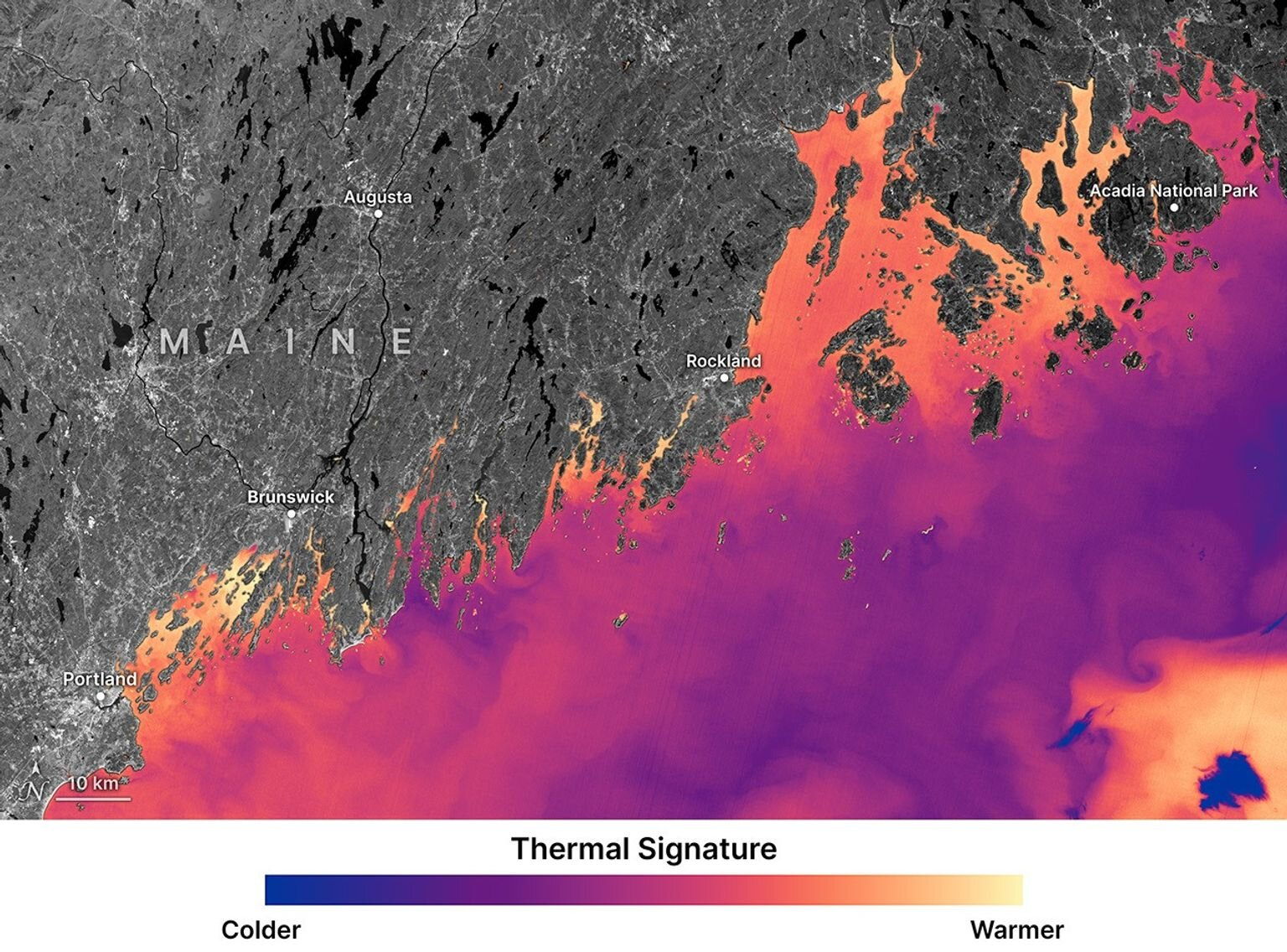
Instead of relying only on traditional scouting, Saindon turned to NASA satellite data, something oyster farmers could not realistically access a generation ago. With help from a site-selection tool developed by University of Maine researchers, he examined satellite maps that showed variations in coastal water temperature and food availability. These maps highlighted a wide, shallow bay near his home as a promising location.
Four years later, the farm remains in operation, and the oysters are growing well. Saindon attributes much of that success to the early use of satellite data, which helped him avoid unsuitable locations and reach faster-than-average oyster growth rates.
Why Water Temperature and Food Matter So Much
Oysters are cold-blooded organisms, meaning their growth rate is closely tied to water temperature. Warmer waters generally increase feeding activity and shell development, while colder waters slow both processes. However, temperature alone is not enough. Oysters rely on microscopic food particles, especially plankton, suspended in the water.
NASA’s Landsat 8 and Landsat 9 satellites, operated jointly with the U.S. Geological Survey, collect detailed sea surface temperature data. At the same time, European Sentinel-2 satellites estimate food availability by measuring chlorophyll and particulate organic matter, both indicators of plankton levels. When these datasets are combined, they offer a powerful picture of where oysters are most likely to grow efficiently.
Turning Satellite Observations into Predictive Models
This satellite-based approach became the foundation of a peer-reviewed study published on January 15 in the journal Aquaculture, led by University of Maine scientists Thomas Kiffney and Damian Brady. The research went beyond identifying good or bad sites. Instead, the team developed a dynamic energy budget model that predicts how oysters allocate energy toward growth, survival, and reproduction under different environmental conditions.
By feeding the model satellite-derived sea surface temperature and food availability data, the researchers could estimate how long eastern oysters (Crassostrea virginica) would take to reach market size at specific locations. This kind of forecasting allows farmers to plan seeding and harvesting schedules more accurately, improving efficiency and lowering financial risk.
Field tests confirmed the model’s reliability. The researchers validated it using seven years of on-the-ground data from multiple sites, showing strong agreement between predicted and observed growth rates. This validation suggests that remote sensing tools are not just experimental, but practical for real-world aquaculture decision-making.
The Growing Importance of Oyster Farming in Maine
The timing of this research is critical. Maine’s oyster industry has expanded rapidly over the past decade. Between 2011 and 2021, the value of the industry increased by 78%, growing from roughly $2.5 million to over $10 million. As more farms come online, competition for suitable sites increases, and mistakes become more costly.
Permitting alone can take two to three years, followed by another two years for oysters to reach market size. A poor site choice can leave a farmer four years behind before realizing the mistake. In this context, satellite-based forecasting tools provide a much-needed layer of confidence.
Why Maine’s Coast Is So Hard to Read from the Water
Maine’s coastline stretches about 3,400 miles (5,500 kilometers) when following the tide line. Shaped by glaciers and drowned river valleys, it is one of the most geographically complex coastlines in the United States. Water depth, circulation, and temperature can change dramatically over short distances, sometimes within a single bay.
Many satellites observe the ocean at broad scales, missing the small coves and inlets where oyster farms operate. What makes Landsat especially valuable for aquaculture is its spatial resolution. With pixels ranging from 98 to 328 feet (30 to 100 meters), Landsat can detect subtle temperature differences between neighboring coves. For oysters, these small differences can translate into months of additional growth time.
Overcoming Cloud Cover and Data Gaps
One of the biggest challenges in satellite observation is cloud cover, which is common in Maine. Landsat satellites also pass over the same location only once every eight days. To overcome these limitations, the research team analyzed 10 years of Landsat data (2013–2023) and created seasonal temperature averages, known as climatologies, for every 98-foot coastal pixel.
By combining these long-term averages with Sentinel-2 food estimates, the researchers created a stable and reliable dataset that smooths out short-term gaps caused by clouds. This approach allowed them to map consistent growth patterns along the coast rather than relying on isolated snapshots.
From Research to Practical Tools for Farmers
The University of Maine team is now working on an online decision-support tool that will allow growers to click on any coastal location and receive an estimate of time-to-market for oysters. This tool is designed to be practical and accessible, even for farmers without technical backgrounds.
In addition, the researchers support farmers through workshops offered under Maine’s Aquaculture in Shared Waters program, helping growers understand satellite-derived temperature and water clarity data and apply it to their own sites.
Looking Ahead with New Satellite Missions
The success of this project also highlights the potential of newer satellite missions. NASA’s PACE satellite (Plankton, Aerosol, Cloud, ocean Ecosystem), launched in 2024, is now delivering hyperspectral observations of coastal waters. Unlike earlier sensors that estimated only the amount of plankton, PACE can begin to distinguish different plankton species.
This matters because not all plankton are equally nutritious for oysters. Some species support healthy growth, while others can be harmful. Future models could incorporate this level of detail, offering even more precise forecasts and further reducing uncertainty for shellfish farmers.
A Science-Based Future for Aquaculture
For farmers like Luke Saindon, the value of satellite data comes down to confidence. By replacing guesswork with evidence, these tools lower the barrier to entry for new farmers and help existing operations plan more efficiently. As climate conditions continue to change and coastal ecosystems become more dynamic, science-driven aquaculture is likely to become not just helpful, but essential.
By bringing space-based Earth observation directly into coastal decision-making, NASA and its research partners are showing how global data can deliver local, practical benefits for sustainable food production.
Research paper:
https://doi.org/10.1016/j.aquaculture.2025.743133