New Veterinary Guidelines Aim to Improve Diagnosis and Monitoring of Canine Cognitive Decline
An international group of canine cognition experts has released a comprehensive new set of guidelines designed to help veterinarians more accurately diagnose and monitor canine cognitive dysfunction syndrome (CCDS), a condition often described as canine dementia. The goal is simple but important: to bring clarity, consistency, and scientific rigor to how age-related cognitive decline in dogs is identified and followed over time.
CCDS is being recognized more frequently as dogs live longer lives, yet until now, veterinarians have lacked a universally accepted framework for diagnosis. These newly published guidelines, developed by the Canine Cognitive Dysfunction Syndrome Working Group, aim to change that by offering a standardized definition, practical diagnostic criteria, and clear recommendations for long-term monitoring. The work appears in the Journal of the American Veterinary Medical Association (JAVMA) and is intended to support both clinical practice and future research.
What Exactly Is Canine Cognitive Dysfunction Syndrome?
CCDS is defined in the guidelines as a chronic, progressive, age-associated neurodegenerative syndrome. In simple terms, it is a condition that develops gradually as dogs age, causing ongoing changes in brain function that worsen over time. The syndrome shares several similarities with Alzheimer’s disease in humans, particularly in how it affects memory, learning, behavior, and daily functioning.
Dogs with CCDS may show a wide range of cognitive and behavioral changes. These can include disorientation, altered social interactions, disrupted sleep–wake cycles, increased anxiety, changes in activity levels, house soiling, and difficulties with learning or memory. Some dogs may seem confused in familiar environments, while others may pace at night, forget house-training, or appear withdrawn from family members.
One of the challenges in diagnosing CCDS is that many of these signs can overlap with other age-related medical conditions. Arthritis, vision or hearing loss, endocrine disorders, and neurological diseases can all mimic or worsen cognitive symptoms. This overlap is one of the key reasons why standardized diagnostic guidelines were urgently needed.
Why Standardization Matters
According to the working group, CCDS diagnoses have been increasing, but there has been no single agreed-upon method to confirm the condition. Without standard criteria, diagnosis can vary widely from one clinic to another, making it harder to compare cases, evaluate treatments, or track disease progression in a meaningful way.
The new guidelines are meant to act as a starting framework, not a final word. They provide a shared language and structure that veterinarians and researchers can use, while leaving room for refinement as scientific understanding improves. Importantly, having a common definition is also essential for developing and testing new therapies aimed at slowing or managing cognitive decline in dogs.
A Clear Diagnostic Pathway
One of the most practical contributions of the guidelines is a diagnostic flowchart that helps veterinarians work through the evaluation process in a logical, step-by-step way. The working group proposes two levels of diagnostic certainty.
The first level focuses on clinical signs and caregiver reports. It involves identifying progressive behavioral changes consistent with CCDS, using structured questionnaires and detailed history-taking. Veterinarians are advised to rule out other medical causes through physical examinations, neurological assessments, and appropriate laboratory testing. If cognitive signs persist even after addressing other health issues, a diagnosis of CCDS becomes more likely.
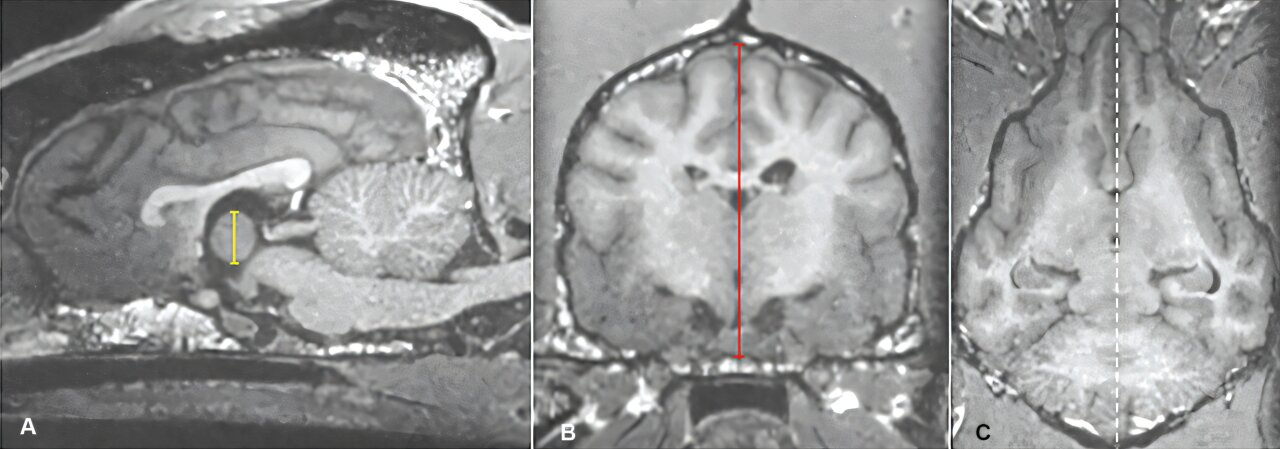
The second level of certainty adds advanced diagnostic support, particularly brain imaging. Magnetic resonance imaging (MRI), when available, may show changes such as cortical atrophy that support a CCDS diagnosis. Cerebrospinal fluid analysis can also help rule out inflammatory or infectious diseases. While advanced imaging is not required in all cases, it provides additional confidence when used.
The guidelines also acknowledge that a definitive diagnosis of CCDS is currently only possible through post-mortem examination of brain tissue. Findings such as amyloid deposition, neuroinflammation, and loss of neurons are considered hallmark features, much like in human Alzheimer’s disease.
Defining Severity Levels
Beyond diagnosis, the working group introduces three levels of CCDS severity to help clinicians and caregivers understand how advanced the condition is.
Mild CCDS involves subtle or infrequent signs that may not significantly interfere with daily life. Moderate CCDS is characterized by clearer, more consistent behavioral changes that affect routine activities and require management. Severe CCDS refers to debilitating impairment, where cognitive dysfunction significantly disrupts a dog’s ability to function normally and demands extensive support.
These severity categories are meant to guide treatment decisions, set expectations for caregivers, and provide a consistent way to track disease progression over time.
When and How to Monitor Aging Dogs
A major emphasis of the guidelines is early detection and ongoing monitoring. The working group recommends that veterinarians begin routinely screening dogs for cognitive changes at around 7 years of age using senior dog surveys. These brief assessments can help flag early signs that might otherwise be dismissed as “normal aging.”
If caregivers report behavioral changes, veterinarians are encouraged to follow up with a CCDS-specific scale, which is a more detailed questionnaire designed to assess cognitive function. From that point on, monitoring should continue every six months.
Starting at 10 years of age, the guidelines recommend using a CCDS scale every six months for all dogs, even if no obvious signs are present. This proactive approach is intended to catch subtle changes early and establish a baseline for comparison as dogs continue to age.
Ruling Out Other Conditions
The guidelines stress that diagnosing CCDS is not about relying on questionnaires alone. A thorough evaluation is essential to rule out other medical or neurological problems that could explain behavioral changes. This includes complete physical and neurological examinations, laboratory testing, and imaging when feasible.
By emphasizing exclusion of other causes, the guidelines aim to reduce misdiagnosis and ensure that dogs receive appropriate treatment for any underlying conditions alongside cognitive care.
A Living Document for a Growing Field
The authors of the guidelines describe the document as a living, working framework rather than a final authority. The working group was intentionally composed of experts who have shaped the field of canine cognition from its earliest definitions to modern clinical applications.
As research advances, particularly in areas like biomarkers, cognitive testing tools, and imaging techniques, the guidelines are expected to evolve. The hope is that future updates will further refine how CCDS is identified, staged, and treated.
Why This Matters for Dogs and Their Caregivers
For dog owners, CCDS can be distressing to witness. Behavioral changes often affect the human–animal bond and can lead to frustration, guilt, or difficult decisions about quality of life. Clear diagnostic criteria help caregivers understand what is happening and why, while consistent monitoring allows for earlier intervention and better planning.
From a research perspective, these guidelines provide a foundation for developing new treatments. Without agreed-upon definitions and outcome measures, clinical trials are difficult to interpret. Standardization opens the door to more reliable studies and, ultimately, better options for aging dogs.
Looking Ahead
Interest in treating and managing CCDS is growing, driven by advances in veterinary neurology and a deeper appreciation of animal cognition. By establishing shared standards for diagnosis and monitoring, these guidelines represent a significant step forward in caring for senior dogs with cognitive decline.
As understanding improves, veterinarians and researchers alike will be better equipped to distinguish normal aging from disease, track progression more accurately, and explore therapies that may help dogs maintain cognitive function for longer.
Research paper:
https://avmajournals.avma.org/view/journals/javma/aop/javma.25.10.0668/javma.25.10.0668.xml