Portable Device Enables Rapid Pathogen Detection in Diverse Field Environments
Researchers at Purdue University have developed a new portable diagnostic device that could significantly simplify how pathogens are detected outside traditional laboratory settings. Designed for use in health care facilities, agricultural fields, and food production environments, the device allows users to perform molecular tests quickly, safely, and with minimal technical expertise. This innovation addresses a long-standing challenge in pathogen detection: how to bring reliable molecular diagnostics into the field without bulky, expensive, or complex equipment.
The device, called IsoHeat, was developed by Nafisa Rafiq, a Ph.D. student in biomedical engineering, along with Mohit Verma, an associate professor of agricultural and biological engineering at Purdue. Another Purdue Ph.D. student, Bibek Raut, is also part of the research team. Their work has been published in the IEEE Sensors Journal, and the team has submitted a patent application covering related technologies. Verma additionally serves as the chief technology officer of Krishi, a startup company focused on developing molecular assays, highlighting the project’s strong connection to real-world applications.
At its core, IsoHeat is designed to support a molecular testing method known as loop-mediated isothermal amplification, commonly referred to as LAMP. LAMP is a technique invented about 25 years ago that detects pathogens by amplifying specific nucleic acid sequences associated with microbes. Unlike PCR, which requires repeated heating and cooling cycles, LAMP operates at a single, constant temperature, making it far more suitable for portable and field-based systems. The method can be used to detect a wide range of targets, including bacterial and viral pathogens, fecal contamination, and even antimicrobial resistance genes.
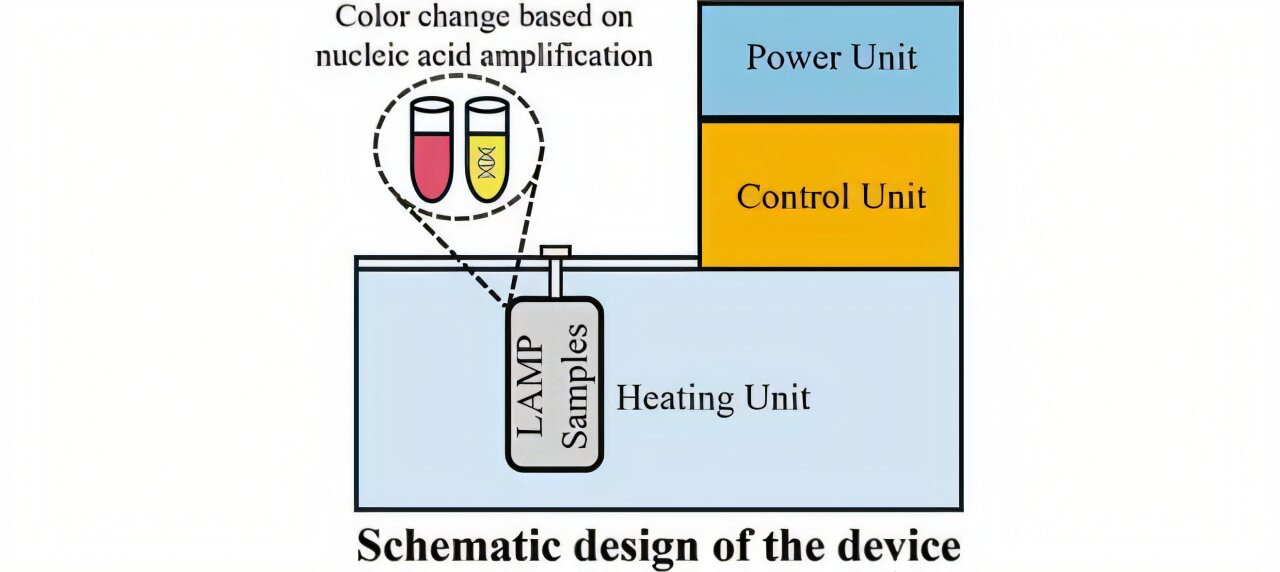
While LAMP itself is not new, performing it reliably outside a laboratory has remained a practical challenge. The Purdue team focused specifically on the hardware problem—how to create a compact, safe, and easy-to-use system that can maintain precise temperatures while allowing users to monitor the reaction visually. IsoHeat was developed as a field-deployable water bath system capable of heating and maintaining samples at approximately 149 degrees Fahrenheit (65 degrees Celsius), the temperature required for LAMP reactions.
One of the major goals of the project was ease of use. The researchers intentionally designed IsoHeat so that it can be operated by nonspecialists, including farm workers, food safety inspectors, or health care staff working in low-resource settings. The system features precise temperature control, uniform heat distribution, and a sealed setup that improves safety when working with heated water and electrical components. Importantly, the device allows visual monitoring of LAMP assays, meaning users can observe reaction changes with the naked eye rather than relying on complex readout instruments.
IsoHeat also represents a continuation of earlier work by the research team. In 2024, Rafiq and Verma co-authored a paper describing a new biosensor for the rapid detection of fecal contamination on produce farms. That earlier research focused on the sensing chemistry, while the new IEEE Sensors Journal publication introduces IsoHeat as the sample-processing system that enables those assays to be performed efficiently in the field. In this sense, IsoHeat fills a critical gap between laboratory-based molecular diagnostics and real-world deployment.
Performance testing highlighted some of the device’s most practical advantages. The team compared IsoHeat with a widely used commercial precision cooker often adapted for heating LAMP assays in field conditions. IsoHeat reached the target temperature of 65°C in about 12 minutes, whereas the commercial cooker required approximately 36 minutes to reach the same temperature. This reduction in warm-up time can make a meaningful difference in time-sensitive situations, such as outbreak monitoring or on-site food safety inspections.
The design process was heavily influenced by considerations of cost, portability, and safety. Drawing on her undergraduate background in industrial engineering, Rafiq fabricated many of the device’s components using 3D printing and laser-cutting technologies. Selecting the right materials was a major challenge, as the system needed to be lightweight yet durable, affordable to manufacture, and safe to use despite combining electric heating elements and water. According to the researchers, ensuring user safety and friendliness was a top priority throughout the development process.
The final IsoHeat system consists primarily of an electrical heating unit, a water bath chamber, a power supply, and supporting hardware. Convenience features include a sealed container that helps maintain uniform heating, a hanging sample holder that keeps test tubes securely positioned, and simple touchscreen controls for setting and monitoring temperature. These design choices eliminate awkward steps often required in improvised setups, such as taping sample tubes to the side of a container while wearing protective gloves.
From a practical standpoint, IsoHeat allows users to prepare biological samples and process them almost anywhere, without the need for a full laboratory. This flexibility opens the door to faster decision-making in settings where delays can be costly or dangerous. On farms, it could help identify contamination sources before produce enters the supply chain. In food processing facilities, it could support routine safety checks. In health care or remote clinics, it could enable quicker detection of infectious agents without shipping samples to centralized labs.
Beyond this specific device, the research reflects a broader trend toward portable molecular diagnostics. Techniques like LAMP are increasingly valued because they combine speed, sensitivity, and simplicity. When paired with thoughtfully designed hardware such as IsoHeat, these methods have the potential to expand access to reliable testing in parts of the world where laboratory infrastructure is limited. They also reduce dependence on centralized testing facilities, which can become bottlenecks during disease outbreaks or large-scale food safety events.
The work published by the Purdue team demonstrates how engineering design, biomedical science, and agricultural applications can intersect to solve practical problems. By focusing not only on the chemistry of detection but also on the realities of field use—training levels, safety concerns, cost constraints, and environmental conditions—the researchers have created a system that is both technically sound and realistically deployable.
As molecular diagnostics continue to move beyond the lab, devices like IsoHeat highlight what is possible when usability is treated as seriously as accuracy reinforces the idea that impactful innovation often comes from refining and integrating existing technologies rather than inventing entirely new ones. With further development and commercialization, IsoHeat could become part of a growing toolkit for rapid, on-site pathogen detection across multiple industries.
Research paper: https://doi.org/10.1109/JSEN.2025.3588790