Seawater Microbes Offer a New Non-Invasive Way to Detect Coral Disease Earlier Than Ever
Coral reefs are among the most biologically rich ecosystems on Earth, supporting more than 25 percent of all marine life and playing a crucial role in food security, coastal protection, tourism, and livelihoods for around one billion people worldwide. Yet these ecosystems are increasingly under threat from warming oceans, pollution, and a growing number of coral diseases. One of the biggest challenges scientists and reef managers face is detecting disease early enough to respond effectively.
A new study led by researchers at the Woods Hole Oceanographic Institution (WHOI), in collaboration with the University of the Virgin Islands, points to a promising and surprisingly simple solution: looking not at the coral itself, but at the microorganisms living in the seawater surrounding it.
A Shift in How Coral Disease Is Detected
Traditionally, coral disease monitoring has relied on visual inspections by divers, who identify disease only after visible damage has already occurred. By that stage, disease outbreaks are often well established, limiting the options for intervention. The new research suggests that seawater microbiomes may provide a much earlier and clearer signal of coral disease, offering a non-invasive and scalable alternative to current methods.
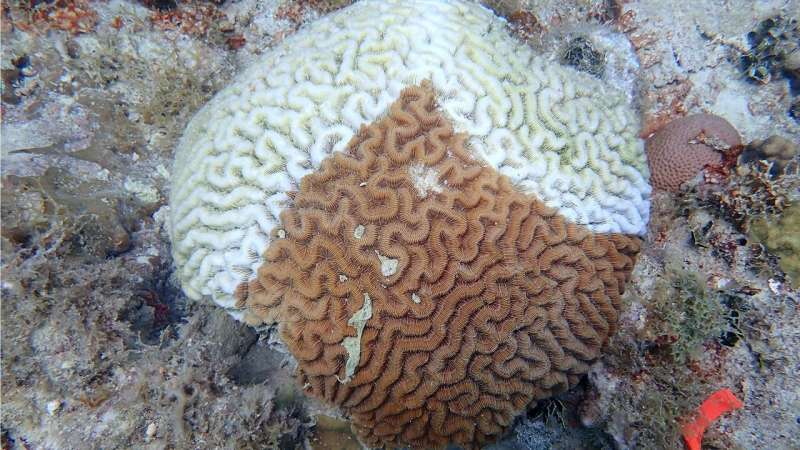
The study focused on stony coral tissue loss disease (SCTLD), one of the most destructive coral diseases ever recorded. SCTLD has spread across much of the Caribbean over the past decade and has caused widespread mortality in reef-building corals. Despite its impact, the exact pathogen responsible for SCTLD remains unknown.
Tracking Corals Over Four Years
One of the strengths of this research is its long-term approach. The team followed the same colonies of brain coral (Colpophyllia natans) over a four-year period on reefs near St. John in the U.S. Virgin Islands. Crucially, the study began before SCTLD reached the area, providing valuable baseline data on coral health and microbial communities.
Between 2020 and 2024, researchers repeatedly collected samples from two sources:
- Coral tissue itself
- Seawater immediately surrounding each coral colony
This allowed them to compare how microbial communities changed before, during, and after the disease outbreak.
What the Microbes Revealed
Using genetic sequencing, the researchers identified and tracked the microorganisms present in both coral tissue and surrounding seawater. What they found was unexpected.
Microbes living inside coral tissue varied significantly, even when corals appeared healthy. This variability made it difficult to use tissue microbes as a reliable indicator of disease. In contrast, the seawater microbiome near healthy corals remained remarkably stable.
That stability disappeared when disease struck.
As corals became infected with SCTLD, the microbial communities in the surrounding seawater changed sharply and consistently. These changes were especially pronounced during the peak of the outbreak, when disease prevalence across the reef was highest. The researchers believe these seawater microbes are responding to materials released by diseased corals, creating a detectable signal in the water.
Why Seawater Works Better Than Coral Tissue
One of the most important findings of the study is that seawater microbes provided a clearer disease signal than microbes living within the coral itself. This challenges long-standing assumptions about where scientists should look for early indicators of coral health.
Sampling seawater also offers practical advantages. It is non-destructive, avoids stressing already vulnerable corals, and can potentially be automated. Instead of divers needing to closely inspect individual corals, future monitoring systems could collect and analyze water samples to detect disease presence across large reef areas.
Implications for Reef Management
For reef managers, especially in the Caribbean, this discovery could be transformative. SCTLD has caused severe losses of reef-building corals, with major ecological and economic consequences. Earlier detection could allow managers to respond faster and more strategically, whether through targeted treatments, movement restrictions, or increased monitoring.
While antibiotic treatments can sometimes slow or halt disease progression in individual corals, they are labor-intensive and not feasible at large scales. An early warning system based on seawater microbiomes could help prioritize where and when such interventions are most needed.
Toward an Early Warning System
The researchers suggest that, if combined with automated sampling technologies and rapid genetic detection, seawater-based monitoring could form the backbone of an early warning system for coral disease. Such a system would allow scientists and managers to identify emerging outbreaks before visible symptoms appear, potentially preventing irreversible damage.
Beyond SCTLD, this approach could also be useful for detecting other reef disturbances, including stress from warming waters, pollution, or harmful algal blooms. The idea that reef seawater carries a measurable and meaningful biological signal opens new avenues for coral reef science.
Understanding Stony Coral Tissue Loss Disease
SCTLD is particularly devastating because of its rapid progression and high mortality rates. In some cases, entire coral colonies die within months of infection. The disease affects many species of hard corals that are essential for reef structure, making its impact especially severe.
Despite years of research, the exact cause of SCTLD remains unresolved. The fact that seawater microbes respond so clearly to diseased corals may help scientists narrow down potential mechanisms behind the disease and better understand how it spreads.
The Bigger Picture for Coral Reefs
Globally, coral reefs are declining at alarming rates. Rising ocean temperatures, acidification, coastal development, and disease are placing unprecedented pressure on these ecosystems. Tools that allow scientists to forecast reef health, rather than simply document losses after they occur, are urgently needed.
This study highlights the importance of the invisible microbial world in shaping reef health. Microorganisms play essential roles in nutrient cycling, disease dynamics, and ecosystem resilience. Paying closer attention to these microscopic communities could be key to protecting coral reefs for future generations.
A Promising Step Forward
By demonstrating that reef seawater carries a strong and consistent disease signal, the study represents an important step toward scalable, non-destructive coral monitoring. It also reflects a broader shift in marine science toward using molecular tools and long-term datasets to tackle complex environmental problems.
As coral reefs continue to face mounting threats, innovations like this offer a rare note of optimism. Sometimes, the answers to big ecological challenges are hiding in plain sight — or, in this case, floating quietly in the water around us.
Research paper:
https://www.cell.com/cell-reports-sustainability/fulltext/S2949-7906(25)00302-7