Tiny RNA Molecules in Sperm Can Have a Big Impact on the Health of Babies
Mounting scientific evidence is steadily reshaping how we think about inheritance, and a new study adds an important piece to that puzzle. Researchers are finding that a father’s environment—what he eats, the stress he experiences, and the toxins he encounters—can influence the health of his children in ways that go beyond DNA. The latest research shows that tiny RNA molecules carried in sperm play a direct role in shaping early embryonic development, with potential long-term consequences for metabolism, behavior, and disease risk.
This work comes from the laboratory of assistant professor Upasna Sharma at the University of California, Santa Cruz, and was published in the journal Cell Reports. The findings provide one of the clearest molecular explanations so far for how non-genetic information from fathers can be passed on to offspring.
A Growing Body of Evidence Linking Fathers to Offspring Health
For years, studies in organisms ranging from nematodes to mice have shown that a father’s lifestyle can affect his children’s health. Male mice fed a high-fat diet, for example, tend to produce offspring with impaired glucose tolerance and insulin resistance—both known risk factors for diabetes and cardiovascular disease. In other experiments, fathers exposed to chronic stress sire offspring with altered stress responses and measurable behavioral defects.
While these patterns have been well documented, the underlying biological mechanism has remained largely unclear. How could information about diet or stress be transmitted to the next generation without changing the DNA sequence itself? The new study offers a compelling answer.
Small RNAs as Messengers of Environmental Information
Instead of altering DNA, the father’s environment appears to influence the small RNA molecules packaged inside sperm. These small RNAs are regulatory molecules that help control when and how genes are turned on or off. They belong to a broader category of epigenetic information—biological signals that sit on top of the genetic code and guide how it is used.
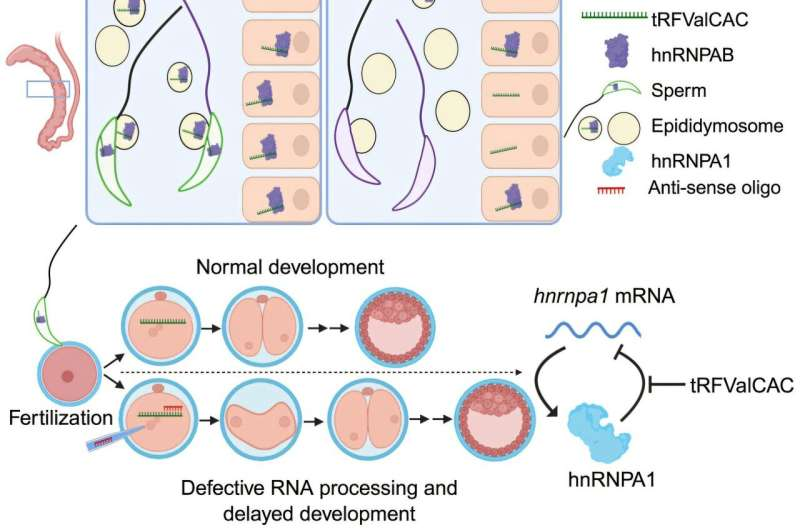
The research team focused on one particular small RNA fragment known as tRFValCAC, a fragment derived from transfer RNA. This molecule becomes highly concentrated in sperm as they mature in the male reproductive tract, specifically in a structure called the epididymis.
Earlier work from Sharma’s lab showed that sperm do not make these RNAs on their own. Instead, they acquire them during maturation through microscopic packages called extracellular vesicles, which are released by cells lining the epididymis. These vesicles act like delivery trucks, transferring RNA cargo into developing sperm.
How Sperm Select Their RNA Cargo
One of the most important discoveries in this study is the identification of a specific protein that acts as a molecular sorting manager. This protein binds to tRFValCAC and controls how much of the RNA fragment is packaged into extracellular vesicles and ultimately loaded into sperm.
When researchers reduced the levels of this protein, far less tRFValCAC made its way into sperm. This finding suggests that sperm RNA content is not random—it is actively regulated, and that regulation can potentially be influenced by environmental factors.
Understanding how this sorting process works opens up new research directions. Scientists now want to know how this protein itself is regulated and which other proteins may be involved in selecting and packaging different small RNAs into sperm.
What Happens After Fertilization
The real impact of sperm RNAs becomes clear after fertilization. When sperm enters the egg, it delivers not only DNA but also its cargo of small RNAs, including tRFValCAC. To understand what this RNA does, researchers blocked its activity immediately after fertilization, when the embryo was still a single cell.
The results were striking. Without functional tRFValCAC, early embryos showed disrupted gene regulation. Genes involved in cell division, chromosome organization, and RNA processing and splicing were especially affected. RNA splicing, an essential process that edits genetic messages before they are used to make proteins, was notably impaired.
These embryos also divided more slowly and were much less likely to reach the blastocyst stage, a critical milestone required for successful implantation and pregnancy. Failure to reach this stage dramatically reduces the chances of a healthy pregnancy.
Why Early Development Matters So Much
Early embryonic development plays a central role in determining long-term health. Disruptions at this fragile stage are increasingly linked to higher risks of common chronic conditions, including obesity, diabetes, and cardiovascular disease. The study shows that a single sperm-enriched small RNA can influence the pace and quality of early development, setting the stage for outcomes that may not appear until adulthood.
Importantly, Sharma’s previous research demonstrated that environmental conditions can change the composition and levels of small RNAs in sperm. Taken together, the findings support a model in which changes in a father’s environment alter sperm RNAs, which then reprogram early development in ways that contribute to disease risk later in life.
Epigenetics and the Transmission of Environmental Effects
At the heart of this research is the concept of epigenetic inheritance. While DNA carries the blueprint of life, epigenetic information determines how that blueprint is read and implemented. Epigenetic marks include chemical modifications to DNA, changes to proteins associated with DNA, and regulatory molecules like small RNAs.
A key implication of epigenetic inheritance is that these marks can be modulated by the environment. This means the experiences of parents—before conception—can shape offspring development without altering the genetic code itself.
The study provides concrete evidence that sperm RNAs are one of the mechanisms through which this process occurs, particularly for paternal environmental effects.
Broader Implications for Health and Medicine
Understanding how paternal environment influences offspring health has significant implications for public health and policy. Many of the diseases linked to early developmental disruptions—such as metabolic disorders—are widespread and costly. Insights into their origins could inform prevention strategies long before symptoms appear.
In the long term, this line of research could lead to early-warning markers that identify developmental or metabolic risks in future offspring. It may also point to new therapeutic targets aimed at improving embryo viability and pregnancy outcomes.
However, researchers emphasize that much work remains. While this study makes an important contribution, the full network of sperm RNAs, their regulatory proteins, and their responses to environmental cues is still being uncovered.
What We Are Learning About Sperm Beyond DNA
This research also challenges the traditional view of sperm as passive carriers of DNA. Instead, sperm emerge as active carriers of environmental information, equipped with regulatory molecules that influence development from the very first moments of life.
As scientists continue to explore how sperm RNAs are established, modified, and transmitted, they are uncovering a richer and more dynamic picture of inheritance—one that connects lifestyle, environment, and biology in powerful ways.
The study ultimately underscores a simple but profound idea: what fathers experience before conception can matter far more than previously believed, and tiny molecules inside sperm may be key messengers carrying that information forward.
Research paper:
https://doi.org/10.1016/j.celrep.2025.116366