Trained Dogs Can Detect Deadly Canine Cancer Hemangiosarcoma by Smell, Offering Hope for Earlier Diagnosis
Cancer remains one of the leading causes of death in both humans and animals, and dogs are no exception. Research suggests that between one-third and one-half of all dogs will develop cancer during their lifetime, making early detection one of the biggest challenges in veterinary medicine. Among the many forms of cancer affecting dogs, hemangiosarcoma stands out as one of the most aggressive and heartbreaking.
Hemangiosarcoma is a malignant cancer of blood vessel cells. It is often called a “silent killer” because it typically shows no obvious symptoms until it reaches an advanced stage. In many cases, dogs appear perfectly healthy until they suddenly collapse due to internal bleeding caused by a ruptured tumor, commonly in the spleen or heart. By the time the disease is discovered, treatment options are limited and the prognosis is usually poor.
A new study from researchers at the University of Pennsylvania’s School of Veterinary Medicine offers a rare glimmer of hope. The research shows that trained dogs can detect hemangiosarcoma by scent, identifying subtle chemical signals in blood samples that humans and machines currently cannot reliably detect.
Why Early Detection of Hemangiosarcoma Is So Difficult
Unlike some other cancers, hemangiosarcoma does not come with reliable early warning signs. There are no standard screening tools that veterinarians can use to detect it before it becomes life-threatening. Imaging techniques like ultrasounds or CT scans are usually only performed after symptoms appear, which is often too late.
Once diagnosed, hemangiosarcoma is known for spreading rapidly throughout the body. Survival times are typically measured in months, not years. This reality makes the search for early, non-invasive detection methods incredibly important.
Exploring the Power of Canine Scent Detection
The Penn Vet research team wanted to find out whether hemangiosarcoma produces a unique scent signature that dogs could detect. Dogs have an extraordinary sense of smell, capable of detecting volatile organic compounds (VOCs) at concentrations far lower than what humans can perceive.
VOCs are the chemical compounds responsible for scent. Every living body produces them, and disease can subtly alter the mix. In recent years, scientists have discovered that dogs can detect VOC patterns associated with various conditions, including human cancers, infectious diseases, and neurological disorders.
The key question was whether hemangiosarcoma also leaves behind a detectable chemical fingerprint.
How the Study Was Conducted
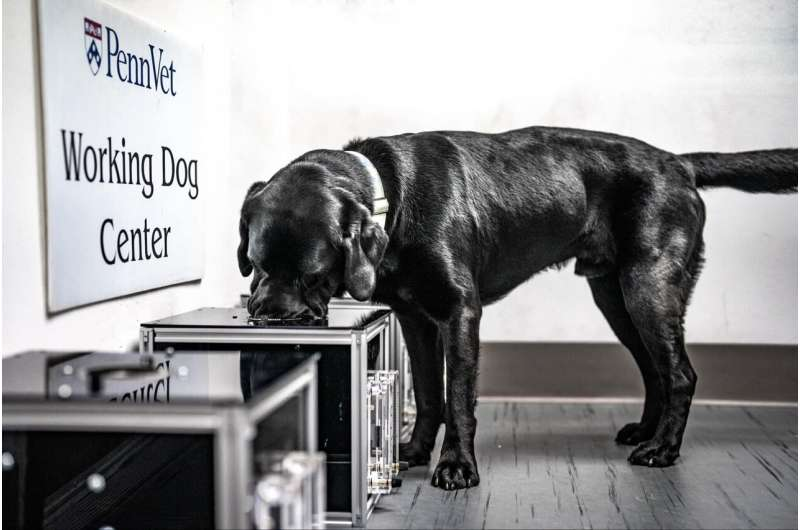
The study involved five highly trained bio-detection dogs. These dogs were not beginners; they already had experience identifying scents linked to other medical conditions such as chronic wasting disease, post-traumatic stress disorder, human ovarian cancer, and human pancreatic cancer.
Researchers used double-blinded testing, meaning neither the handlers nor the observers knew which samples were cancerous during the trials. This approach helped eliminate bias and ensured that the dogs were responding only to scent cues.
The dogs were presented with blood serum samples from three groups:
- Dogs with confirmed hemangiosarcoma
- Dogs with non-cancerous diseases
- Healthy dogs serving as controls
Each dog evaluated 12 matched sample sets, and each set was tested across seven separate trials. Importantly, none of the samples had been used during training, ensuring that recognition was based on scent detection rather than memory.
To conduct the tests, researchers used olfactometers, specialized devices that precisely measure when and how long a dog investigates a sample. These devices include infrared laser beams that register a dog’s interest and confirm when the correct target is identified.
What the Dogs Were Able to Detect
Across all trials, the dogs correctly identified hemangiosarcoma samples about 70% of the time. While this may not sound perfect, it is well within the accuracy range seen in studies where dogs detect human cancers, an area of research that is much further along.
The results clearly demonstrated that hemangiosarcoma does, in fact, produce a distinct scent profile. This was the central goal of the study: to prove that the disease has a detectable odor signature.
From a scientific perspective, this finding is extremely important. It confirms that early detection is theoretically possible, even if current veterinary tools are not yet capable of doing it.
Why This Discovery Matters
The researchers are not suggesting that dogs will become routine diagnostic tools in veterinary clinics. Instead, the dogs serve as biological proof-of-concept. Their success suggests that hemangiosarcoma alters VOC patterns in a measurable way.
This opens the door to developing machine-based detection systems, sometimes referred to as electronic noses. Such tools could one day analyze blood samples and flag dogs at risk before tumors rupture or spread.
Early detection could dramatically change outcomes. Veterinarians might be able to:
- Remove the spleen before rupture
- Begin chemotherapy earlier
- Monitor at-risk dogs more closely
- Improve survival times and quality of life
It could also allow researchers to conduct clinical trials on earlier-stage disease, something that is currently very difficult due to late diagnosis.
Could This Become a Routine Screening Tool?
One possible future application is annual screening, especially for breeds at higher risk of hemangiosarcoma, such as Golden Retrievers, German Shepherds, and Labrador Retrievers. A scent-based test could act as an early warning system, prompting follow-up imaging like ultrasounds or CT scans.
Even a screening tool that is not perfect could be incredibly valuable if it helps identify dogs that need closer examination.
Dogs and Disease Detection: A Growing Field
This study adds to a growing body of research showing that dogs can detect diseases through scent alone. Over the years, trained dogs have demonstrated the ability to identify:
- Various human cancers
- Infectious diseases
- Metabolic disorders
- Neurological conditions
Dogs’ noses contain hundreds of millions of scent receptors, compared to about six million in humans. Their brains are also specially wired to process scent information, making them uniquely suited for this kind of work.
While dogs themselves may not be the final diagnostic solution, they continue to help scientists understand what to look for when designing new detection technologies.
A Small Study With Big Implications
This research is still at an early stage, and larger studies will be needed to refine accuracy and identify the specific VOCs involved. However, the findings provide what researchers describe as an “initial kernel of hope.”
For a disease that is often discovered too late, even the possibility of earlier detection represents a meaningful step forward.
If future research succeeds in translating this scent signature into a practical test, it could reshape how veterinarians approach one of the most devastating cancers affecting dogs today.
Research Paper Reference:
https://doi.org/10.1016/j.tvjl.2025.106522