Tyrannosaurus Rex Grew Much More Slowly Than We Thought and Kept Growing Until About Age 40
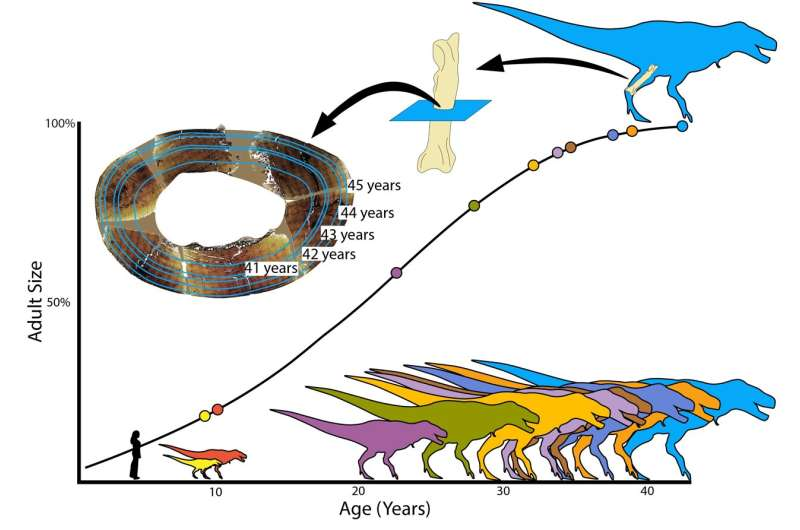
For decades, Tyrannosaurus rex has been portrayed as a fast-growing, short-lived giant that raced its way to the top of the food chain. A major new scientific study now challenges that long-standing view. According to new research, the so-called king of dinosaurs did not stop growing in its mid-20s, as scientists once believed. Instead, T. rex likely continued growing for nearly four decades, reaching full size much later in life than previously estimated.
This new picture of T. rex growth comes from the most comprehensive life-history analysis of the species ever conducted. By combining expanded fossil sampling, advanced bone analysis techniques, and sophisticated statistical modeling, researchers were able to reconstruct how these massive predators grew year by year—from tiny juveniles to eight-ton adults.
How scientists estimate the age of dinosaurs
To understand why this discovery is so important, it helps to know how dinosaur growth is studied in the first place. Paleontologists often examine growth rings inside fossilized bones, particularly leg bones. These rings are similar to tree rings and form annually, reflecting seasonal changes in growth.
For many years, scientists counted these rings to estimate how old a dinosaur was when it died and how quickly it grew. Earlier studies of T. rex suggested that individuals grew rapidly during adolescence and stopped growing at around 25 years of age. This idea fit well with the image of T. rex as an aggressive, fast-maturing predator.
However, there was a major limitation. A single bone cross-section usually preserves only the last 10 to 20 years of growth. Earlier growth rings can be lost as the bone expands and remodels itself. This meant that scientists were often working with incomplete records.
A larger sample and better tools change the picture
The new study analyzed 17 tyrannosaur specimens, ranging from early juveniles to massive adults. This dataset is the largest ever assembled for Tyrannosaurus rex. By comparing growth records across many individuals, researchers were able to piece together a far more complete growth timeline.
A key breakthrough came from using circularly polarized and cross-polarized light when examining bone slices. Under this special lighting, researchers discovered previously hidden growth rings that traditional methods failed to detect. These newly identified rings revealed that earlier studies had systematically undercounted years of growth.
To make sense of the fragmented growth records, the research team developed a new statistical approach. Instead of analyzing each specimen in isolation, they stitched together partial growth histories from multiple individuals. This produced a composite growth curve that reflects how T. rex grew across all life stages.
The result was clear and surprising: Tyrannosaurus rex continued growing for about 40 years, roughly 15 years longer than earlier estimates.
What a 40-year growth period means
This revised growth timeline suggests that T. rex did not rush into adulthood. Rather than experiencing a short burst of growth followed by early maturity, the species grew slowly and steadily over decades.
While T. rex still experienced faster growth during its teenage years, the new data show that growth continued well into later adulthood. Even large individuals that were already several tons in weight had not yet reached their final size.
This prolonged growth phase likely had major biological and ecological implications. Younger and subadult tyrannosaurs may have filled different ecological roles than fully grown adults. Instead of competing directly with giant adults for the same prey, smaller individuals could have hunted different animals or scavenged more frequently.
Such ecological flexibility may have helped tyrannosaurs dominate their environments near the end of the Cretaceous Period, when competition among large carnivores was intense.
Rethinking famous T. rex specimens
The study also touches on an ongoing and controversial debate: whether all specimens labeled as Tyrannosaurus rex truly belong to the same species.
Some researchers have long argued that certain fossils—especially smaller ones—might represent a separate species known as Nanotyrannus, rather than juvenile T. rex individuals. Others have suggested that even large specimens might belong to multiple species or subspecies.
In this new analysis, two well-known specimens nicknamed Jane and Petey stood out. Their growth curves were statistically incompatible with those of the other tyrannosaurs in the study. While growth data alone cannot definitively prove that they represent separate species, the findings raise intriguing possibilities.
An independent study published recently reached a similar conclusion using different methods, classifying Jane and Petey as distinct Nanotyrannus species. The new growth data add further fuel to this debate, though the issue remains far from settled.
Why this discovery matters beyond T. rex
One of the most important outcomes of this research is methodological rather than species-specific. The discovery of new growth rings using polarized light suggests that standard protocols for studying dinosaur growth may need revision.
Interpreting closely spaced growth marks is notoriously difficult, and the new study provides strong evidence that previous methods may have missed crucial data. This has implications not only for tyrannosaurs but also for many other dinosaur species whose growth rates and lifespans have been estimated using similar techniques.
Reevaluating these growth models could reshape our understanding of dinosaur biology, metabolism, and life expectancy across the board.
How big and how old was T. rex, really?
Fully grown Tyrannosaurus rex individuals are estimated to have weighed around eight tons and measured over 12 meters in length. With a growth period extending to 40 years, it is possible that T. rex also lived longer than previously thought.
Earlier estimates placed the maximum lifespan of T. rex at around 30 years. The new findings suggest that some individuals may have lived well into their 40s, potentially even longer under favorable conditions. This longer lifespan fits better with the idea of slow, sustained growth rather than rapid maturation.
What we now know about Tyrannosaurus rex
Thanks to this expanded study, T. rex emerges as a more complex and nuanced animal than its pop-culture image suggests. It was not just a fast-growing killing machine, but a long-lived predator whose development unfolded over decades.
By combining fossil evidence, innovative imaging techniques, and robust statistical modeling, researchers have produced the clearest and most accurate growth history of Tyrannosaurus rex to date. And even after more than a century of scientific study, this iconic dinosaur continues to surprise.
Research paper:
https://peerj.com/articles/20469/