World’s First Scientifically Accurate Dinosaur-Killer Crocodile Skeleton Is Now on Display
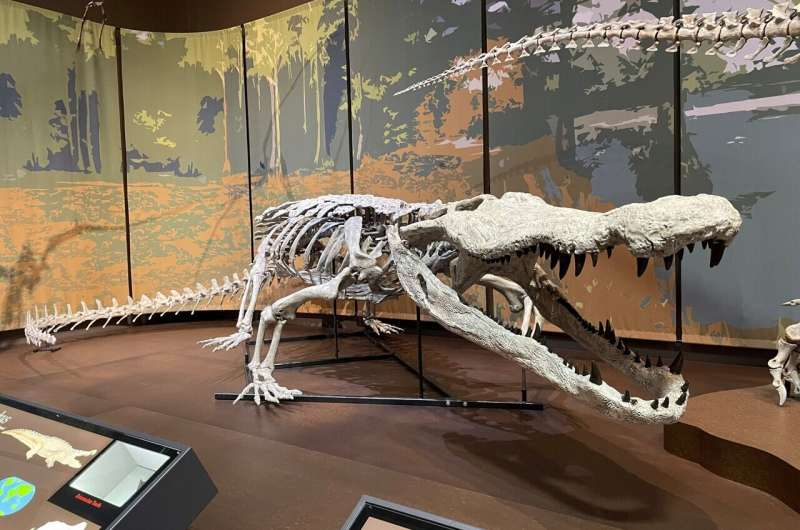
A major milestone in paleontology has quietly taken shape in Georgia, where decades of research have finally resulted in the first-ever scientifically accurate, life-sized fossil skeleton replica of one of the most terrifying predators to ever live. The creature is Deinosuchus schwimmeri, a massive prehistoric crocodilian often nicknamed the “dinosaur-killer”, and it now stands fully assembled at the Tellus Science Museum in Cartersville, Georgia.
This achievement is the result of more than 40 years of research by Dr. David Schwimmer, a geology professor at Columbus State University and one of the world’s leading experts on the giant crocodilian genus Deinosuchus. For the first time, museum visitors and researchers alike can see a mounted skeleton that accurately reflects what this animal really looked like, based on fossil evidence rather than artistic guesswork.
A Predator That Dominated the Late Cretaceous
Deinosuchus schwimmeri lived during the Late Cretaceous Period, roughly 83 to 76 million years ago, across what is now the eastern United States. Closely related to modern alligators but vastly larger, this animal reached lengths of up to 31 feet (9.45 meters), making it comparable in size to a school bus.
Unlike today’s crocodilians, Deinosuchus occupied the absolute top of the food chain. Fossil evidence shows that it preyed on large animals, including dinosaurs, earning it its long-standing reputation as a true apex predator. Bite marks found on dinosaur bones strongly suggest ambush attacks near riverbanks, much like modern crocodiles, but on a far more terrifying scale.
Why This Replica Is a Big Deal
Until now, museums around the world displayed partial reconstructions or speculative models of Deinosuchus. The problem was simple: the fossil record is fragmentary, and for decades there was no single, scientifically grounded skeletal mount that reflected the full anatomy of the animal.
That changed thanks to a two-year collaboration between Dr. Schwimmer and Triebold Paleontology Inc., a company internationally recognized for producing museum-quality fossil skeletons. Using high-resolution 3D scans of existing fossil material, the team carefully reconstructed the skeleton, including its dermal armor, skull proportions, and limb structure, all grounded in peer-reviewed research.
This replica is not designed for shock value alone. Its purpose is to inform science, refine anatomical understanding, and give researchers and educators a reliable reference for studying one of the most important predators of the Cretaceous ecosystems in North America.
The Tellus Science Museum’s Exclusive Exhibit
The completed skeleton was commissioned by the Tellus Science Museum, which is currently the only museum in the world to display a cast of Deinosuchus schwimmeri. The museum sees thousands of student visitors each year, many of whom come specifically to learn about the geological and biological history of the southeastern United States.
Seeing the creature fully assembled offers a level of understanding that measurements and illustrations simply cannot provide. Standing next to a 30-foot-long predator instantly communicates the sheer scale of life during the Late Cretaceous and helps visitors better grasp how dominant these animals were in their environments.
The museum’s location also makes sense scientifically. Several known Deinosuchus fossil sites lie within 40 miles of Columbus, Georgia, making the region one of the richest areas for studying this genus.
The Scientist Behind the Skeleton
Dr. David Schwimmer’s connection to Deinosuchus began long before this replica existed. He grew up in New York City, just blocks away from the American Museum of Natural History, where a massive crocodilian skull display sparked his early fascination.
After joining Columbus State University in the late 1970s, Schwimmer discovered his first Deinosuchus fossils in 1979. From that point on, his career became deeply intertwined with understanding the animal’s biology, behavior, and environment. Over the decades, his work has helped establish him as a global authority on Late Cretaceous life in the southeastern U.S.
His fossil discoveries are now preserved in major institutions, including the Smithsonian Institution, the American Museum of Natural History, and the Tellus Science Museum.
A Species Named in His Honor
In 2020, a team of paleontologists formally recognized Deinosuchus schwimmeri as a distinct species and named it in honor of Schwimmer’s contributions. The designation was published in the Journal of Vertebrate Paleontology, acknowledging his decades of fieldwork, academic publications, conference presentations, and his influential 2002 book, King of the Crocodylians: The Paleobiology of Deinosuchus.
The researchers specifically cited his tireless work on the Late Cretaceous paleontology of the Southeast and Eastern Seaboard of the United States, solidifying his legacy in the field.
How Fossil Replicas Advance Science
Life-sized replicas like this one are more than impressive museum displays. They act as three-dimensional research tools, allowing scientists to analyze posture, movement, and biomechanical relationships that are difficult to visualize from isolated bones.
By assembling a complete skeleton, researchers can test hypotheses about how Deinosuchus moved, hunted, and interacted with its environment. These insights also help paleontologists better understand how modern crocodilians evolved and why their body plans have remained so successful over millions of years.
Extra Context: What Makes Deinosuchus Different From Modern Crocodiles?
While modern crocodiles are formidable predators, Deinosuchus stood apart in several ways:
- Extreme size, far exceeding any living crocodilian
- Thicker dermal armor, offering enhanced protection
- A skull built for bone-crushing bite forces, capable of tackling dinosaurs
- A habitat range that included vast river systems and coastal wetlands
Its dominance illustrates how ancient ecosystems supported predators far larger and more specialized than those alive today.
A Blueprint for Understanding Ancient Life
With this replica now installed, scientists, students, and the public finally have access to a physically accurate blueprint of one of prehistory’s most fearsome animals. It represents not only technological progress in fossil reconstruction, but also the payoff of decades of patient scientific work.
As more museums and researchers build upon this model, Deinosuchus schwimmeri will no longer be known only through scattered bones and dramatic illustrations. Instead, it stands fully realized, offering a clearer window into the dynamic and dangerous ecosystems of the Late Cretaceous.
Research Reference:
Journal of Vertebrate Paleontology (2020) – Species description and classification of Deinosuchus schwimmeri
https://www.tandfonline.com/toc/ujvp20/current