Quantum-Centric Supercomputing Takes a Major Step Forward by Accurately Simulating Supramolecular Molecular Interactions
Researchers from the Cleveland Clinic and IBM have taken a meaningful leap in quantum-enhanced molecular simulation by demonstrating that quantum-centric supercomputing can accurately model supramolecular interactions—the subtle forces that cause entire molecules to attract, repel, and organize themselves. This is an area where classical computers excel in accuracy but struggle with scalability, while quantum computers promise speed but often fall short in precision. The new approach attempts to combine the strengths of both.
The team, led by Kenneth Merz, Ph.D. from Cleveland Clinic and Antonio Mezzacapo, Ph.D. from IBM, focused specifically on noncovalent interactions such as hydrogen bonds and hydrophobic forces. These are weaker than covalent chemical bonds but are essential for biological and chemical behavior. Protein folding, cell-membrane formation, molecular recognition, and drug binding all rely heavily on these subtle forces. Because the number of possible electronic configurations and interaction pathways grows exponentially with molecular size, high-accuracy simulation of these interactions has always been a challenging computational problem.
In this study, the researchers used a strategy they call quantum-centric supercomputing, which allows a quantum computer to generate and sample large sets of electronic configurations, while a classical high-performance computer performs the heavy analytical work on those samples. The idea is straightforward: instead of expecting a quantum computer to do everything with limited qubits and no full error correction, let it work in tandem with conventional HPC systems that are already highly reliable.
To test the method, the team selected two benchmark systems:
- A water dimer interacting via hydrogen bonding
- A methane dimer interacting through hydrophobic or dispersion-dominated forces
These are small, well-studied systems in computational chemistry, which makes them ideal for evaluating accuracy.
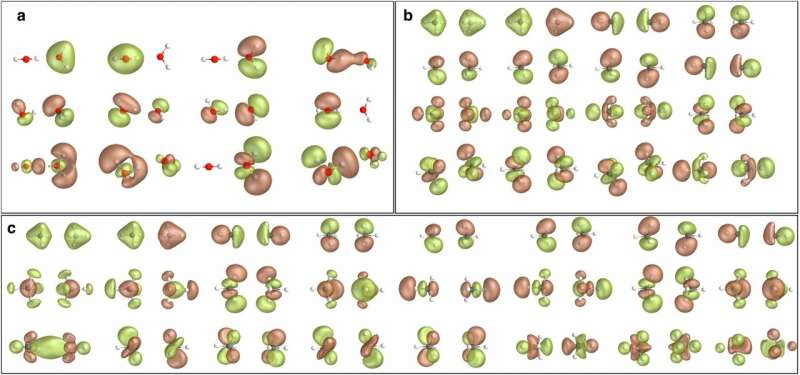
For the water dimer, the quantum computations used an active space of (16 electrons, 12 orbitals). For the methane dimer, they used (16 electrons, 16 orbitals) and an expanded (16 electrons, 24 orbitals) configuration. In quantum chemistry, an “active space” determines how many electrons and orbitals are included in the highest-accuracy part of the simulation. Enlarging this space increases accuracy but also greatly increases computational cost. Running these expansions on quantum hardware marks a meaningful test of scaling potential.
The quantum sampling itself was carried out on IBM Quantum System One, which generated multiple possible molecular configurations for each system. These samples were then transferred to classical systems that calculated the corresponding molecular energies. By combining the quantum-generated possibilities with classical accuracy, the researchers were able to produce chemically accurate potential energy surfaces for both dimers.
This matters because potential energy surfaces describe how molecular energy changes with the distance and orientation between molecules—exactly the data needed to understand how and why molecules interact. The team reports that this is the first time quantum computers have ever been used to accurately simulate supramolecular interactions, marking an important proof of concept.
The implications go beyond dimers. Supramolecular interactions play central roles in biomolecular assembly, pharmaceutical drug design, polymer behavior, and material science. Even a modest scaling of this method could open the door to simulating interaction networks that are currently impossible to compute with full quantum-mechanical accuracy.
Still, it’s important to be realistic. While the results match the accuracy of high-level classical methods, the systems studied here are very small. Scaling this approach to larger biological systems—like proteins, multi-molecule complexes, or solvent networks—will require significant increases in quantum hardware capability. Quantum computers today remain limited by qubit count, noise, and lack of full error correction. However, the study suggests that quantum-centric workflows may allow researchers to extract useful, accurate results from current devices far sooner than previously expected.
Understanding Supramolecular Interactions
Supramolecular interactions refer to molecular behaviors that arise not from direct bonds, but from noncovalent forces. These include:
- Hydrogen bonding
- Van der Waals dispersion forces
- Hydrophobic effects
- Electrostatic attractions and repulsions
- π-stacking interactions
While individually weak, these forces collectively define the shape and behavior of macromolecules. DNA base pairing, the folding of proteins into functional structures, and the self-assembly of lipid membranes all depend heavily on these interactions.
Because noncovalent forces shift dynamically and involve large configuration spaces, accurately modeling them at the quantum-mechanical level often becomes computationally prohibitive. Quantum-centric supercomputing attempts to tackle this challenge head-on.
How Quantum-Centric Supercomputing Works
Quantum-centric supercomputing is not the same as typical hybrid quantum-classical algorithms like VQE. Instead, this approach separates labor between classical and quantum systems much more strategically.
- The quantum processor is used to sample complex electronic configurations that would be difficult for classical systems to explore exhaustively.
- The classical HPC system takes those samples and computes precise molecular energies, ensuring the accuracy modern chemistry requires.
This avoids requiring the quantum machine to solve the full problem directly and reduces sensitivity to noise—an important advantage given that today’s quantum devices lack robust error correction.
Broader Context in Quantum Chemistry
Historically, classical computational chemistry relies on methods like:
- CCSD(T) — the “gold standard” for small-molecule accuracy
- CASCI/CASSCF — multi-configuration methods for systems where electron correlation is complex
These methods scale poorly for systems larger than a few dozen atoms. Researchers have long viewed quantum computers as a potential solution, but most quantum simulations until now have struggled to surpass classical baselines.
This study stands out because it demonstrates that combining quantum sampling with classical post-processing can actually achieve classical-grade accuracy for small systems, rather than functioning only as a theoretical or qualitative demonstration.
Challenges Ahead
Even though this is promising, several challenges remain:
- Quantum hardware still limits the size of active spaces that can be sampled.
- Larger molecular assemblies will require dramatically more qubits and circuit depth.
- Noise and decoherence remain major bottlenecks.
- Hybrid workflows must become more automated and efficient to handle high-complexity systems.
Still, the ability to reach chemically accurate results for supramolecular dimers is a genuinely encouraging milestone.
Why This Matters for Future Applications
If scalable, this method could eventually support:
- Drug discovery through high-accuracy binding simulations
- Protein-folding analysis using true quantum-mechanical models
- Materials design involving complex intermolecular networks
- Nanotechnology and supramolecular engineering
- Improved understanding of hydration shells and solvent effects
In short, this research points toward a future in which quantum computers play a meaningful and practical role in computational chemistry rather than a purely experimental one.
Research Paper:
Accurate quantum-centric simulations of intermolecular interactions (Communications Physics, 2025)
https://www.nature.com/articles/s42005-025-02305-9