Detailed Map Reveals Groundwater Levels Across the U.S. and Answers How Much Fresh Water the Nation Really Has
How much fresh water does the United States actually have? It sounds like a simple question, but it turns out to be one of the hardest ones scientists can ask. That’s because most of the country’s fresh water is hidden underground, stored in vast but unevenly distributed groundwater systems that are difficult to measure directly.
A new study led by researchers at Princeton University and the University of Arizona has now provided the most detailed answer yet. By combining more than a million real-world groundwater measurements with artificial intelligence, the team has created an incredibly high-resolution map that estimates groundwater depth across the entire continental United States. The results dramatically improve our understanding of where groundwater exists, how deep it is, and how much of it may actually be accessible.
A Groundwater Map Unlike Anything Before
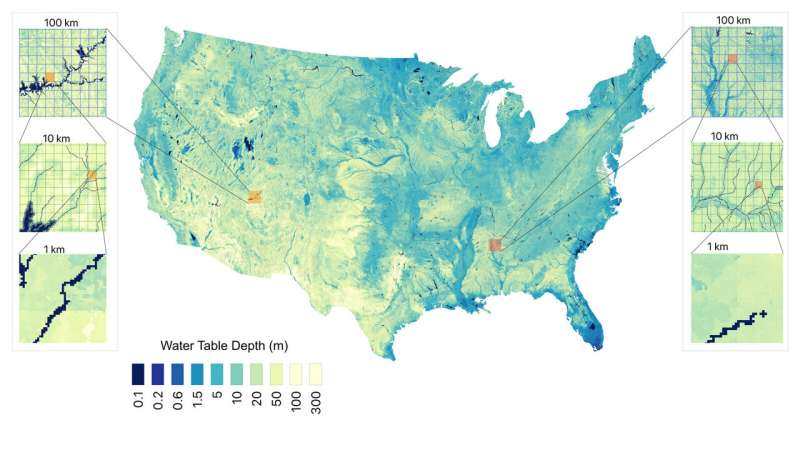
The newly developed map estimates groundwater depth at a resolution of around 30 meters (98 feet). To put that into perspective, earlier nationwide groundwater models typically worked at resolutions of about one kilometer, which meant that local variations were often smoothed out or completely missed.
Using this finer resolution, researchers divided the continental U.S. into more than 8 billion grid cells, each measuring 30 meters on a side. For every single square, the model estimates how far below the surface groundwater can be found.
This level of detail is unprecedented for a study covering such a large area. It allows scientists, policymakers, and local water managers to examine groundwater conditions almost at the scale of individual farms or communities, rather than relying on broad regional averages.
How Much Groundwater Is There?
One of the most striking findings from the study is the estimate of total groundwater volume in the continental United States. According to the analysis, the country holds approximately 306,000 cubic kilometers of groundwater.
That figure is more than 13 times the total volume of all the Great Lakes combined.
While this total amount is generally consistent with earlier estimates, the new map reveals something important: significant supplies of shallow groundwater that previous models failed to identify. These shallow resources are especially relevant for agriculture, ecosystems, and rural water supplies, where wells often do not reach extreme depths.
Why Measuring Groundwater Is So Difficult
Unlike rivers or lakes, groundwater cannot be easily observed from satellites or surface measurements. Instead, scientists rely on groundwater monitoring wells, which are unevenly distributed across the country. Some regions have dense measurement networks, while others have very few data points.
To address this challenge, the research team gathered over one million direct groundwater depth measurements, sourced largely from U.S. Geological Survey monitoring wells and previous scientific studies. These measurements span a long time period, from 1895 to 2023, because many locations were only measured once.
Most of the available data comes from after 1970, but combining older and newer observations was essential to create a dataset large enough for a data-driven approach. Rather than representing groundwater conditions at a single moment in time, the researchers describe their results as a modern estimate that reflects long-term conditions.
How Artificial Intelligence Made This Possible
The heart of the study is its use of machine learning, specifically a method known as a random forest model. The researchers trained the model using direct groundwater measurements along with regional climate data, geological information, and land characteristics.
Once trained, the AI could estimate groundwater depth in places where no measurements exist. This approach allowed the team to fill in massive gaps across the country while still being grounded in real observations.
An important advantage of this method is that it also calculates uncertainty. For each location, the model runs hundreds of slightly different decision trees. The variation among these trees provides a measure of how confident the model is in its estimate.
The results show that uncertainty is generally higher in the western United States, where groundwater tends to be deeper and measurement networks are often sparser. This finding is particularly significant because the West relies heavily on groundwater for irrigation and drinking water, especially during droughts.
A Shift Away From Traditional Groundwater Models
Historically, large-scale groundwater models have been physics-based, relying on equations that simulate how water flows through soil and rock. While powerful, these models are computationally expensive and typically operate at coarse spatial resolutions.
In contrast, the new data-driven, AI-based model achieves a resolution more than 1,000 times finer while using far less computing power. This efficiency makes it much easier to update the model, explore uncertainties, and adapt the approach to other regions.
This study represents the first large-scale, hyper-resolution groundwater model built directly from observations, rather than relying primarily on theoretical simulations.
Why This Matters for Water Management
Groundwater plays a critical role in drinking water supplies, agriculture, industry, and ecosystems, yet it is often poorly understood at local scales. The new map provides a foundation for more informed decision-making around irrigation planning, conservation strategies, and water infrastructure investments.
For agriculture, the implications are especially clear. Much of U.S. farming relies on center-pivot irrigation systems, where a single well supplies water to large circular fields. In regions like the Ogallala Aquifer of the Great Plains, there are millions of such irrigation pivots, and each one depends on local groundwater conditions.
By accounting for shallow groundwater that earlier models overlooked, the new map offers farmers and water managers better information about how accessible their water really is and how vulnerable it may be to over-pumping.
Public Access Through HydroGEN and HydroFrame
The researchers have made the model outputs publicly available through the HydroFrame platform, part of the broader HydroGEN (Hydrologic Scenario Generation) initiative. These digital tools are designed to make hydrology data and simulations accessible to scientists, policymakers, and the public.
The HydroGEN effort brings together hydrologists, machine-learning experts, and software developers to ensure that advanced scientific models are not only accurate but also usable. A major focus of the project has been user experience and software design, making it easier for non-specialists to explore groundwater data.
Expanding the Approach Beyond the U.S.
Although this study focuses on the continental United States, the research team is already working to expand the method globally. Efforts are underway to apply similar techniques to parts of Europe, and collaborations in Australia are exploring how machine-learning and physics-based models can be combined for other continents.
The long-term goal is to develop a foundational machine-learning model for groundwater that can be adapted worldwide, especially in regions where data is scarce but water scarcity is severe.
Why Groundwater Knowledge Matters More Than Ever
As climate change intensifies droughts, alters rainfall patterns, and increases demand for water, groundwater is becoming an even more critical buffer against shortages. Yet, without accurate information on how much groundwater exists, how deep it is, and how accessible it may be, managing this resource sustainably is nearly impossible.
This new high-resolution groundwater map doesn’t solve every problem, but it provides a powerful new tool. By combining big data, artificial intelligence, and real measurements, it moves groundwater science closer to the level of detail long available for surface water.
In doing so, it helps answer one of the most fundamental questions in environmental science: how much water do we really have beneath our feet?
Research paper:
https://doi.org/10.1038/s43247-025-03094-3