Drone-Mounted Mini Lab Lets Scientists Monitor Fertilizer Runoff in Real Time
Researchers have developed a drone-mounted laboratory that can measure nitrate pollution in waterways on the spot, eliminating the need to collect samples and send them back to a traditional lab. The technology, recently reported in the journal ACS Sensors, represents a significant step forward in environmental monitoring, especially for agriculture-heavy regions where fertilizer runoff is a persistent problem.
At its core, this innovation flips a long-standing scientific workflow. Instead of bringing water samples to the lab, the lab itself goes directly to the water—carried by a drone.
Why Monitoring Nitrate Runoff Matters
Nitrogen-based fertilizers are a cornerstone of modern agriculture. They help crops grow faster and produce higher yields, but they also come with a downside. A large portion of applied fertilizer does not stay in the soil. Rainfall and irrigation systems wash excess nitrogen into drainage ditches, streams, and rivers.
Once in water, nitrogen often converts into nitrate, a compound that can cause serious environmental and public health issues. High nitrate levels are linked to:
- Algal blooms, which can block sunlight and disrupt aquatic ecosystems
- Low-oxygen “dead zones”, where fish and other organisms struggle to survive
- Drinking water contamination, which poses risks to human health, particularly for infants
In the United States, the Environmental Protection Agency (EPA) has set a maximum contaminant level of 10 parts per million (ppm) for nitrate in drinking water. Staying below that threshold requires consistent monitoring, but that has traditionally been easier said than done.
The Challenge With Traditional Monitoring
Monitoring agricultural runoff is difficult because much of it occurs in hard-to-reach places. Drainage ditches can be steep, muddy, or surrounded by crops. Low-lying wetlands and swampy areas are often inaccessible by vehicle or foot.
On top of that, conventional monitoring involves several steps: collecting samples, preserving them, transporting them to a lab, and then running chemical analyses. This process takes time, costs money, and limits how frequently samples can be collected. As a result, nitrate levels are often measured infrequently, missing short-term spikes or localized pollution events.
Scientists have been exploring remote and automated solutions for years, but many existing systems are expensive, bulky, or slow.
How the Lab-on-a-Drone System Works
A research team led by Jonathan Claussen set out to design a solution that was lower-cost, faster, and more flexible than existing nitrate-monitoring tools. Their answer was a compact laboratory system mounted on a commercially available drone.
The system includes several key components:
- A custom-built pump that pulls water into the system
- Low-cost electrochemical nitrate sensors designed to detect nitrate ions
- A potentiometric device that converts sensor signals into precise nitrate concentration readings
- An onboard data storage system to record measurements during flight
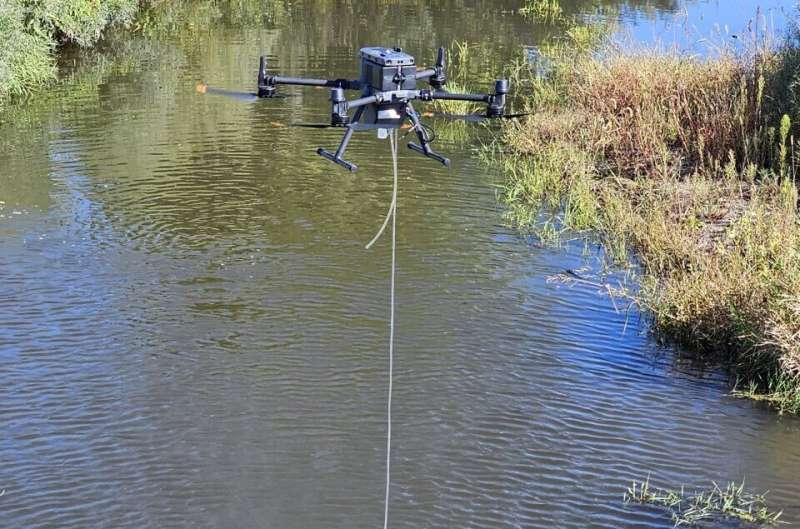
Hanging beneath the drone is a long intake tube. While the drone hovers above a ditch or stream, the tube draws water up into the mini-lab. Once inside, the sample is analyzed mid-air.
Each analysis takes about seven minutes, after which the drone can move on to another location and repeat the process. Importantly, the drone can collect and analyze multiple samples in a single flight before needing to land.
All data are stored on a memory card for later download and analysis.
Accuracy and Detection Limits
Performance was a critical question. Could a lightweight, airborne lab really compete with a full-scale laboratory?
Testing showed that the answer is largely yes. The drone-mounted system was able to detect nitrate concentrations as low as 2.5 ppm, which is well within the range needed for environmental and drinking water monitoring. When compared to standard laboratory-based electrochemical methods, the system achieved approximately 95% accuracy.
This level of precision makes it suitable not just for rough screening, but for meaningful scientific and regulatory use.
Real-World Testing in Iowa
To evaluate the system outside the lab, the researchers deployed it at an agricultural drainage ditch in Iowa, a state where fertilizer runoff is a well-documented concern.
During these field tests, the drone measured an average nitrate concentration of 5.39 ppm. This value closely matched previous measurements from the same area, confirming the reliability of the drone-based approach. Importantly, the detected levels were below the EPA’s 10 ppm drinking water limit, offering reassurance about local water quality at the time of testing.
The successful field trial demonstrated that the system can operate effectively under real-world conditions, not just controlled environments.
Benefits for Farmers and Environmental Monitoring
One of the most promising aspects of this technology is its potential impact on precision agriculture. By making nitrate monitoring faster and more accessible, farmers could:
- Better understand how fertilizer moves through their fields
- Adjust application rates to reduce waste
- Identify problem areas where runoff is especially high
From an environmental standpoint, agencies and researchers could use drones to monitor waterways more frequently and more widely than before. This could lead to earlier detection of pollution, better enforcement of water quality standards, and more informed policy decisions.
Expanding Beyond Nitrate
While the current system focuses on nitrate, the underlying concept is much broader. The researchers describe this drone-mounted lab as a platform technology.
With different sensors, similar systems could potentially monitor:
- Bacteria that indicate fecal contamination
- Pesticides and herbicides used in agriculture
- Other chemical pollutants affecting water quality
This opens the door to drones becoming routine tools for environmental surveillance, public health protection, and ecosystem management.
Intellectual Property and Future Development
The research team has filed a U.S. patent related to the lab-on-a-drone system, signaling plans for further development and potential commercialization. Funding for the work came from multiple sources, including the National Science Foundation, the U.S. Department of Agriculture’s National Institute of Food and Agriculture, and Iowa State University’s Digital and Precision Agriculture program.
As sensor technology continues to improve and drones become more capable, systems like this are likely to become smaller, faster, and even more accurate.
The Bigger Picture: Drones in Environmental Science
Drones are already widely used in agriculture for crop imaging, irrigation planning, and yield estimation. Adding real-time chemical analysis to their capabilities significantly expands their role.
By combining mobility, automation, and analytical chemistry, lab-on-a-drone systems represent a shift toward faster, data-driven environmental decision-making. Instead of waiting days or weeks for lab results, scientists and farmers can access actionable information almost immediately.
That speed could make a real difference in protecting waterways, optimizing fertilizer use, and reducing the environmental footprint of modern agriculture.
Research Paper:
https://doi.org/10.1021/acssensors.5c02620