East Antarctic Ice Sheet’s History Reveals Clues About Ice Loss, Recovery, and the Future of Climate Change
The melting of polar ice sheets is one of the most discussed aspects of climate change today. We often hear about how fast ice is disappearing and what that means for sea levels. But there is a less explored question hiding behind all of this: what actually happens after an ice sheet melts? Does it keep shrinking forever, or can it stabilize—or even grow again?
New research focused on the East Antarctic Ice Sheet, one of the largest and most stable ice masses on Earth, offers valuable insight into this overlooked phase. By examining how the ice sheet behaved thousands of years ago, scientists are uncovering patterns that may help us better understand how Antarctica could respond to modern and future climate change.
Looking to the Past to Understand the Future
The study zeroes in on a coastal region of East Antarctica known as Lützow-Holmbukta. Researchers wanted to determine what happened after a period of rapid ice sheet thinning that occurred between approximately 9,000 and 6,000 years ago, during the mid-Holocene period.
Previous geological evidence already suggested that the ice sheet in this region thinned dramatically during that time. What remained unclear was whether this thinning continued unchecked or whether the ice sheet eventually stabilized or re-thickened. This distinction is crucial, because it directly affects how scientists model future ice sheet behavior and estimate long-term sea-level rise.
Understanding these past dynamics helps scientists establish a baseline for how ice sheets respond after major melting events, rather than focusing only on the melting itself.
Advanced Tools Used to Reconstruct Ice Sheet History
To answer these questions, researchers used a combination of modern measurement techniques and advanced modeling tools.
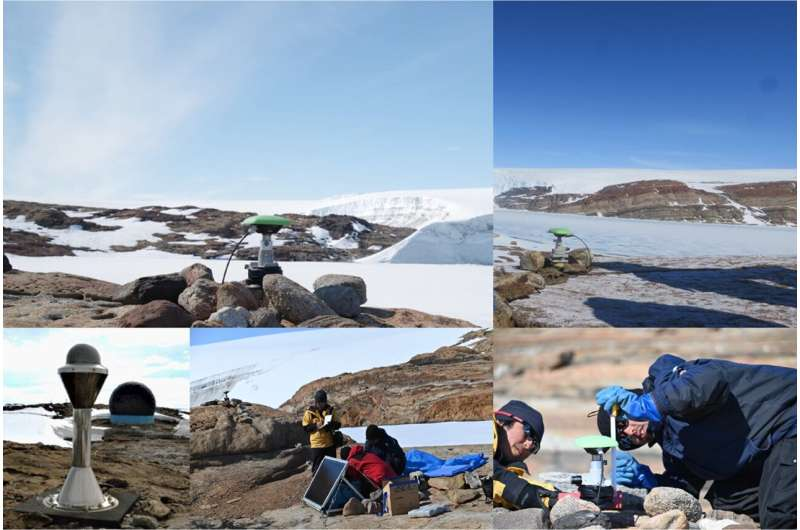
One major component of the study was data from the Global Navigation Satellite System (GNSS). GNSS stations measure very small movements of Earth’s surface with extreme precision. In Antarctica, these measurements help scientists track how the land is rising or sinking in response to changes in ice mass.
This land movement is part of a process called glacial isostatic adjustment (GIA). When massive ice sheets melt, the enormous weight pressing down on Earth’s crust is reduced, and the land slowly rebounds upward. By modeling this rebound, scientists can infer how much ice must have been present in the past and how it changed over time.
The team combined GNSS observations with glacial isostatic adjustment modeling, along with previously published geological evidence from the Skarvsnes area within Lützow-Holmbukta. This integrated approach allowed them to test multiple scenarios of ice loss and recovery and compare them against real-world crustal movement data.
Evidence of Ice Sheet Re-Thickening
One of the most important findings from the study is that the East Antarctic Ice Sheet in this region did not simply thin and continue shrinking. Instead, models that included a phase of modest re-thickening—between 65 and 100 meters—after the rapid thinning period provided a much better match to the observed data.
This re-thickening occurred after the major thinning event ended around 6,000 years ago. While the ice did not return to its earlier thickness, the evidence strongly suggests that the ice sheet was capable of partial recovery.
This challenges the assumption built into many global ice models, which often assume a more straightforward, one-directional decline following deglaciation.
Why Global Ice Models Fell Short
Another major outcome of the study was the discovery of a significant mismatch between local observations and predictions made by previously published global deglaciation models.
These large-scale models could not adequately explain the crustal uplift measured in the Lützow-Holmbukta region. In other words, when researchers applied standard global ice histories to this part of East Antarctica, the numbers simply did not add up.
This discrepancy highlights an important point: regional ice sheet behavior can differ dramatically from continental-scale trends. Ice sheets are not uniform blocks of ice. They are influenced by local geography, ocean conditions, bedrock structure, and climate patterns, all of which can produce complex and sometimes unexpected responses.
Insights Into Earth’s Interior Beneath Antarctica
Beyond ice sheet dynamics, the research also provided new information about the structure of Earth’s interior beneath East Antarctica.
Using their GIA models, researchers were able to constrain several key parameters of the Earth beneath the study area. These include the thickness of the lithosphere and the viscosity of the upper and lower mantle, which influence how quickly and how much the land rebounds after ice loss.
The study relied on a three-layer Earth model, which worked well for the Lützow-Holmbukta region. However, researchers caution that these Earth structure parameters may not apply uniformly across the entire Antarctic continent. This limitation opens the door for future studies that refine Earth models using region-specific data.
Why This Matters for Climate Change Predictions
The findings have clear implications for how scientists predict the future behavior of Antarctic ice.
First, the evidence that ice sheets can undergo rapid thinning followed by stabilization or re-thickening suggests that ice loss does not always follow a simple, irreversible path. While this does not mean current ice loss will automatically reverse, it does show that ice sheets have mechanisms for adjustment under certain conditions.
Second, incorporating more accurate regional ice histories improves sea-level rise projections. Even small errors in estimating Antarctic ice behavior can translate into significant differences in predicted sea levels, which affect coastal planning and climate adaptation strategies worldwide.
Finally, the study underscores the importance of long-term observational data, such as extended GNSS time series, in improving model accuracy.
The Bigger Picture: Understanding Ice Sheets
The East Antarctic Ice Sheet holds enough ice to raise global sea levels by tens of meters if it were to melt completely. While it has long been considered more stable than West Antarctica, recent studies have shown that parts of East Antarctica are also vulnerable to change.
Ice sheets respond not only to air temperature but also to ocean heat, snowfall patterns, and the shape of the bedrock beneath them. Some regions sit on bedrock below sea level, making them particularly sensitive to warming oceans.
Studies like this one highlight why understanding past ice sheet behavior is so valuable. The geological record acts as a natural experiment, showing how ice sheets responded to climate shifts long before human influence became dominant.
What Comes Next for This Research
The researchers involved in this study plan to expand their integrated approach to other regions of East Antarctica. They also aim to lengthen GNSS observation records, which will further improve the precision of crustal movement measurements.
By refining both ice history reconstructions and Earth structure models, future research can deliver more reliable projections of how Antarctica will respond to ongoing climate change.
This work was conducted by researchers from the Research Organization of Information and Systems, the National Institute of Polar Research, the Graduate University for Advanced Studies, and Kyoto University, reflecting a collaborative effort across multiple institutions.
Research paper:
https://doi.org/10.1038/s41598-025-24176-4