Health Care Electronics Are Booming and Researchers Are Rethinking How to Make Them Sustainable
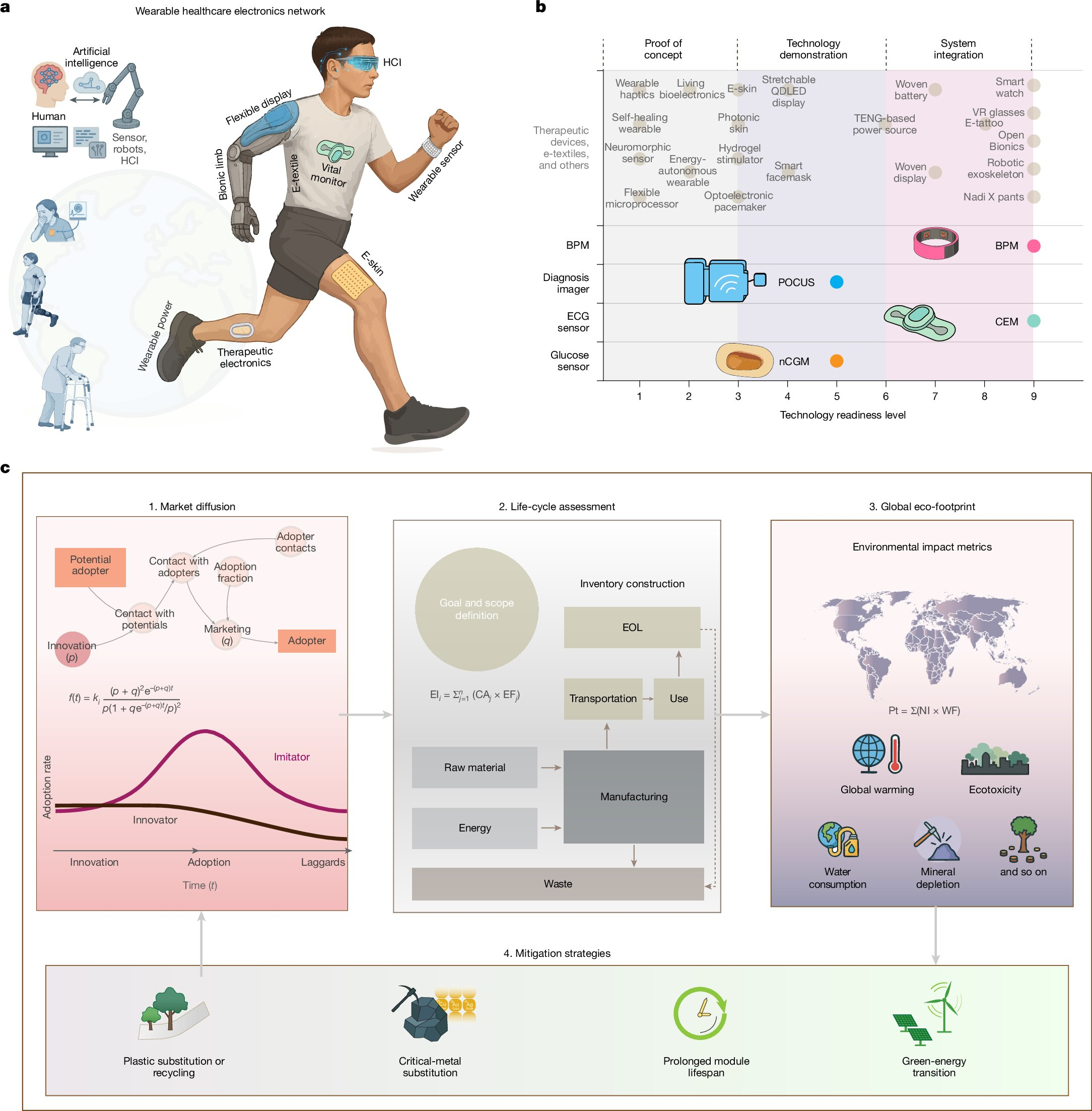
Wearable health care electronics are becoming an essential part of modern medicine. Devices like continuous glucose monitors, wearable blood-pressure trackers, heart-rate sensors, and even flexible ultrasound patches are now widely used to monitor patients in real time. These tools help doctors catch problems early, manage chronic conditions more effectively, and improve patient safety outside of traditional hospital settings. But as this sector grows at a rapid pace, researchers are raising an important question: what is the environmental cost of all this innovation?
A new scientific study from researchers at the University of Chicago and Cornell University takes a deep look at the environmental footprint of wearable health care electronics. Published on January 1, 2025, in Nature, the research offers one of the most detailed assessments so far of how these devices impact the planet—and what can be done to reduce that impact.
A Market Growing Faster Than Expected
The researchers began by modeling how demand for wearable health care electronics is likely to change over time. Based on current adoption trends and technological development, they estimate that by 2050, global demand could reach nearly 2 billion wearable health care devices per year. That represents an increase of roughly 42 times compared to today’s usage.
This growth is driven by several factors: aging populations, the rise of chronic diseases like diabetes and cardiovascular conditions, increased use of remote patient monitoring, and growing investment by both health care companies and technology firms. Wearables are also increasingly being designed for short-term or single-use applications, especially in clinical settings where hygiene and performance reliability are critical.
The Environmental Cost of Disposable Devices
While wearable devices provide clear medical benefits, the study highlights a concerning downside. If current manufacturing and disposal practices continue unchanged, these devices could collectively generate more than one million tons of electronic waste and around 100 million tons of carbon dioxide emissions by 2050.
Many health care wearables are intentionally designed to be disposable. Unlike consumer electronics such as smartphones or smartwatches, medical wearables often have limited lifespans. Some glucose monitors, for example, are used for just 10 to 14 days before being discarded. This frequent replacement dramatically increases material use, energy consumption, and waste generation.
Looking Beyond Plastics
One of the most surprising findings of the study is where the environmental impact actually comes from. When people think about sustainability in electronics, they often focus on plastics—especially single-use plastics. However, the researchers found that plastics are not the main problem.
The biggest contributor to a wearable device’s carbon footprint is the printed circuit board, which accounts for about 70% of total carbon emissions associated with the device. This includes the integrated circuits that control the device’s functions.
Even if all the plastic components in these devices were replaced with biodegradable alternatives, the overall environmental impact would drop by only around 3%. This shows that focusing solely on plastics, while helpful, barely addresses the larger issue.
Why Circuit Boards Matter So Much
Integrated circuits require materials that are expensive, energy-intensive, and environmentally damaging to extract and process. Precious metals like gold are commonly used because they are highly stable and resistant to corrosion. However, gold mining consumes large amounts of energy and produces significant waste and pollution.
Although each individual chip uses only a tiny amount of gold, the sheer scale of production—billions of devices over time—adds up to a substantial environmental burden. Manufacturing these components also requires extremely precise processes that rely on high temperatures and clean-room facilities, further increasing energy use.
A Full Life-Cycle Analysis
To fully understand the problem, the research team conducted a cradle-to-grave life-cycle assessment. This approach evaluates every stage of a product’s life: raw material extraction, manufacturing, transportation, usage, and eventual disposal.
The study examined multiple environmental indicators, including carbon footprint, material toxicity, and electronic waste generation. By combining life-cycle data with global usage forecasts, the researchers created a comprehensive framework for assessing the long-term environmental impact of wearable health care electronics.
Two Major Paths Toward Sustainability
Rather than simply pointing out the problem, the study also outlines practical solutions.
The first major strategy involves rethinking the materials used in integrated circuits. The researchers suggest exploring alternatives to gold, such as copper or aluminum, which are far more abundant and require less energy to extract. These metals are more reactive and less stable than gold, which is why they have not traditionally been used in sensitive electronics. However, the analysis suggests that with proper design and protective coatings, performance losses could be minimal.
The second key strategy is modular device design. Most wearable health care devices need to be replaced periodically, but not all components wear out at the same rate. If devices were designed so that the outer casing or sensor layer could be discarded while the integrated circuit is reused, the largest source of carbon emissions could be dramatically reduced.
The Role of Renewable Energy
Manufacturing methods also play a significant role. The study found that if wearable health care electronics were produced using 100% renewable energy, the overall carbon footprint of these devices could be reduced by about 15%. While this alone is not enough to solve the problem, it represents a meaningful improvement when combined with better materials and design choices.
Why This Matters Beyond Wearables
Although the study focuses specifically on health care electronics, its implications go much further. The researchers describe their work as a systems-level engineering framework that can be applied to other fast-growing technologies, including artificial intelligence hardware, robotics, and flexible electronics.
As technology becomes more integrated into everyday life, understanding its environmental impact early—rather than after widespread adoption—can help prevent long-term damage.
The Bigger Picture of Sustainable Health Tech
Wearable health care devices are not going away. In fact, their role in medicine is likely to expand even further as remote monitoring, personalized treatment, and digital health platforms continue to grow. The challenge is making sure that this progress does not come at an unsustainable environmental cost.
This study makes one thing very clear: true sustainability requires looking at the entire system, not just the most visible materials. By focusing on electronics design, material choices, and manufacturing energy sources together, it may be possible to align technological innovation with environmental responsibility.
As global investment in health technology accelerates, frameworks like this could play a crucial role in guiding smarter, greener development choices for the future.
Research paper: https://www.nature.com/articles/s41586-025-09819-w