Hidden Magma Movements Beneath Kīlauea Reveal Clues That Could Improve Eruption Forecasts
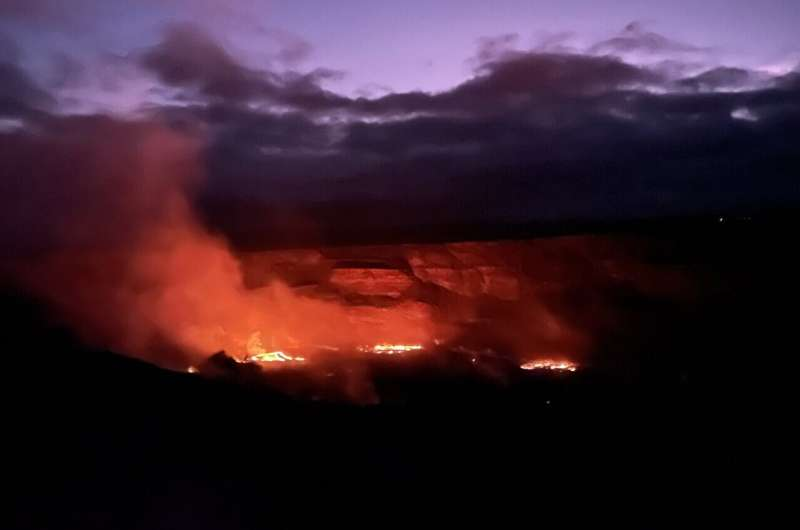
A new scientific study has uncovered long-running, hidden changes inside Kīlauea Volcano that began nearly a year before its massive 2018 eruption—and the details are fascinating for anyone interested in how volcanoes behave beneath the surface. The research comes from a team at the University of Hawaiʻi at Mānoa, working with scientists from the University of Miami and the University of California, San Diego. Their findings show that Kīlauea’s magma plumbing system was behaving in an unusual and detectable way long before the eruption that destroyed entire neighborhoods and coincided with more than 60,000 earthquakes on Hawaiʻi Island.
The study used a specialized seismic-monitoring technique that relies not on earthquakes but on the constant vibration energy generated by ocean waves. This method allowed researchers to monitor subtle shifts inside the volcano over long periods. What they discovered has important implications for predicting future eruptions and improving volcanic hazard preparation.
Below is a clear, straightforward breakdown of everything the study revealed—followed by additional useful information about Kīlauea, magma plumbing systems, and how seismic monitoring actually works.
Early Signs Inside Kīlauea Before the 2018 Eruption
According to the new analysis, something began to change inside Kīlauea around one year before the 2018 eruption. The volcano’s usual internal behavior involves magma rising from deep within the mantle into two main magma reservoirs beneath the summit. This upward flow typically feeds the shallow reservoir beneath Halemaʻumaʻu crater, which also regulates the height of the visible lava lake.
But sometime in late 2016, researchers noticed that this normal upward movement became disrupted. The team believes a blockage formed between the two summit reservoirs. While the deeper reservoir continued to receive magma and maintain pressure, much less magma made it into the shallower reservoir.
This blockage triggered several measurable effects:
- Pressure started accumulating beneath the volcano’s East Rift Zone rather than rising directly to the summit.
- The lava lake inside Halemaʻumaʻu crater dropped about 30 meters—roughly the height of a 10-story building.
- Meanwhile, pressure in the deeper magma system remained steady, indicating that magma supply from below had not decreased.
This combination of events suggested that the magma was being diverted sideways, likely toward the network of horizontal dikes that lead into the East Rift Zone. This is the region where the 2018 eruption eventually broke out, producing widespread lava flows.
The abnormal behavior continued for months, showing that this wasn’t a short-term fluctuation but a significant internal reorganization within the volcano.
The Role of a Magnitude-5 Earthquake in Resetting the System
In June 2017, Kīlauea experienced a magnitude-5 earthquake on its flank. According to the researchers, this quake may have released the blockage that had been slowing the flow of magma between the reservoirs.
After this earthquake, pressure once again began rising in the shallow summit reservoir. However, the system remained disturbed from that point onward—another major clue that something deeper was brewing. This unstable state persisted into 2018, setting the stage for the massive eruption that would eventually occur.
The researchers emphasize that while their data strongly supports this interpretation, it is still unclear whether this behavior was a one-time event or part of a recurring pattern in Kīlauea’s long-term activity. Collecting more continuous monitoring data in the future will help determine which is true.
How Ocean Waves Helped Scientists “Listen” to Kīlauea
One of the most interesting aspects of the study is the method used to detect these hidden changes. Instead of waiting for earthquakes, the scientists used a type of seismic monitoring that analyzes the continuous vibrations created by ocean waves hitting the island. These waves generate low-frequency energy that travels through the ground all the time, making them a perfect natural tool for tracking subtle underground changes.
This method has several major advantages:
- It works even when the volcano is quiet at the surface.
- It can detect very small changes in pressure or rock deformation.
- It provides a nearly constant stream of data, enabling long-term tracking.
When magma moves, it affects the surrounding rock by changing pressure and temperature. These changes alter the speed at which seismic waves travel through the rock. By monitoring variations in seismic velocity over time, researchers can infer what is happening inside the volcano.
This technique allowed the team to detect the prolonged disruption between the magma reservoirs—something traditional earthquake-based monitoring might have missed.
Why This Discovery Matters
If hidden internal changes like these can be detected months to years before an eruption, monitoring systems may be able to offer earlier warnings and better insights into what a volcano is planning to do.
This has practical consequences:
- Improved warning times for residents living near active volcanoes.
- Better planning for evacuations and emergency response.
- More accurate risk assessments for infrastructure, tourism, and natural resources.
- A deeper scientific understanding of how magma systems evolve before major events.
For areas like Hawaiʻi that live with volcanic hazards every year, these improvements could be incredibly valuable.
Understanding Kīlauea’s Magma Plumbing System
Kīlauea is one of the most studied volcanoes on Earth, but it remains extremely complex. Its magma travels through a branching, interconnected network of:
- Deep mantle supply channels
- A lower summit reservoir (South Caldera reservoir)
- A shallow summit reservoir beneath Halemaʻumaʻu
- Horizontal magma pathways, called dikes, feeding the East Rift Zone
- Multiple flank faults that influence pressure and movement
When this system behaves normally, magma flows fairly predictably between the summit and rift zones. But when blockages occur—or when pressure shifts unexpectedly—the results can include sudden eruptions, earthquakes, ground deformation, or long-lasting lava flows.
The newly discovered long-term blockage in 2016–2017 adds a significant piece to the puzzle of how these internal pathways evolve over time.
What Makes the 2018 Eruption Stand Out
Kīlauea’s 2018 eruption was one of the most dramatic in its recorded history. Key features included:
- More than 60,000 earthquakes, including several large events.
- Lava fountains and flows that destroyed entire neighborhoods in Lower Puna.
- The collapse of the Halemaʻumaʻu crater, which widened and deepened dramatically.
- Long-lived lava flows that reshaped the landscape and coastline.
The new study suggests that the roots of this eruption can be traced back at least a year earlier, to the internal blockage and magma diversion detected through seismic-velocity monitoring.
Looking Ahead: Could This Help Forecast Future Eruptions?
The research team hopes that continued monitoring will reveal whether this type of subtle, long-term internal shift is a common precursor to eruptions or a unique event tied to 2018. Either way, the new method offers a powerful addition to the tools volcanologists already use—such as GPS deformation, gas emissions, thermal monitoring, and traditional seismic networks.
The ultimate goal is clear: support better volcanic hazard mitigation and help protect both residents and visitors in Hawaiʻi.
Research Paper
Seismic Velocity Monitoring Reveals Complex Magma Transport Dynamics at Kīlauea Volcano Prior to the 2018 Eruption
https://agupubs.onlinelibrary.wiley.com/doi/10.1029/2025av001759