Melting Glaciers May Be Mixing Ocean Waters More Than We Ever Expected
Scientists have long known that melting glaciers influence the oceans, but new research suggests their impact on ocean mixing may be far more intense and complex than previously believed. A recent study focusing on marine-terminating glaciers shows that when glacier meltwater enters the ocean from below, it doesn’t just gently rise and dilute—it actively stirs, pulls, and reshapes surrounding seawater, changing circulation patterns in ways existing theories fail to fully explain.
This discovery is especially important as oceans continue to warm and glacier melt accelerates worldwide. Understanding exactly how freshwater from glaciers interacts with salty ocean water is crucial for predicting future sea-level rise, ocean circulation, and even marine ecosystems.
How Marine-Terminating Glaciers Release Freshwater
Marine-terminating glaciers are glaciers that flow directly into the ocean. Unlike land-based glaciers that melt and feed rivers, these glaciers release freshwater beneath the ocean surface, right at the seafloor. Meltwater emerges from channels under the glacier and rises upward because it is lighter than the surrounding saltwater.
Scientists typically study this process using buoyant plume theory, a framework that describes how a less-dense fluid rises through a denser one. In this case, cold, fresh meltwater rises through warmer, salty seawater, forming what is known as a subglacial discharge plume.
Until now, most of what scientists believed about these plumes came from theoretical models and indirect observations, because working close to glaciers is extremely dangerous. Falling ice chunks, known as calving events, can crush boats and create powerful waves without warning.
Why Getting Real-World Data Has Been So Difficult
Collecting direct measurements near glacier fronts has always been risky. Large pieces of ice can break off at any moment, making it unsafe for research vessels or divers. Because of this, scientists rarely had the opportunity to directly observe plume behavior, especially right above where meltwater emerges from the glacier base.
This lack of direct data meant that buoyant plume theory, while useful, was largely untested in real-world glacier settings. Researchers had limited ways to verify whether the models truly reflected what was happening beneath the surface.
Robotic Kayaks Changed the Game
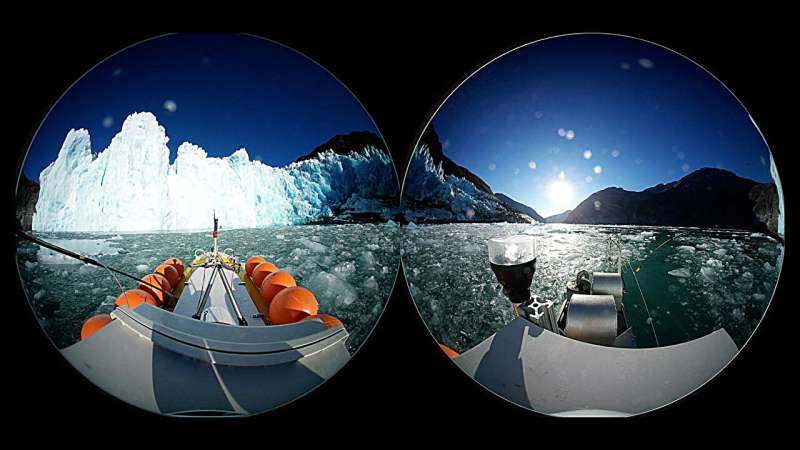
To overcome these dangers, a research team led by Bridget Ovall deployed remotely operated robotic kayaks at Xeitl Sít’, also known as LeConte Glacier, located in southeastern Alaska. These autonomous kayaks could move close to the glacier without putting human researchers at risk.
The kayaks were equipped with instruments that sent acoustic signals downward into the water. These signals bounced off particles within the rising plume, allowing scientists to measure water velocity, plume shape, and plume size directly from above—something that had never been done before.
This marked the first time researchers captured direct measurements of an upwelling subglacial discharge plume from such a vantage point.
What the Measurements Revealed
The results were striking. The observed plume behaved very differently from what buoyant plume theory predicted.
The researchers found that upwelling water moved at speeds exceeding one meter per second, which is far faster than expected. More importantly, the plume pulled in much more surrounding seawater than models suggested.
This process, known as entrainment, occurs when rising freshwater drags salty ocean water along with it. The study showed that buoyant plume theory underestimates plume volume by as much as 50 percent, largely because it fails to capture how aggressively freshwater mixes with seawater near the glacier front.
In other words, melting glaciers are not just releasing freshwater—they are actively mixing large volumes of the ocean.
The Role of Glacier Shape Underwater
One key reason for this mismatch appears to be the shape of the glacier below the waterline. The underwater geometry of a glacier’s ice face strongly influences how meltwater interacts with the ocean.
The study suggests that scientists have been underestimating how submarine ice morphology affects plume behavior. Features like overhangs, cavities, and uneven ice faces can intensify turbulence and enhance entrainment.
However, the researchers also emphasize that glacier shape is not the only factor. There are likely additional processes influencing plume dynamics that have yet to be identified, meaning current models may still be missing important pieces of the puzzle.
Why This Matters for Ocean Circulation
Freshwater input from glaciers plays a major role in shaping local and regional ocean circulation, particularly in fjords and coastal regions. When freshwater mixes more vigorously with seawater, it can alter temperature layers, salinity gradients, and current patterns.
These changes influence how warm ocean water reaches glacier fronts, potentially accelerating further melting. This creates a feedback loop where melting glaciers enhance mixing, which can then drive even more melting.
On a larger scale, freshwater input affects density-driven ocean circulation, which helps regulate climate by redistributing heat around the planet.
Broader Implications for Climate Models
Most climate and sea-level rise models rely on simplified representations of glacier-ocean interactions. If plume volumes and mixing rates are being underestimated by up to half, this could mean that current models are missing a significant source of ocean mixing and heat transfer.
Better understanding these processes will help scientists refine predictions related to glacier retreat, sea-level rise, and changes in marine ecosystems—especially in polar and subpolar regions.
Extra Context: What Is Buoyant Plume Theory?
Buoyant plume theory is widely used in oceanography, volcanology, and atmospheric science. It describes how lighter fluids rise through denser ones, driven by differences in density.
While the theory works well in controlled environments, this study highlights its limitations in complex natural systems, especially where rough surfaces, irregular geometry, and strong turbulence come into play.
The findings suggest that glacier environments are far more dynamic than the simplified systems assumed in many models.
Extra Context: Why LeConte Glacier Is Important
LeConte Glacier is one of the southernmost tidewater glaciers in North America and has been retreating rapidly for decades. Its accessibility and active melt dynamics make it an ideal natural laboratory for studying glacier-ocean interactions.
Insights gained here are likely applicable to other marine-terminating glaciers around the world, including those in Greenland and Antarctica.
The Takeaway
This research makes it clear that melting glaciers are far more effective at mixing ocean waters than scientists once thought. By directly measuring plume velocity, size, and structure, researchers have revealed major gaps in existing theories and models.
As glaciers continue to melt in a warming world, understanding these hidden underwater processes will be essential for making accurate climate predictions and preparing for future changes in the oceans.
Research paper:
https://agupubs.onlinelibrary.wiley.com/doi/10.1029/2025JC022902